As lingering volatility tied to severe winter weather was fading into more typical seasonal patterns, rapidly rising fuel costs disrupted rates and distorted the overall market picture this month.
Diesel price increases drove up all-in rates as surcharges adjusted to the higher national average, with contract-heavy shippers feeling the most immediate impact. At the same time, linehaul rates appeared to decline, but this was a byproduct of spot rates lagging behind fuel spikes rather than a true reflection of underlying market conditions. Recent upward trends in linehaul rates support this assumption.
The result is an environment where shippers are paying elevated contract rates while spot-reliant carriers are absorbing higher upfront costs and often waiting weeks for reimbursement as rates adjust more slowly.
The reason for recent fuel price increases is growing uncertainty in global energy markets amid escalating geopolitical tension. As that story unfolds, it remains unclear how long prices will hold at current levels. However, if they remain elevated, spot rates will continue to rise to offset carrier costs or financial strain will accelerate capacity attrition, both of which will contribute to tighter supply conditions.
This pressure is building at a critical time for the freight market. While demand indicators remain mixed, spot activity continues to show year-over-year strength. Growing produce season demand is tightening reefer capacity across South Texas, Florida and California. Flatbed markets are also tightening as the construction and lawn and garden seasons ramp up alongside post-storm recovery volume.
With these variables adding to existing supply risks such as high operating costs and regulatory pressure, the market remains highly vulnerable to disruption as we approach some of the busiest shipping months of the year.
Read on for more on the latest supply, demand, rates and economic conditions trends shaping the market this month.
David Spencer
VP of Market Intelligence
Key Takeaways
The war in Iran has resulted in a steep increase in diesel costs, immediately raising contract costs and creating a lagged impact on spot rates as carriers adjust.
Demand indicators remain weak, but recent disruptions have driven a surge in spot activity.
Capacity attrition has improved the supply-demand balance, increasing volatility during disruptions.
Despite a temporary administrative stay on new FMCSA rules for non-domiciled CDL drivers, the regulatory environment remains a significant risk to capacity. Illegally issued licenses also continue to be revoked amid ongoing audits of state agencies, carriers and driving schools, including more than 13,000 licenses in California alone earlier this month.
Equipment orders remained elevated in February as fleets gained more clarity around EPA emissions regulations. Near-record average fleet ages could support truckload rate increases as the tractor population declines and equipment costs rise.
Import volumes remain challenged compared to recent years but are strong relative to historical averages, with February ranking as the fourth-highest on record.
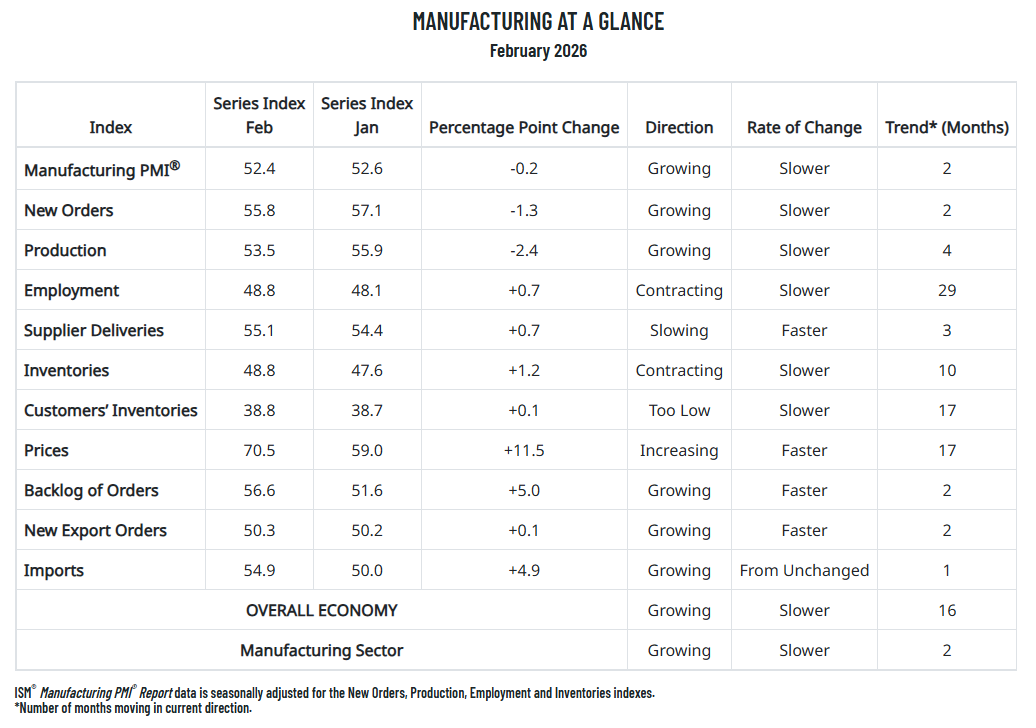
In February, all three ISM Manufacturing Index demand indicators, including new orders, expanded for the second consecutive month.
Surging fuel surcharges are making it difficult to determine the new spot rate floor as inferred linehaul rates dipped and all-in rates jumped. As spot market carriers gain pricing power from an extended diesel price hike, linehaul rates will also face upward pressure.
A resilient economy and steady spending are helping stabilize freight demand, but lagging inflationary pressure, especially as interest rates remain elevated, remains the largest risk to consumer-driven demand in 2026.
Truckload Demand
Looking Back
Demand improved in February as seasonal activity ramped up, with an additional boost from post-winter storm recovery freight. Contract volumes have shown growth in March. However, they remain below prior year levels. Imports declined from the January peak but remained historically elevated, while manufacturing expanded for a second consecutive month as new orders, production and backlogs increased.
Looking Ahead
Near-term demand is expected to build as produce season continues on a regional basis, supported by strong consumer spending and recent manufacturing improvements. However, whether those improvements indicate a true turnaround remains uncertain. Notably, some shippers are shifting volume toward rail and intermodal to reduce exposure to elevated fuel prices, which could temporarily drag on truckload demand.
View Related Data
Contract Load Accepted Volume, SONAR
Chart Notes
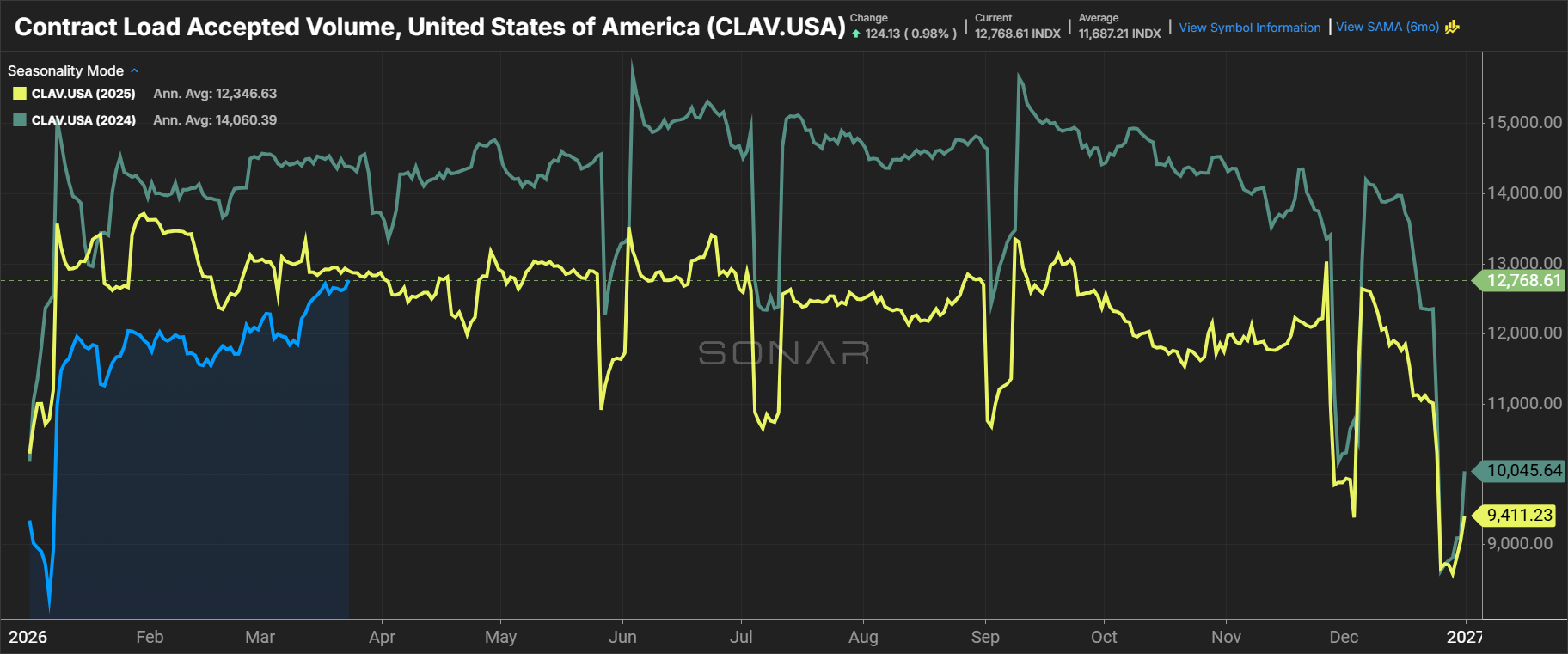
Accepted contract volumes remain depressed: FreightWaves SONAR data shows accepted contract volumes are down less than 1% year-over-year in late March, showing a strong recovery from being down nearly 13% in January and 10% throughout February.
DAT Trendlines
Chart Notes
Spot market activity remains elevated: DAT data shows both month-over-month and year-over-year increases in February spot demand, as winter weather disrupted routing guides and drove more volume to the spot market.
Cass Freight Index Report – February 2026
Chart Notes
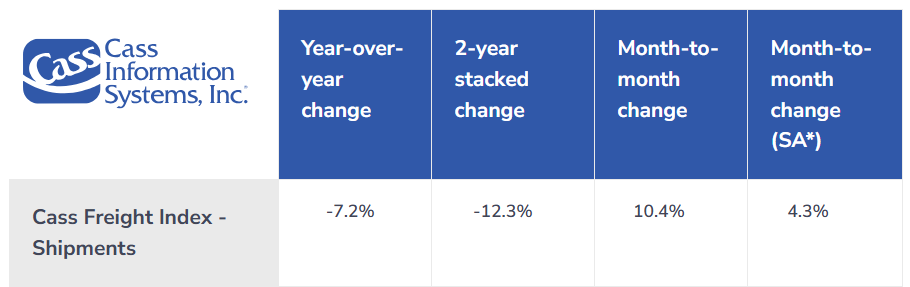
Cass Freight Index shows seasonally adjusted growth in February: Cass reported volumes were down 7.2% year-over-year following a 4.3% seasonally adjusted increase in February, with analysts expecting modest improvement in the near term as warmer weather allows backlogs to clear.
Cass Freight Index Shipments Forecast – February 2026
Chart Notes
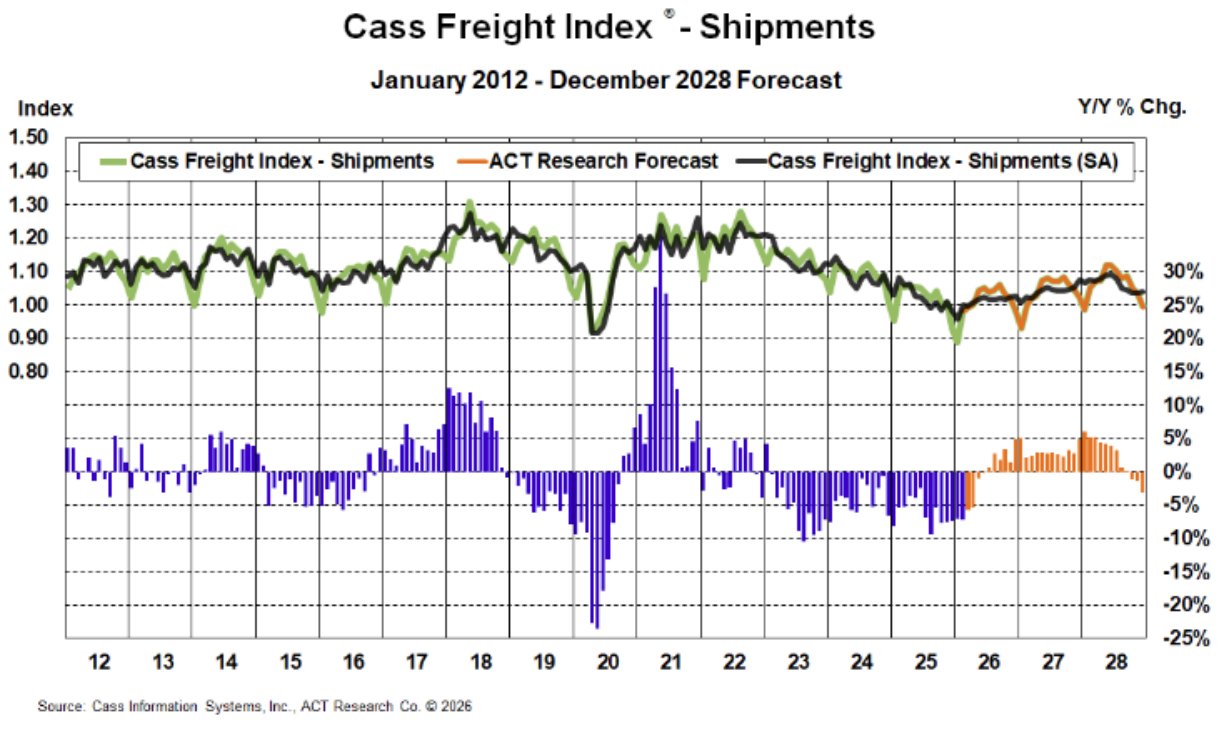
Mixed signals for freight demand outlook: Cass and ACT analysts said the recent tariff ruling would have benefitted freight demand, but impacts from the Iran war may offset those gains.
Descartes U.S. Container Import Volume
Chart Notes
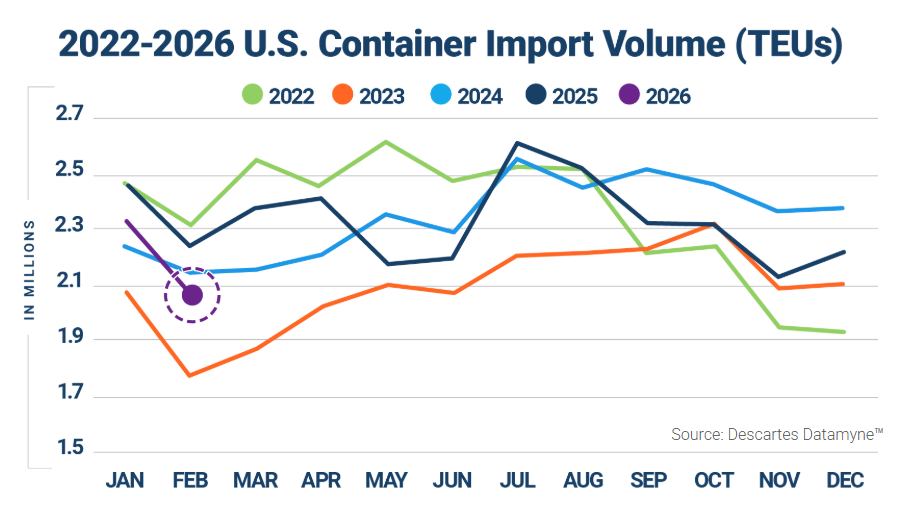
Imports are following typical seasonal patterns: Volumes were down 6.5% year-over-year as importers navigate ongoing policy uncertainty, compared to the pull-forward we observed in 2025. Descartes analysts said this was the fourth strongest February on record in spite of the conflict in the Middle East and overall uncertainty.
Inbound Ocean TEUs Volume Index, SONAR
Chart Notes
Import orders remain below prior year levels: SONAR data shows orders continued to follow seasonal trends through early Q1 but were still down more than 15% year-over-year ahead of the annual Chinese New Year dip. They remain 13% below last year’s levels but are climbing.
Manufacturing at a Glance, Manufacturing ISM
Chart Notes
Manufacturing expansion continues in February: The ISM Manufacturing Index expanded for the second time in as many months, with all three demand indicators in expansion, a positive signal for freight demand. Just 21% of the sector’s GDP contracted, in line with 20% in January and down significantly from 85% in December.
Truckload Supply
Looking Back
Carriers relying heavily on spot market freight, especially smaller businesses, are facing increased financial strain as all-in rates lag rising fuel prices. Meanwhile, high operating costs, tightening driver supply and ongoing regulatory enforcement continue to constrain capacity.
Looking Ahead
Supply is likely to tighten further as seasonal demand builds through April and May. Fuel prices will continue to play an important role — lagging spot rate increases could accelerate attrition, whereas higher FSC-protected contract rates could improve shipper routing guide compliance. Further, equipment orders have improved but not beyond replacement levels, meaning supply is unlikely to expand enough to meet any near-term demand growth or market volatility that may materialize in the coming months.
View Related Data
Outbound Tender Reject Index, SONAR
Chart Notes
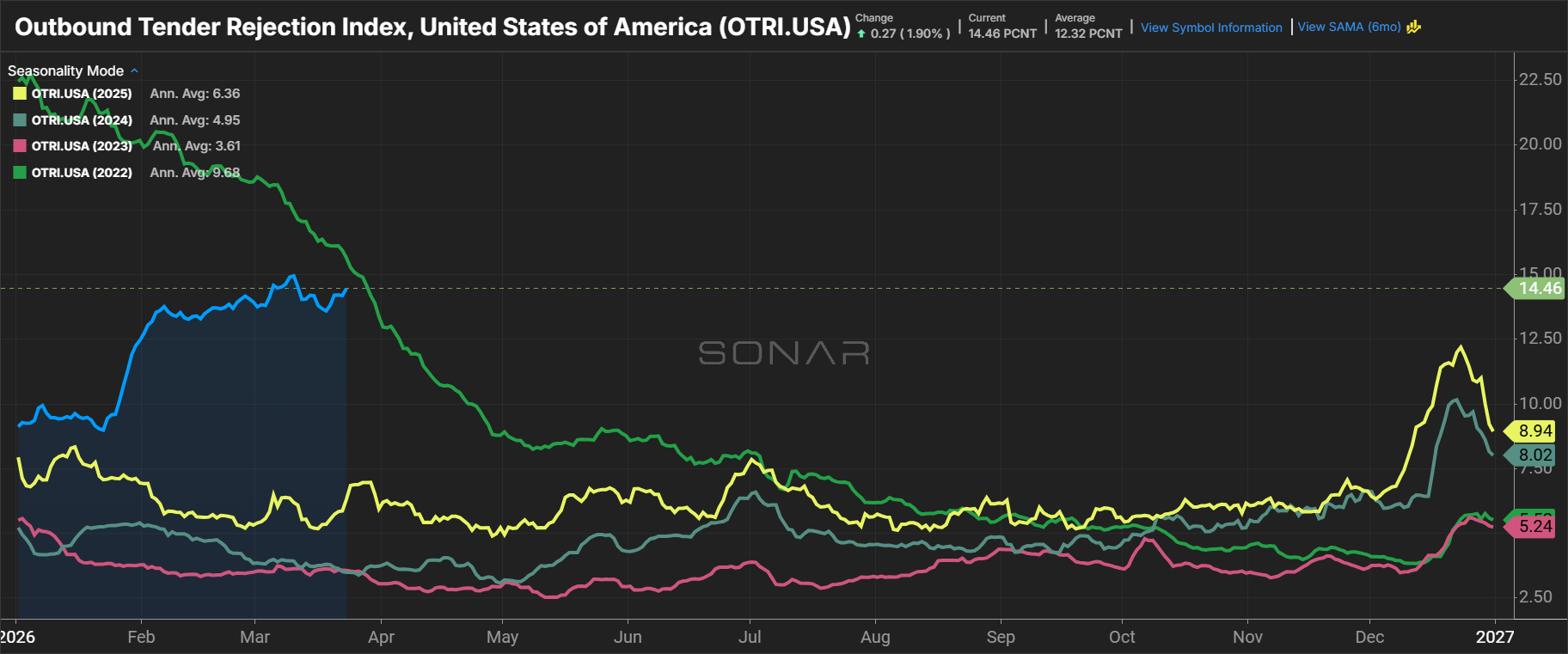
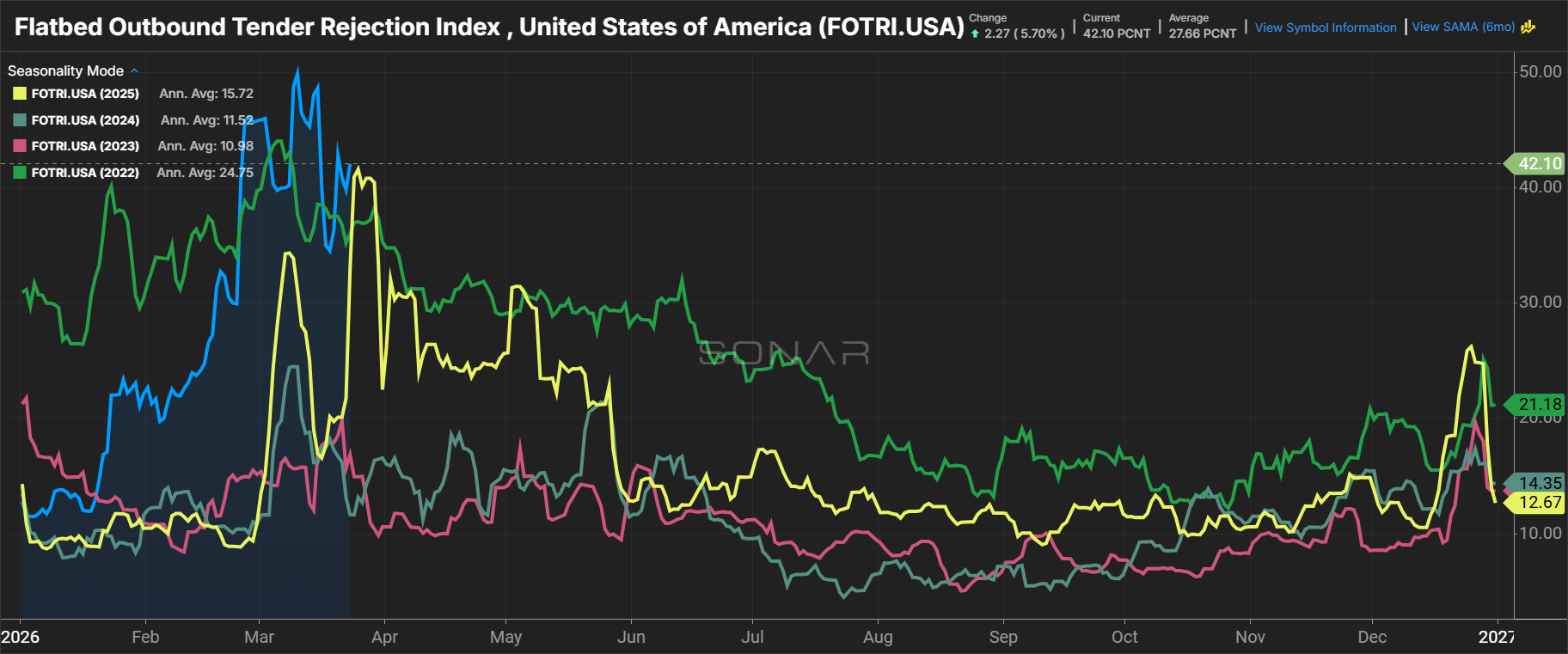
Rejections remain at high levels: SONAR data shows rejection rates reached a multi-year high of 14.95% in early March as produce season ramps up in areas like South Texas, the Southeast, and even early activity in California. Increased rejection rates mean continued spot demand, which will keep the rate floor elevated.
Van Outbound Tender Rejection Index, SONAR
Chart Notes
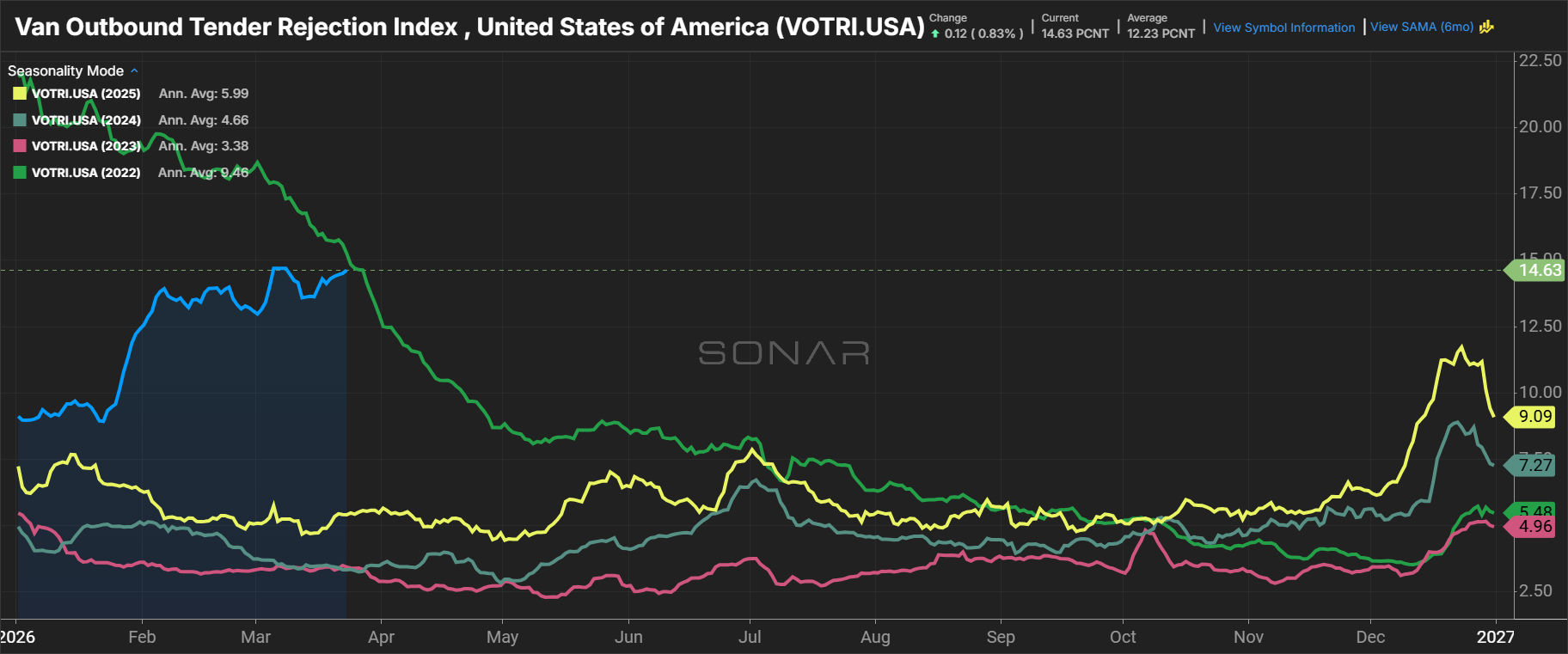
Dry van rejections stable above 14%: Van rejections climbed to the highest levels since March 2022 after Winter Storm Fern and showed no signs of fading by mid-February, keeping spot demand and rates elevated.
Reefer Outbound Tender Rejection Index, SONAR
Chart Notes
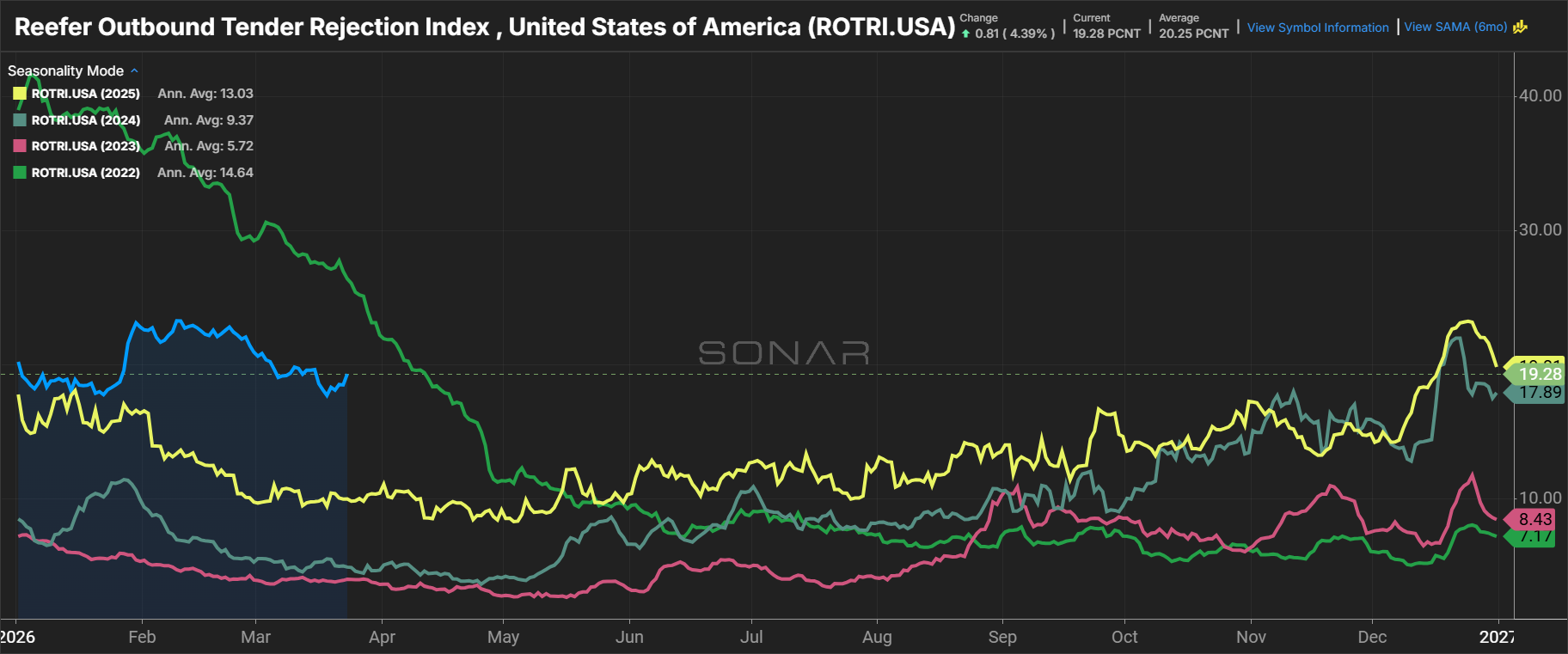
Reefer tender rejections bounce as produce season hits: Reefer rejections were fading fast as the need for freeze-protect declined with warmer weather, but are rising as spring produce demand picks up in southern regions.
Flatbed Outbound Tender Rejection Index, SONAR
Chart Notes
Flatbed tightness likely to persist: Increased manufacturing activity and freeze cleanup-related demand are tightening flatbed capacity as we enter the typical construction season. Tight capacity conditions are expected to persist through at least summer.
Van Load-to-Truck Ratios
Reefer Load-to-Truck Ratio
Chart Notes
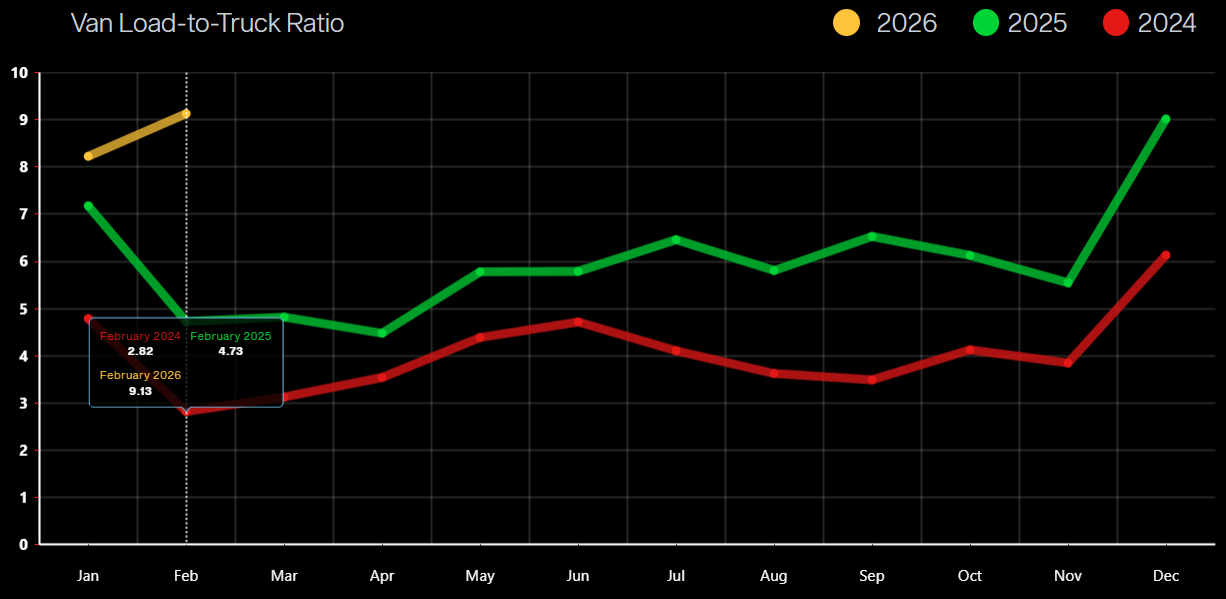
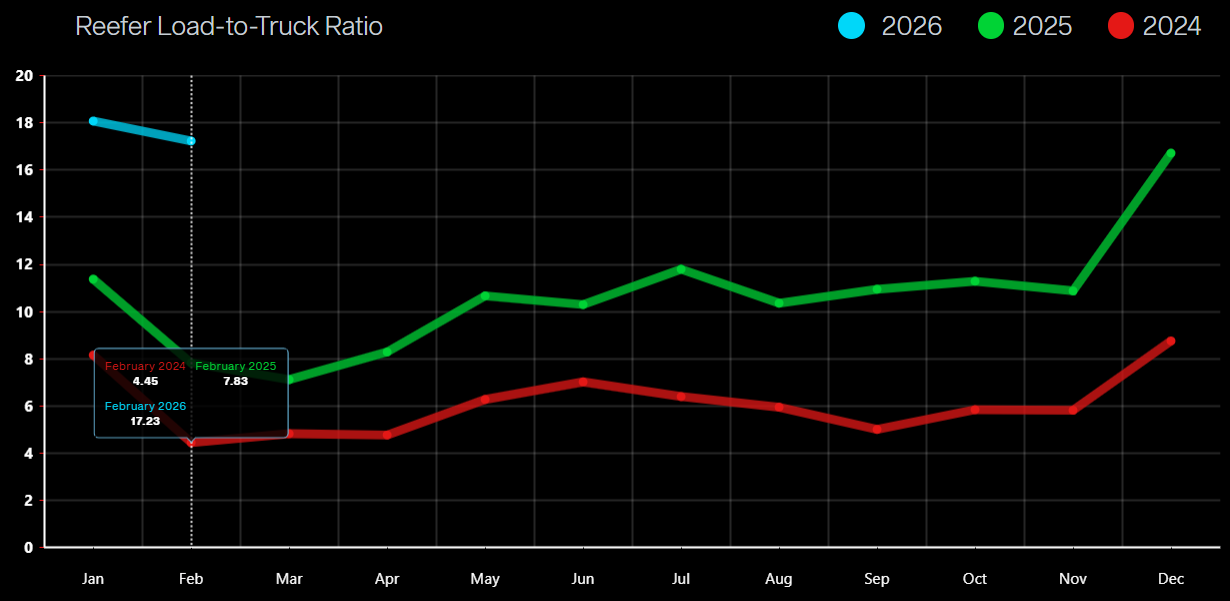
Equipment ratios elevated in February: Equipment demand remains high as shippers continue to look to the spot market for coverage, while supply remains limited as carriers navigate driver, regulatory and equipment cost pressures.
Flatbed Load-to-Truck Ratios
Chart Notes
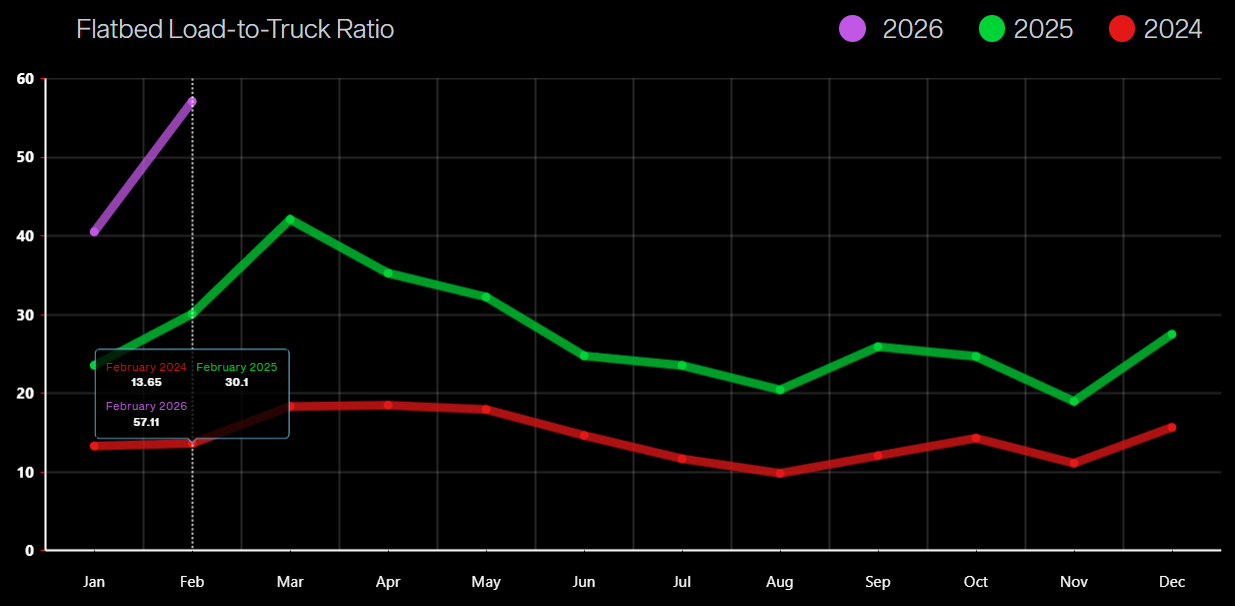
Flatbed load-to-truck ratio moving upward: The flatbed load-to-truck ratio increased 40.9% month-over-month and 89.7% year-over-year in February, driven largely by higher spot market demand.
Morgan Stanley Dry Van ONLY Truckload Freight Index
Chart Notes
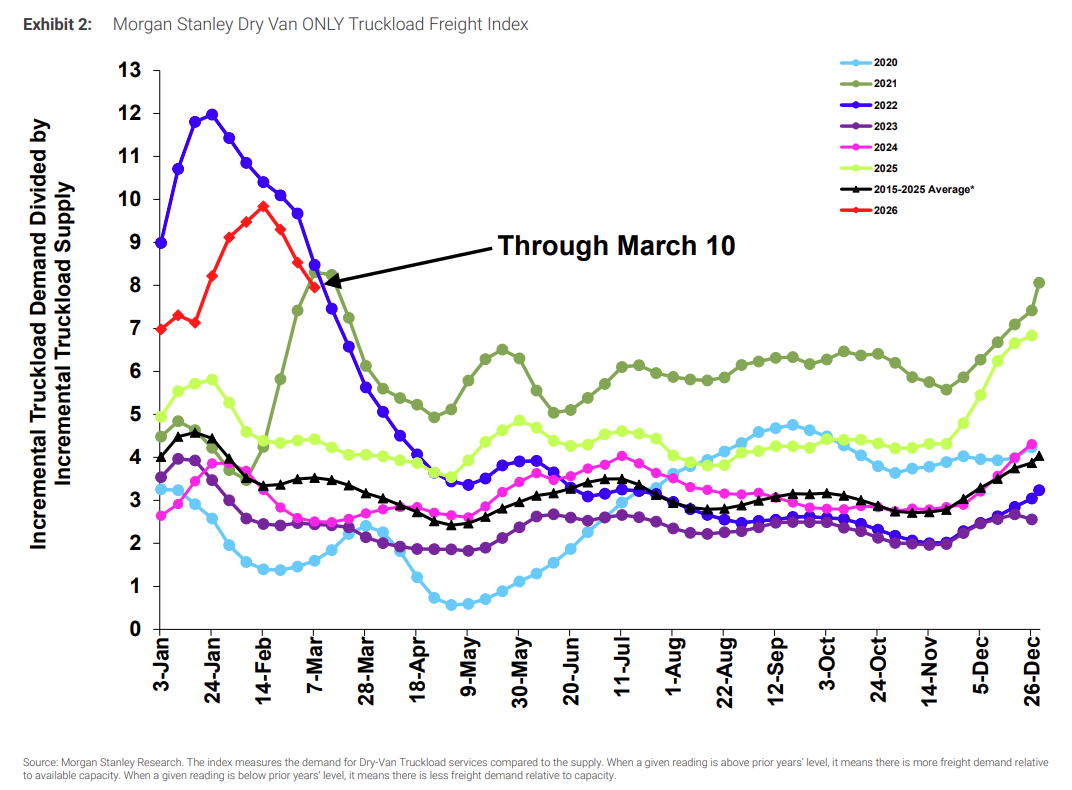
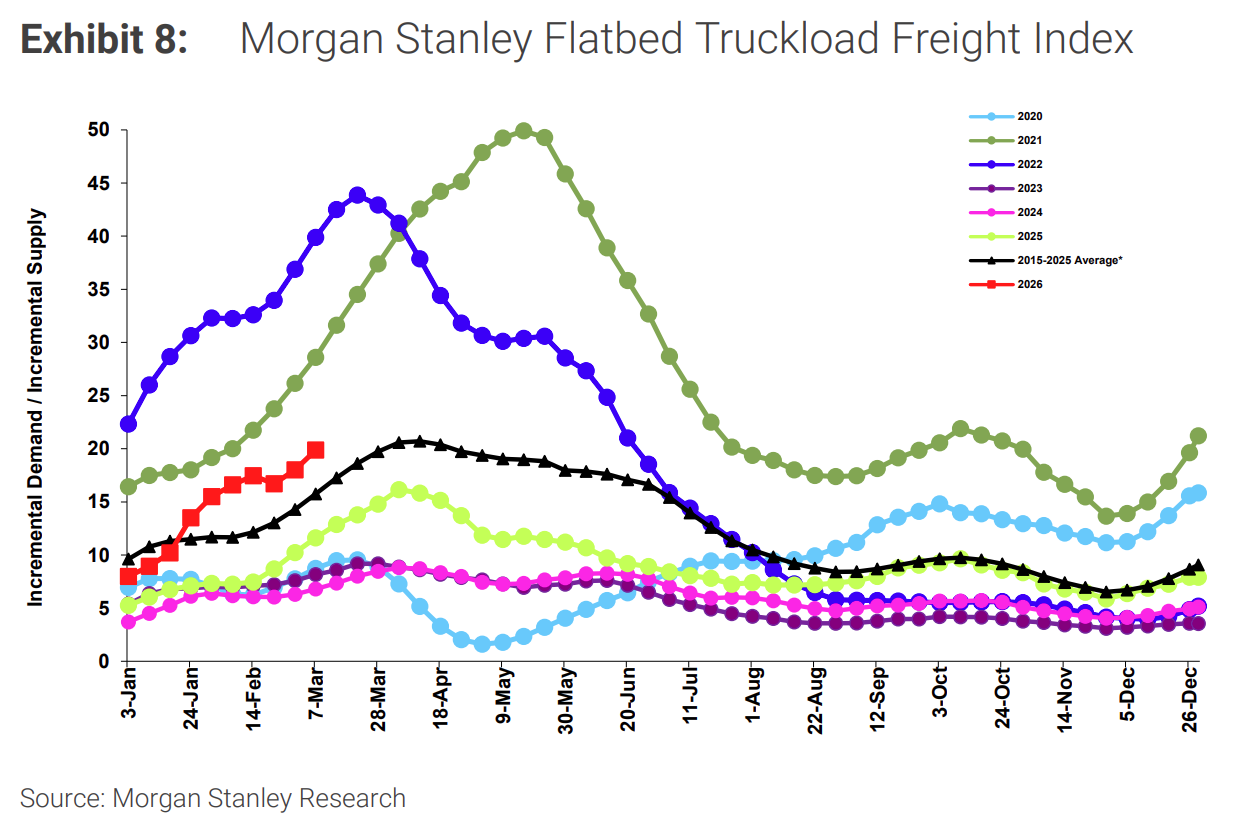
Morgan Stanley Index shows elevated seasonality across modes: Indices continue to show tighter conditions than at any point outside the pandemic disruption while following seasonal trends. Tightening when historical trends typically point to easing signals that the market is more sensitive to disruptions like severe weather.
Morgan Stanley Reefer Truckload Freight Index
Morgan Stanley Flatbed Truckload Freight Index
Carrier Revocations, New Carriers & Net Change in Carrier Population, FTR
Chart Notes
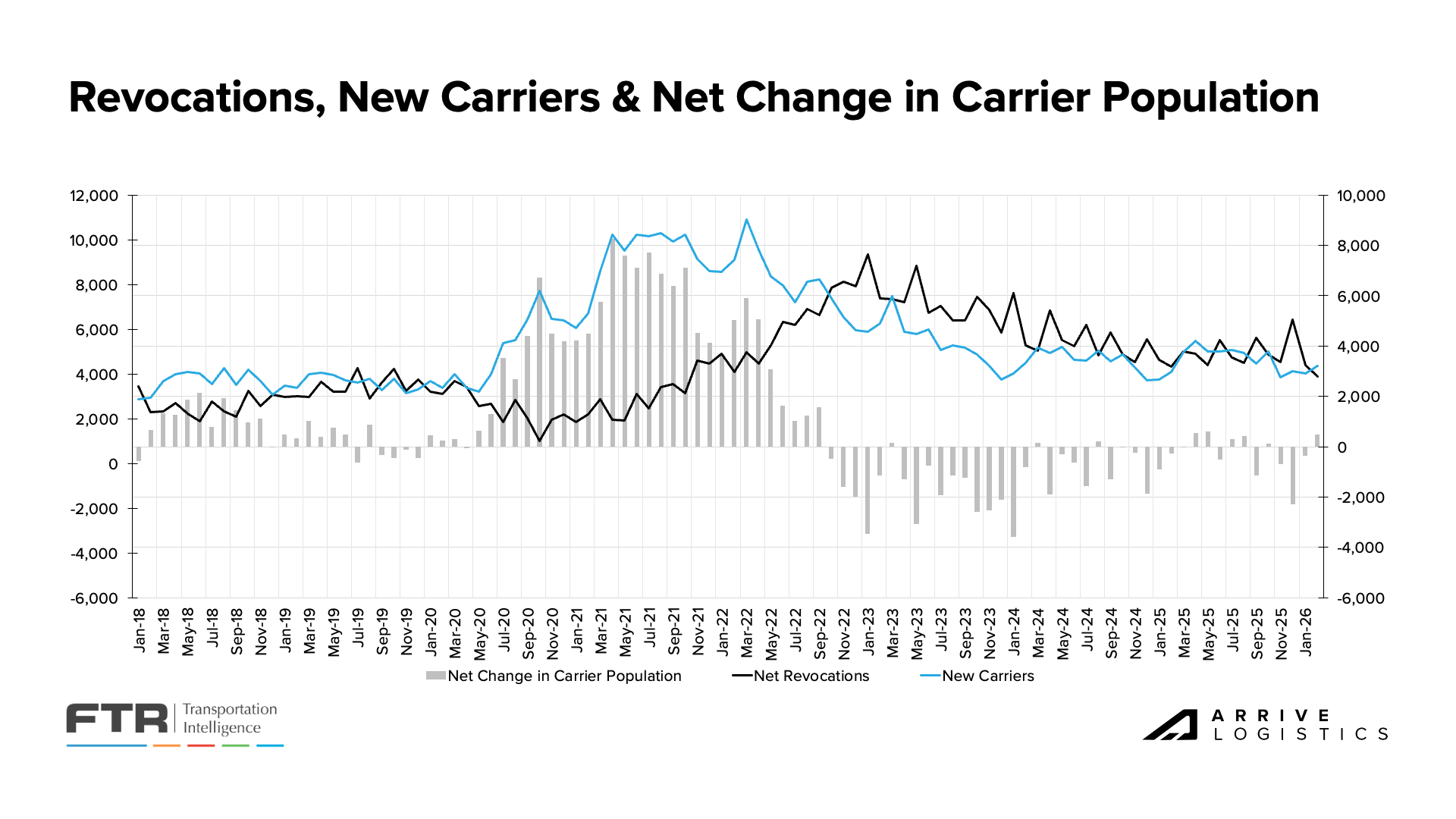
Carrier population grows in February: Healthy spot rate conditions may be leading to a reduction in the pace of carrier exits; however the sudden increase in fuel costs could reverse this trend as small carriers experience greater financial strain.
Class 8 Tractor Net Orders, ACT Research
Chart Notes
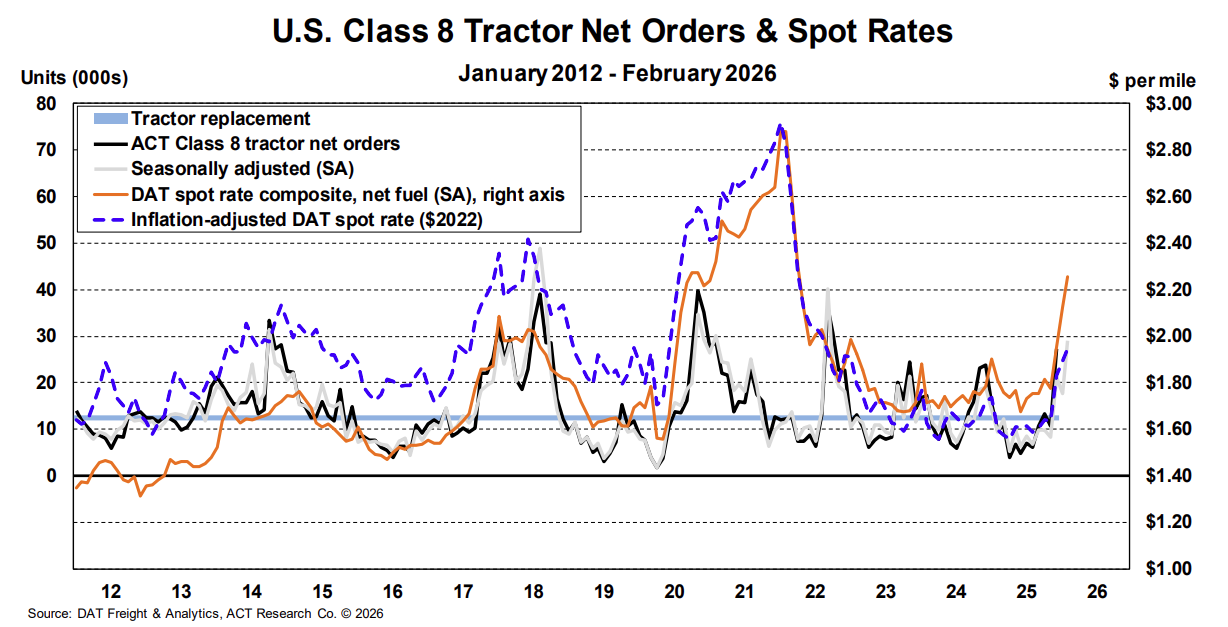
Tractor orders surge in February: ACT data shows Class 8 orders were up to nearly 30,000 units in February, indicating that a healthy spot rate environment and greater clarity on emission regulations will likely support stronger ordering patterns in 2026.
Active Truck Utilization, FTR
Chart Notes
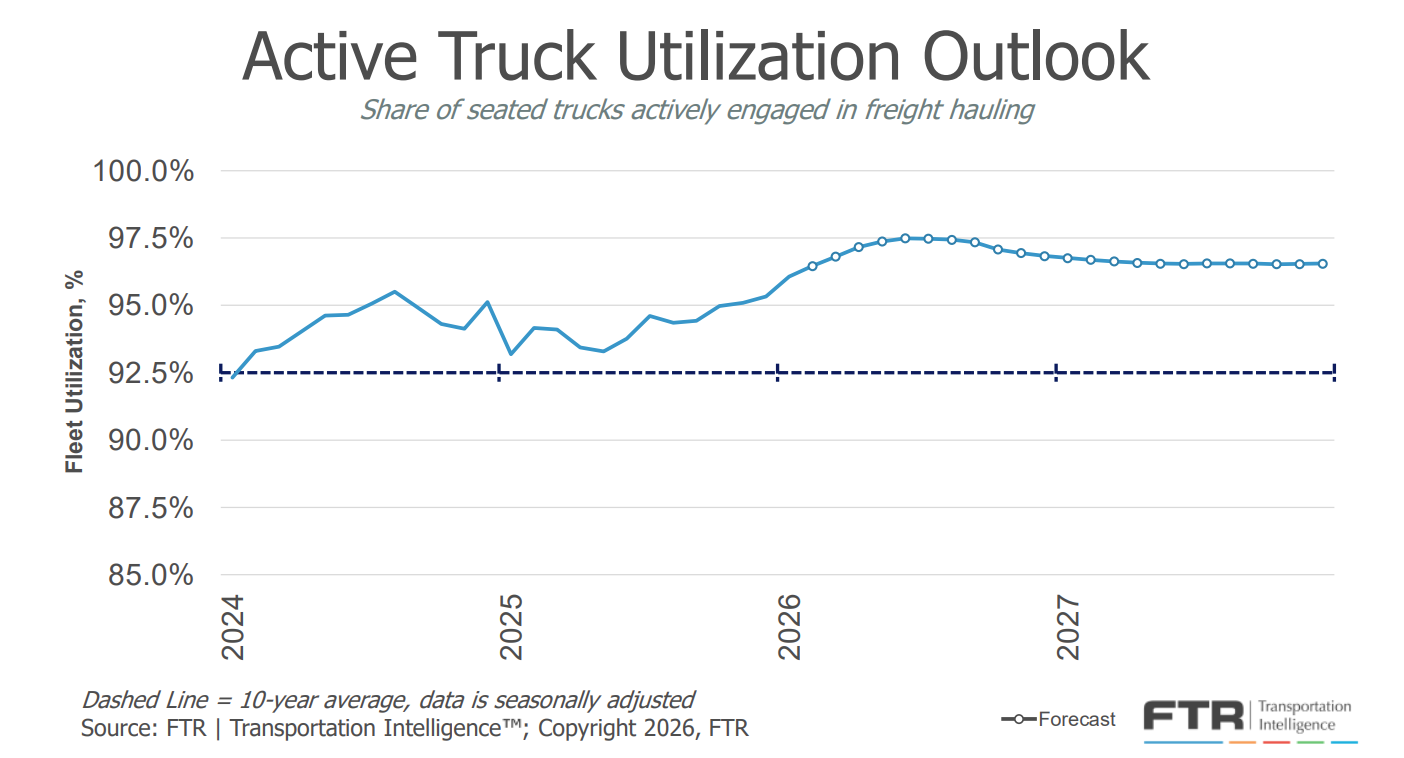
Truck utilization strengthens: FTR’s near-term outlook calls for utilization to exceed 97% by Q2. Analysts said the forecast faces risks in both directions depending on freight volumes and driver capacity in the coming months. They also noted that manufacturing resilience will be key to sustained improvement in truck freight.
Monthly Change in Trucking Jobs, FRED Economic Data
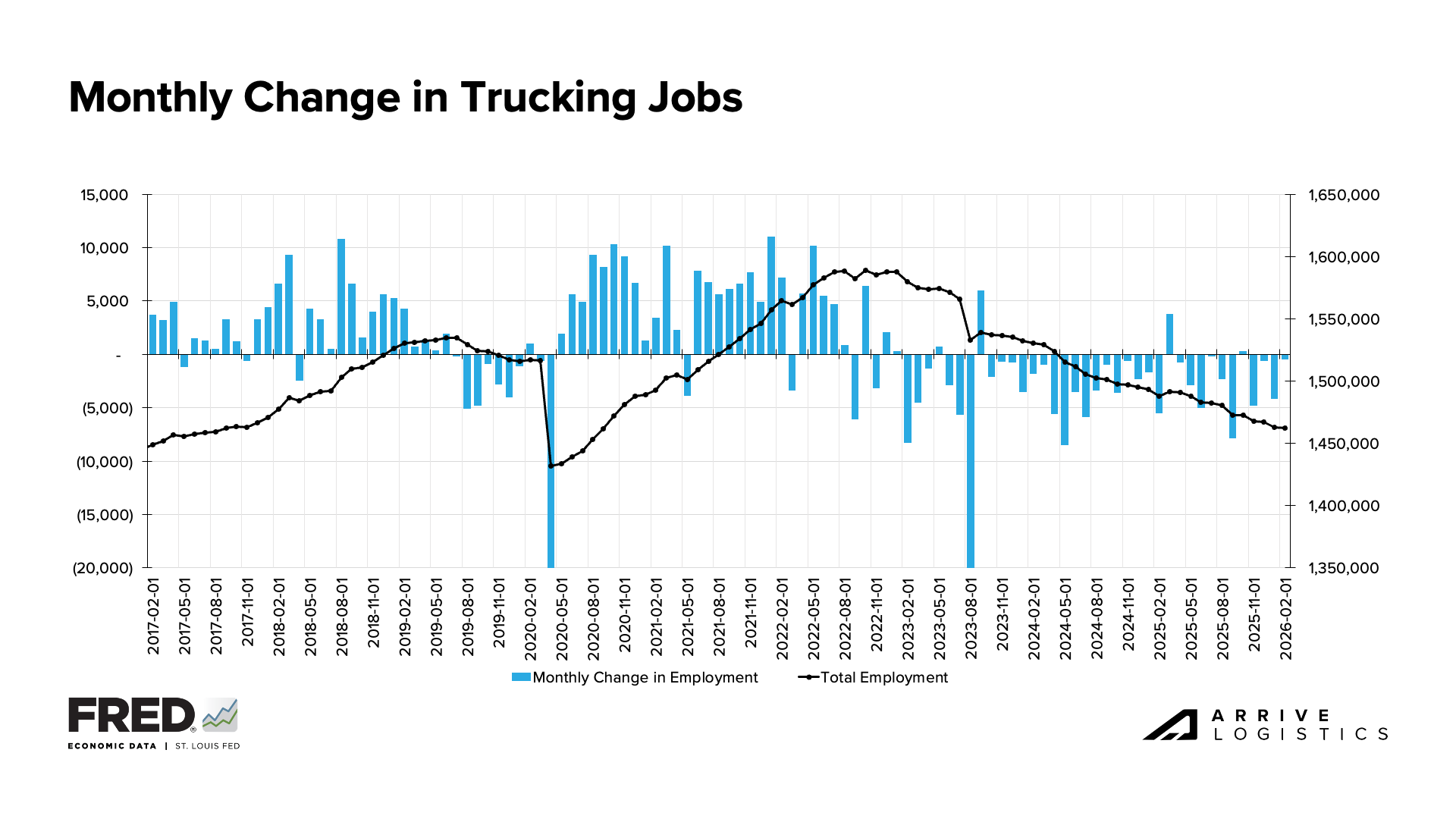
Employment shows further declines: After last month’s significant revision, the trucking industry lost additional headcount in February. Although strong rates should fuel job growth if sustained, the lack of confidence in demand stability is likely driving the sector’s lagging hiring trends.
U.S. Prime Age Class 8 Tractor Population, ACT Research
Chart Notes
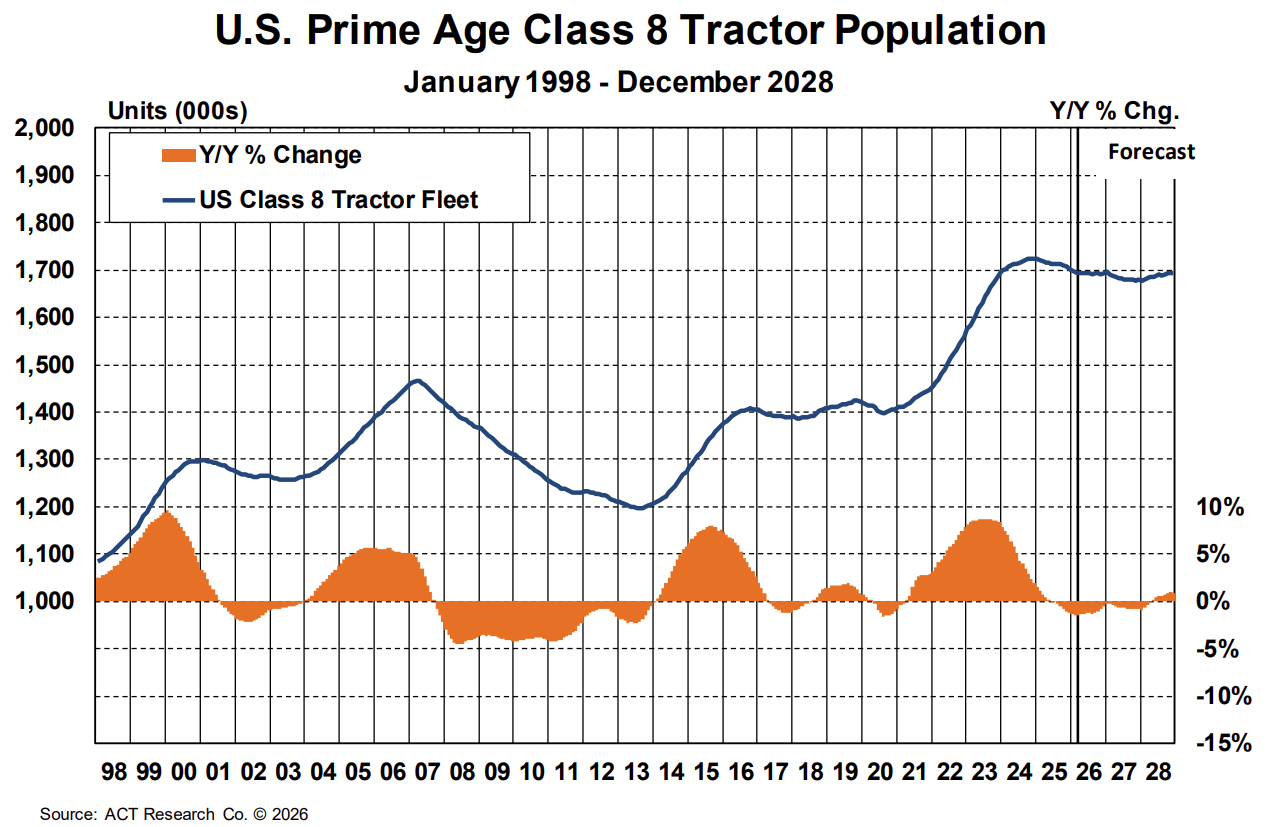
Orders surge should temper tractor population decline: Class 8 tractor counts are down 25,000 units, or 1.5%, year-over-year. While higher sales should slow the decline, fleet counts are expected to fall 0.5% through 2026 and another 0.8% in 2027.
For-Hire Driver Availability Index, ACT Research
Chart Notes
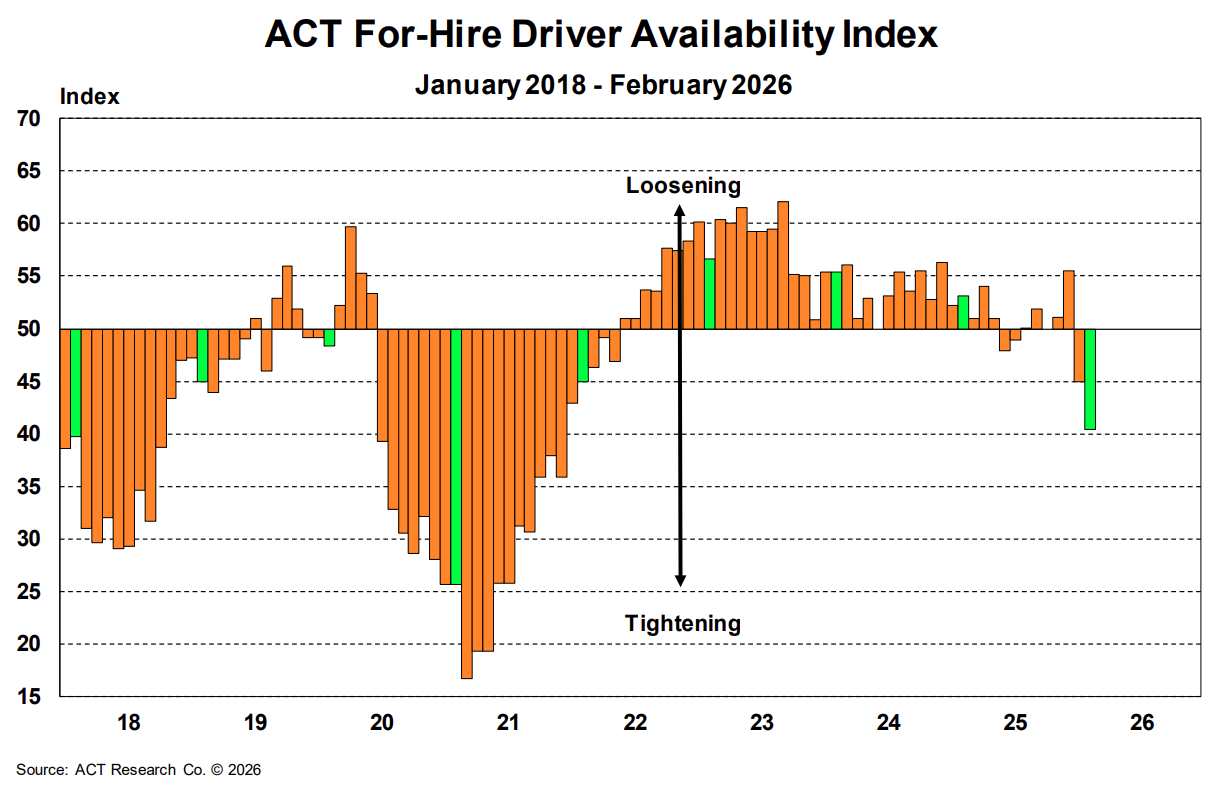
Driver availability tightens: ACT reported that driver availability tightened significantly in recent months. If current conditions persist, fleets’ limited ability to add drivers may become a growing concern as regulations and costs act as speed bumps to seating trucks with new drivers.
For-Hire Trucking Survey: Supply-Demand Balance, ACT Research
Chart Notes
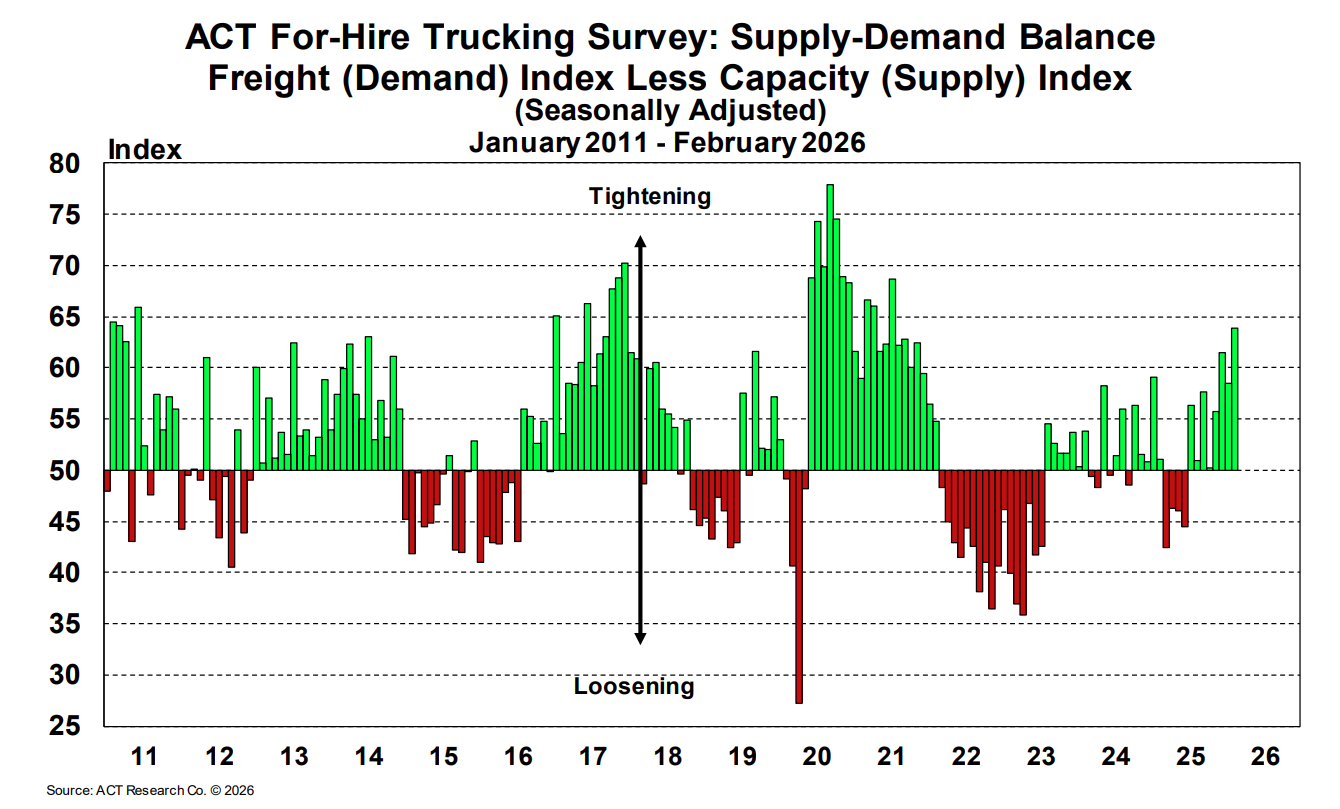
Winter storms drive tightness: ACT says that while gains may ease as the weather improves, factors such as private fleet contraction and continued capacity exits will likely prolong tight truck conditions.
Enforcement Data – SONAR
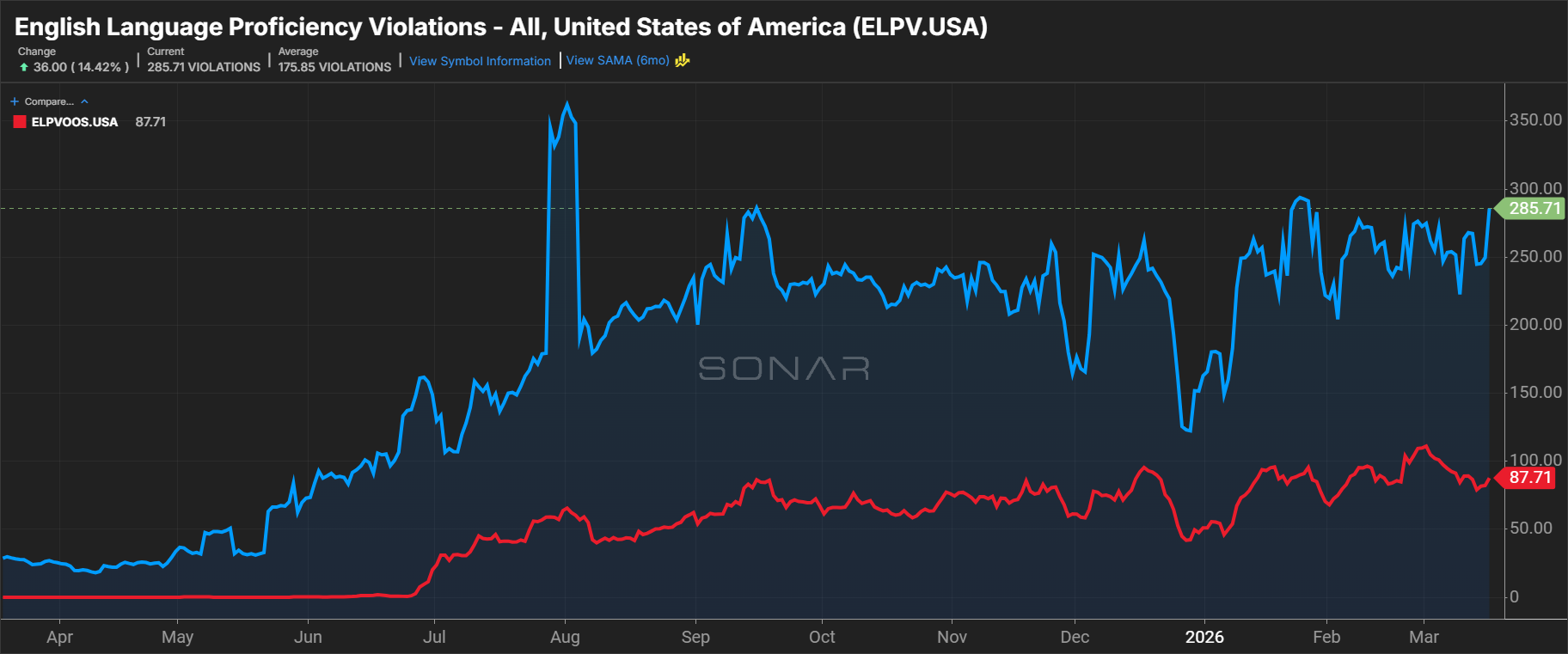
ELP violations remain elevated as out-of-service violations stabilize: Overall violations and out-of-service violations remain near peak levels but do not appear to be accelerating or decelerating. This suggests a more gradual capacity decline that is unlikely to be consequential on its own. However, any additional capacity exits with conditions at or near equilibrium will continue to increase the market’s sensitivity to disruptive events.
Insurance Premiums – FTR
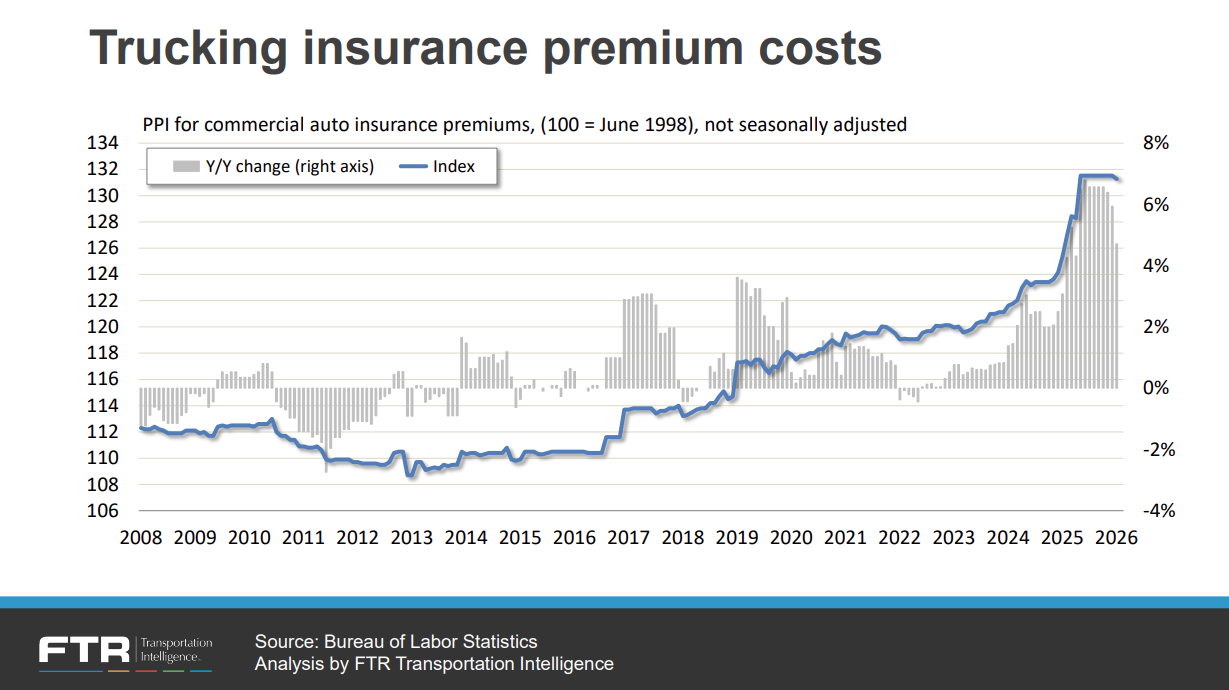
Insurance premium increases continue to weigh on carriers: Rising insurance premiums are a commonly stated reason for carrier financial distress. Increases in theft, fraud and nuclear verdicts have worsened the situation in recent years.
Truckload Rates
Looking Back
Rising fuel costs pushed all-in contract rates higher in March, while spot linehaul pricing remained low as rates failed to catch up with fuel increases. Flatbed markets remained historically elevated amid seasonal tightness and post-winter storm recovery volumes, and reefer rates softened outside of key produce regions.
Looking Ahead
Outside of seasonal volatility, fuel will have the most significant influence on the near-term rate environment. If prices remain elevated, spot rates will likely rise as carriers seek to cover higher costs, particularly as demand increases through in the summer months.
View Related Data
Truckstop Weekly National Average Spot Rates
Chart Notes
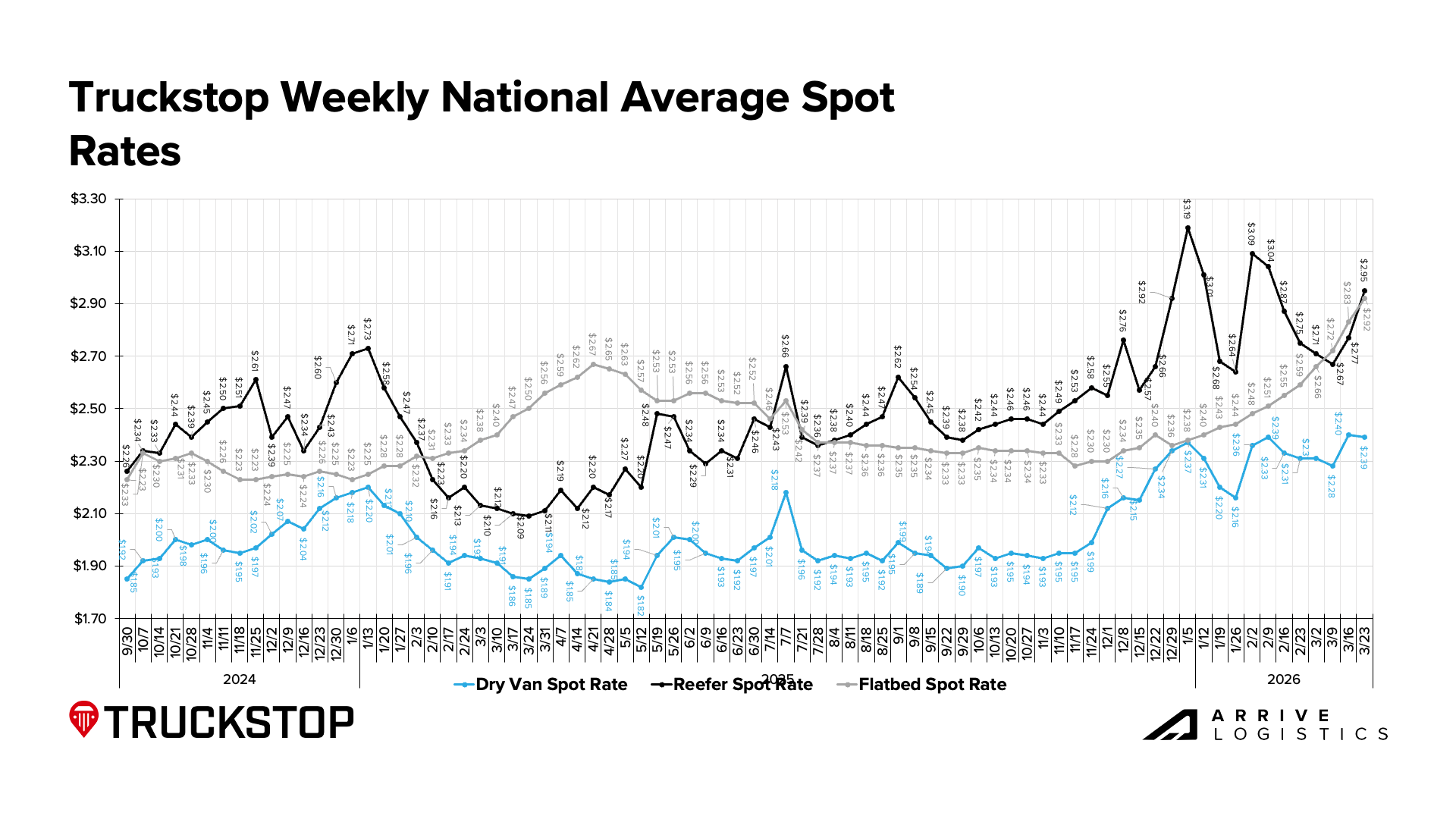
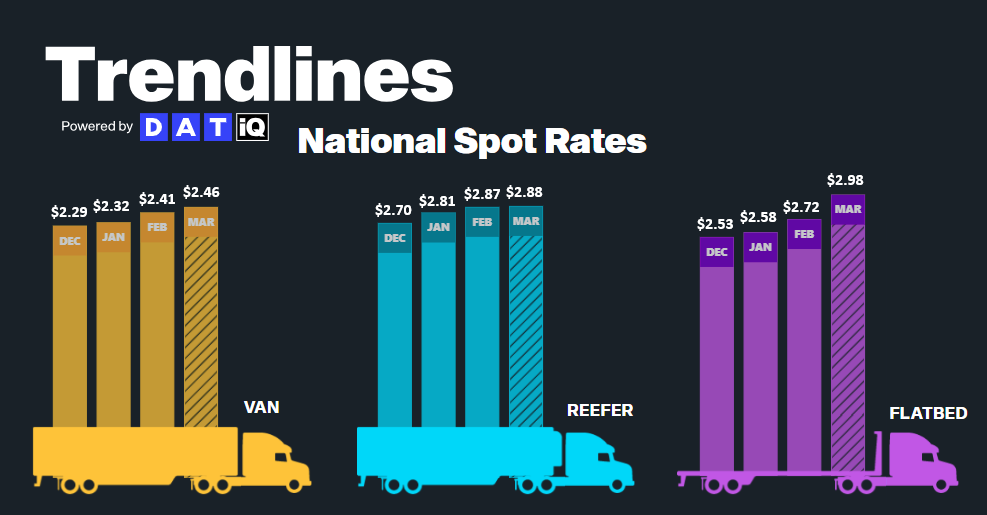
Fuel increases push up all-in rates across all modes: Rates across all equipment types are on the rise as diesel prices climb. Additional upward pressure on spot rates is expected as carriers gain pricing power.
DAT Monthly Rate Trends
Chart Notes
Monthly spot rates increase across all modes: National average spot rates rose in February and early March across all modes as winter weather and rising fuel costs tightened capacity and increased carrier costs.
DAT Fuel Trends
Chart Notes
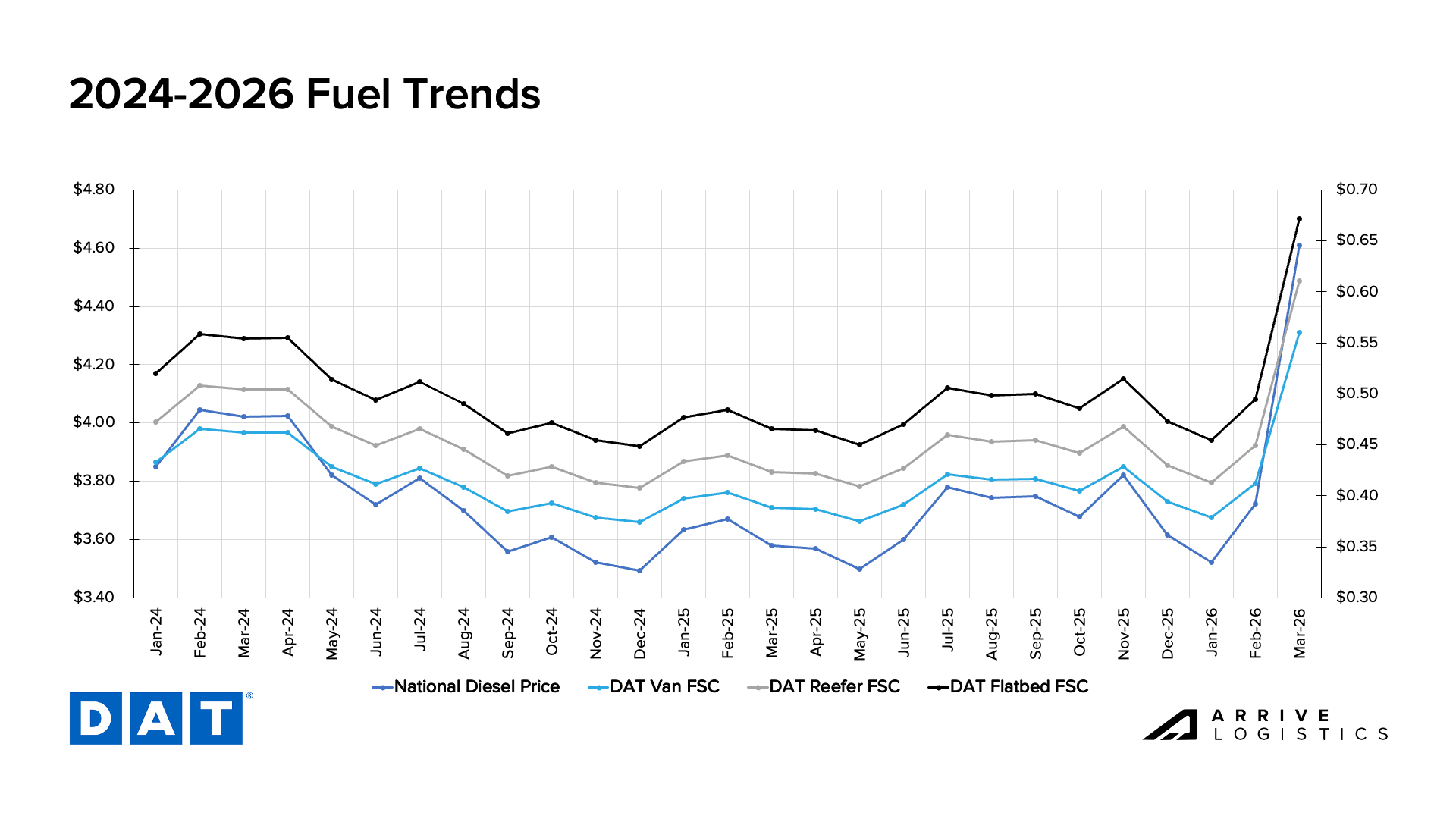
Diesel prices skyrocket: Unprecedented fuel price increases drove up truck costs overnight, and the continued war in the Middle East is likely to worsen the situation.
DAT Dry Van National Average RPM Spot vs. Contract
Chart Notes
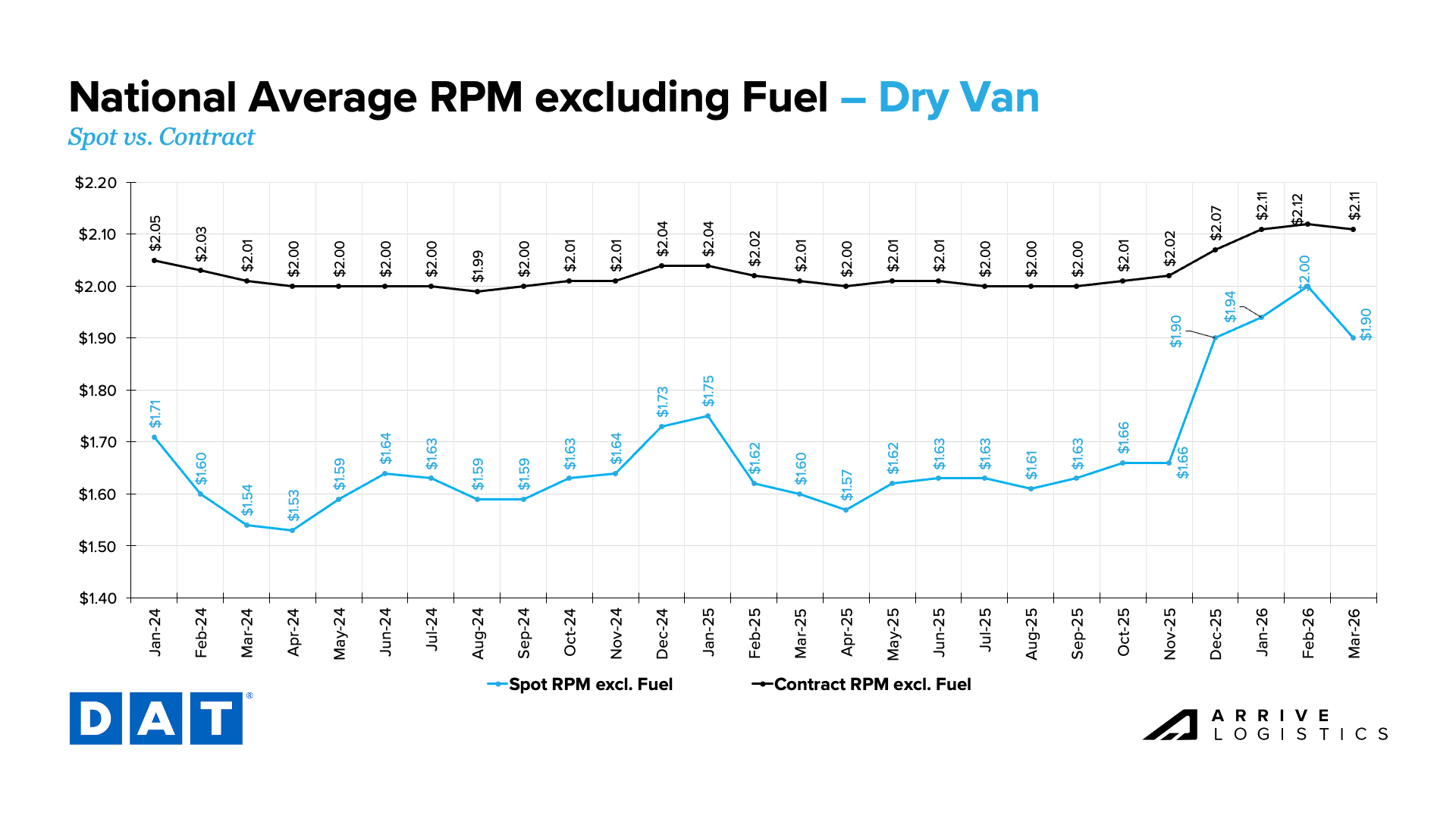
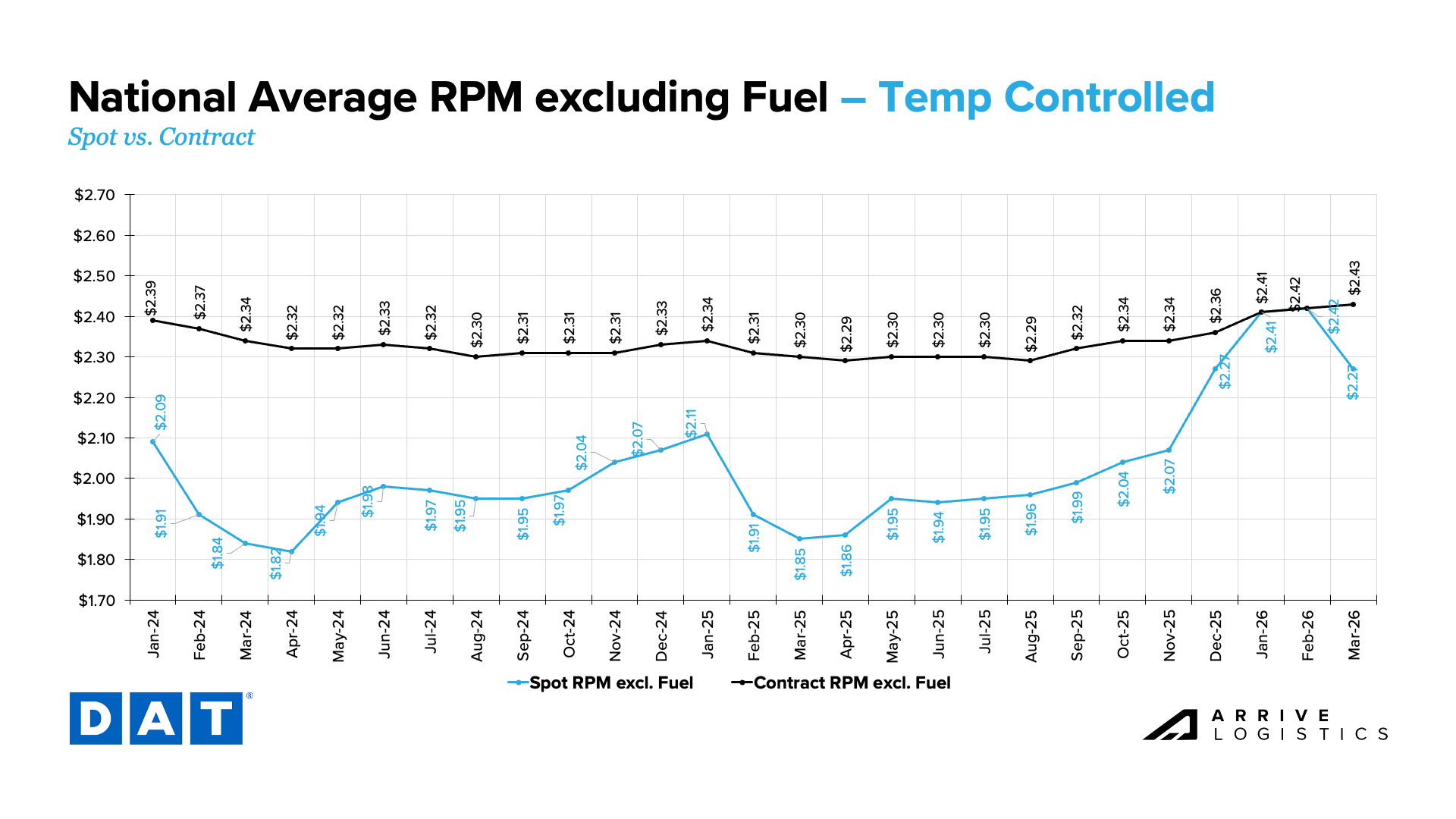
Linehaul rates dip across all van and reefer equipment: Because spot rates are typically quoted as “all-in” rates, they do not move when fuel shifts. This led to a sudden decrease in inferred linehaul rates even as fuel costs rose sharply. However, recent trends suggest that as spot market carriers gain pricing power, linehaul rates will adjust upward to reflect higher fuel costs.
DAT Temp Controlled National Average RPM Spot vs. Contract
DAT Flatbed National Average RPM Spot vs. Contract
Chart Notes
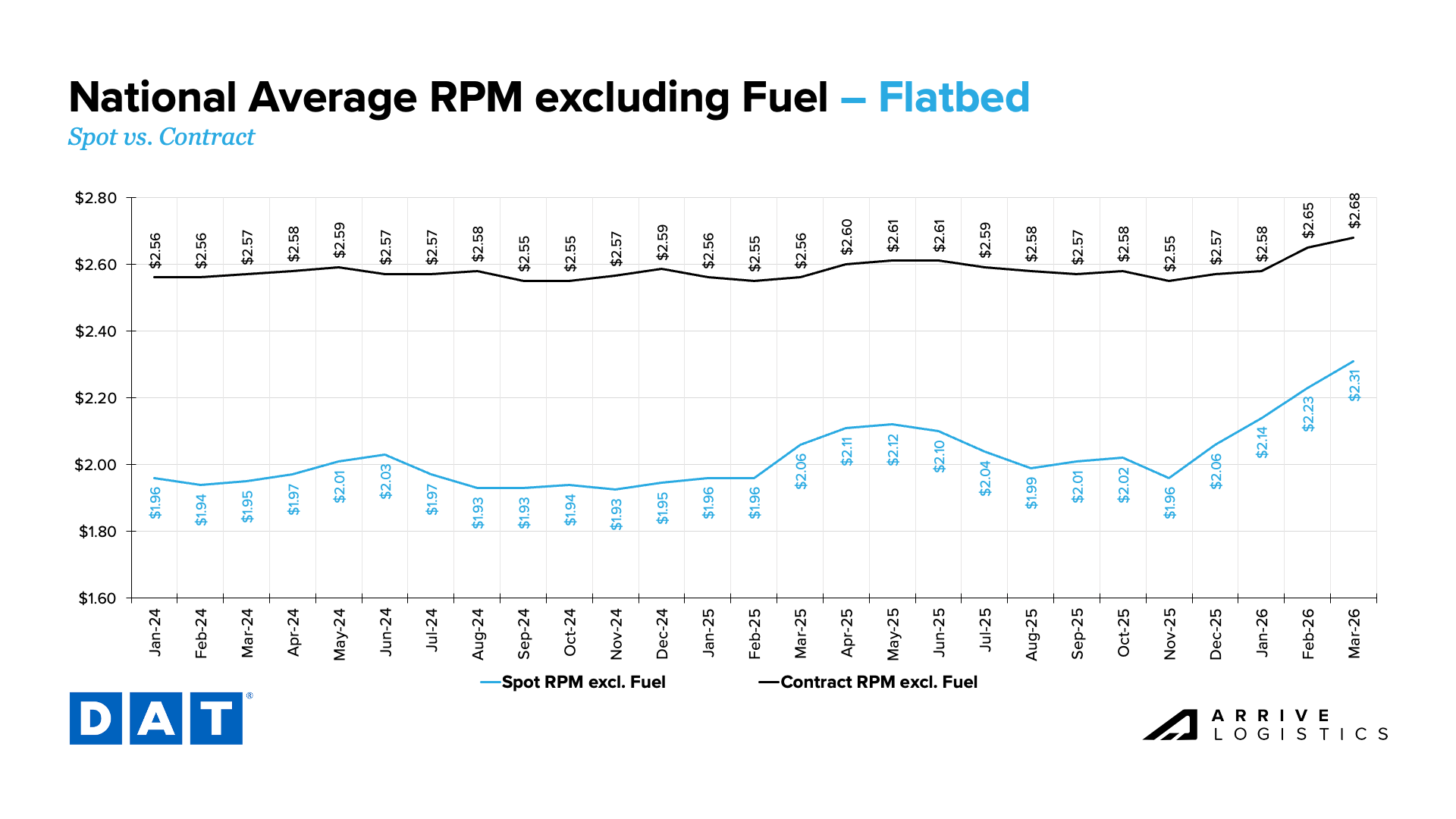
Flatbed growth accelerates despite fuel increases: Flatbed spot linehaul rates showed strong year-over-year growth of 13.8% in February. They are up 12.1% month-to-date in March and continue to gain upward momentum despite fuel-related pressures.
Economic Conditions
Looking Back
Manufacturing expanded for a second consecutive month, with increases across new orders, production and backlogs. Consumer spending also reached its highest year-over-year growth rate since early 2023, though those gains were primarily driven by higher-income households.
Looking Ahead
Geopolitical tension remains a key economic wildcard, as rising inflation tied to increased energy costs may limit the potential for interest rate cuts in the near term. However, if strong consumer spending and recent manufacturing growth continue, it would help support stable freight demand.
View Related Data
Bank of America Total Card Spending, Bank of America Consumer Checkpoints
Chart Notes
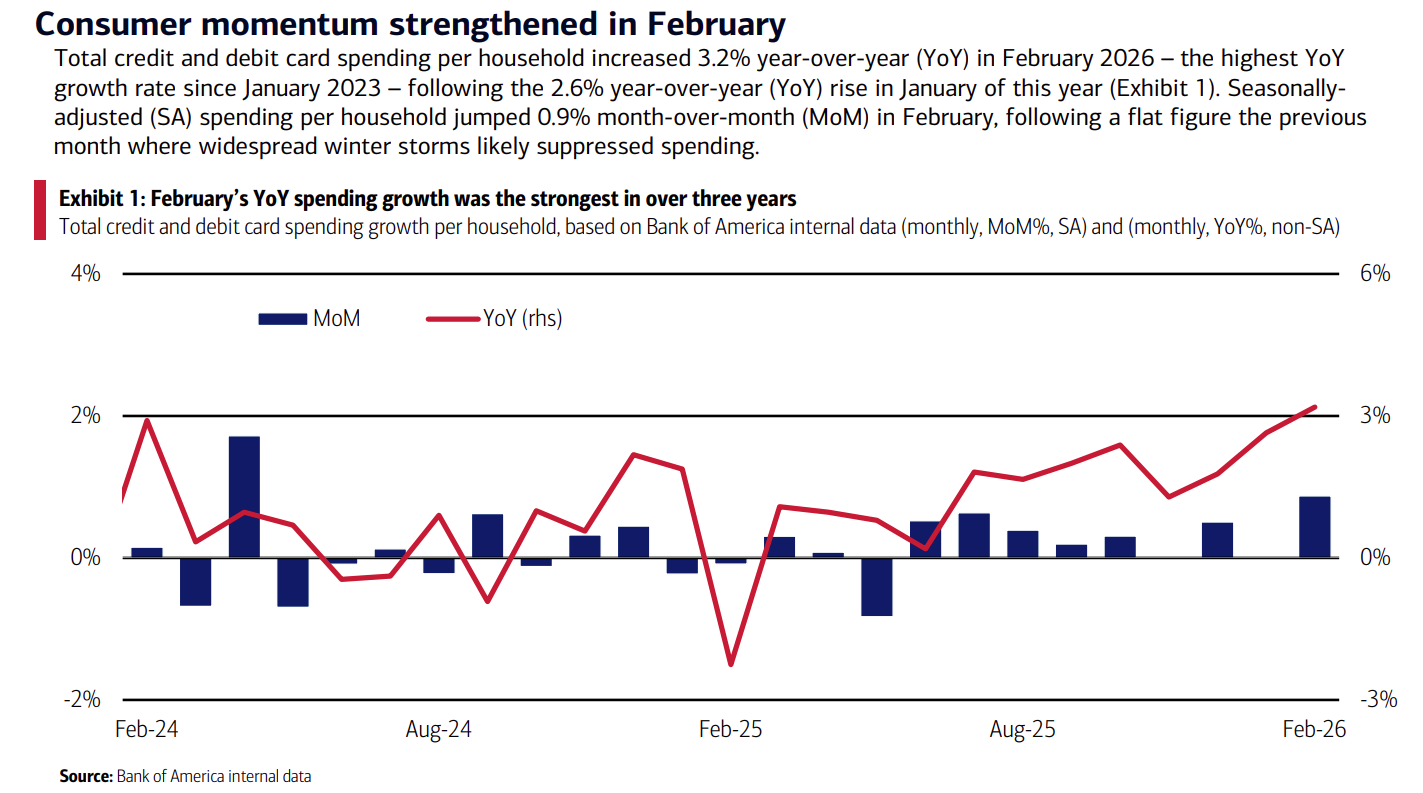
Consumer spending growth continues to be strong: Bank of America said household spending rose 3.2% year-over-year in February, the largest increase in over three years. They also reported a temporary boost in discretionary spending by lower-income households, likely driven by tax returns. Overall, consumer spending remains strong and should continue to support stable freight volumes.
The Employment Situation – February 2026
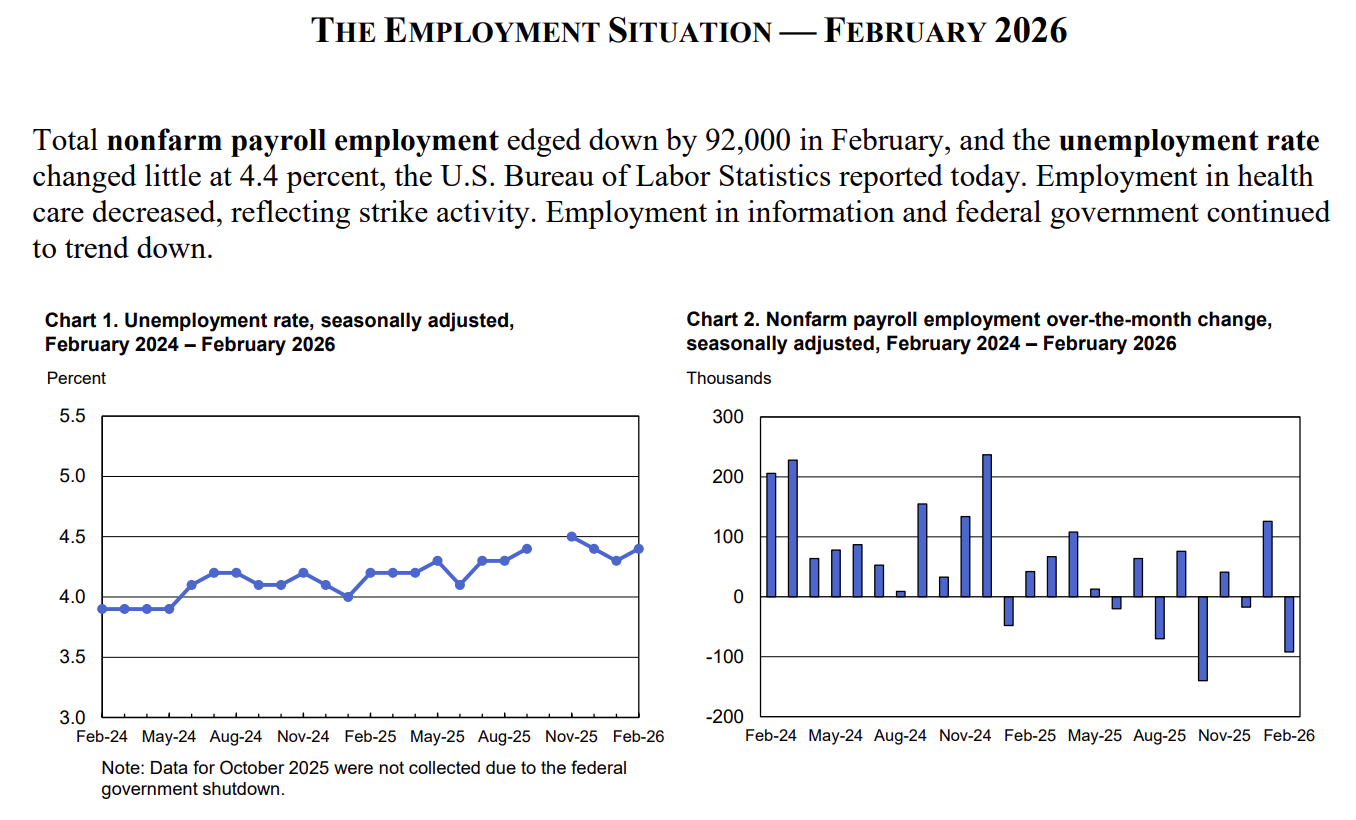
Employment falls in February: The Bureau of Labor Statistics reported a decrease of 92,000 jobs in February. The unemployment rate rose slightly from 4.3% in January to 4.4% in February. Although there are signs of weakening conditions, relative labor market stability should support relatively steady consumer spending and related freight demand.
Canadian Market Update
Looking Back
While most drivers have returned from seasonal holiday time off, the Canadian labor market is facing a structural shift as new federal regulations on foreign drivers prompt a notable increase in industry exits. This contraction in the driver pool has kept outbound Canada rates elevated, even as inbound capacity has begun to normalize toward late last year’s levels. Fuel costs remain a primary justification for sustained rate floors, providing little relief to shippers despite stabilization in some lanes. The capacity crunch is most notable in the temperature-controlled sector, where reefer rates have surged to record highs across the board for Canadian shipments.
Looking Ahead
Capacity is expected to remain under pressure as the full impact of driver attrition and regulatory compliance continues to filter through the market. While dry van rates may level off on inbound lanes, the reefer segment will likely face persistent volatility and tightening supply as seasonal demand ramps up. Shippers should anticipate that high fuel surcharges will remain a fixed narrative in rate negotiations for the foreseeable future. The shrinking availability of specialized equipment and a smaller overall driver pool suggest that any significant surge in volume will quickly trigger further rate increases across both domestic and cross-border corridors.
View Related Data
Canadian Spot Market – Freight Index
Chart Notes
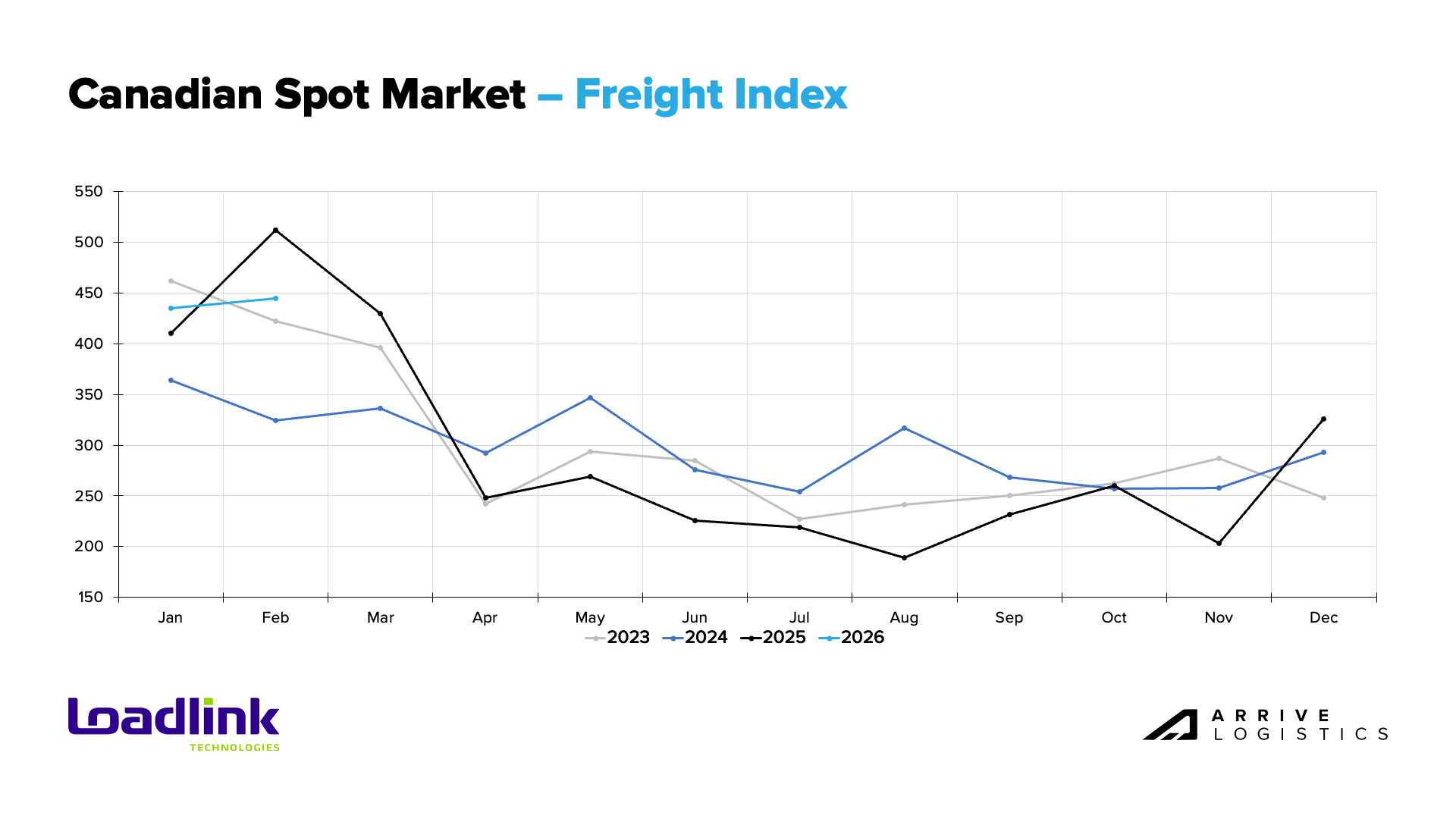
Load postings beat expectations in February: Loadlink data shows continued momentum that began in November and carried through February, with postings up 2% month-over-month — a surprise to the upside as volumes typically dip in February. Year-over-year declines of 13% in February are more a result of last year’s pre-tariff push than a reflection of growth this year.
Canada – Cross-Border Volume vs. Intra-Canada Volume
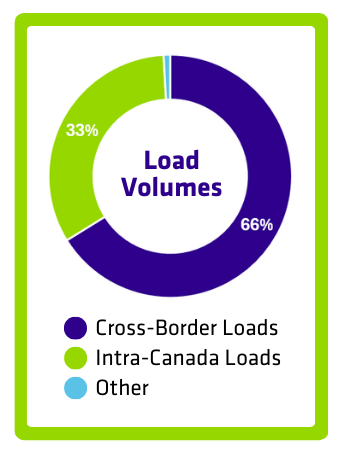
Cross-border share increases, volumes expand: Cross-border load volumes gained additional market share, rising from 65% of total load postings in January to 66% in February. This was driven by a 38% increase in southbound lane volumes and a 16% increase in northbound lane volumes. Intra-Canada volume share fell 1% as total intra-Canada freight volumes declined 2% month-over-month.
Truck Crossings OB Canada
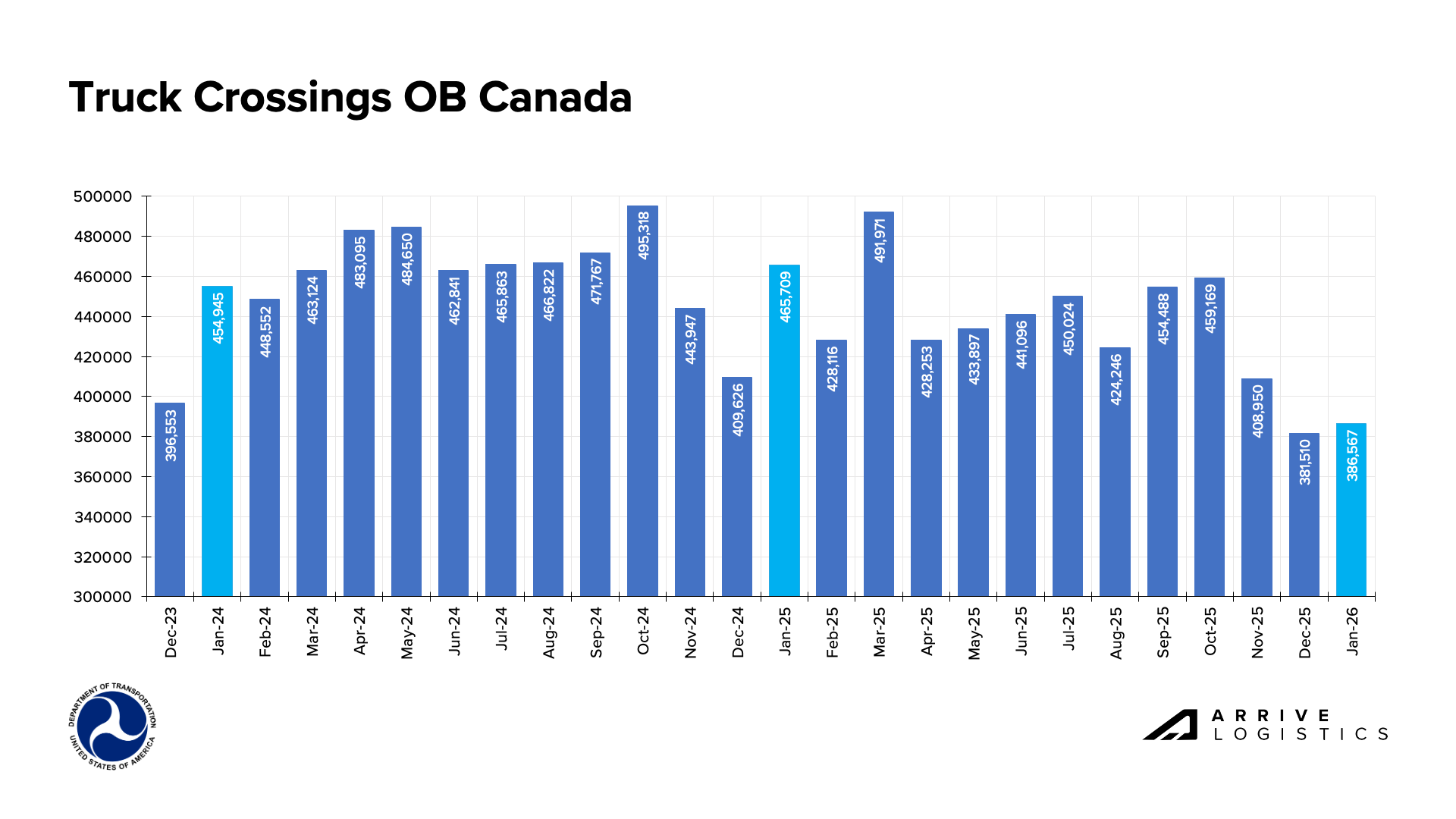
Canada-to-U.S. truck crossings decline amid winter weather: In what is typically a rebound month following seasonal slowdowns in December, truck crossings from Canada to the U.S. grew by just 1.3% month-over-month and were down 17% year-over-year in January.
US & Canada Dry Van Truckload Spot Rates
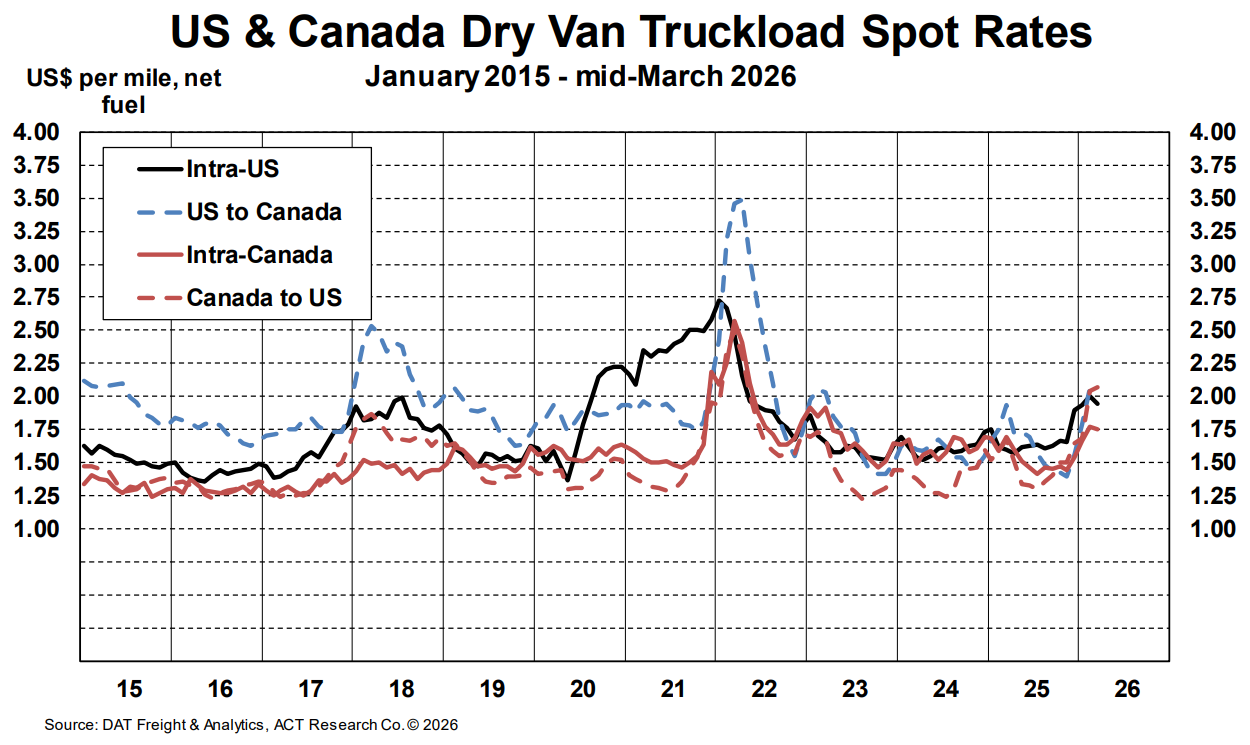
Capacity tightness in Canada keeps rates elevated: Rates across all lanes increased in February as seasonal tightness and foreign driver-related regulatory enforcement continued to challenge capacity.
Canadian Spot Market – Truck Index
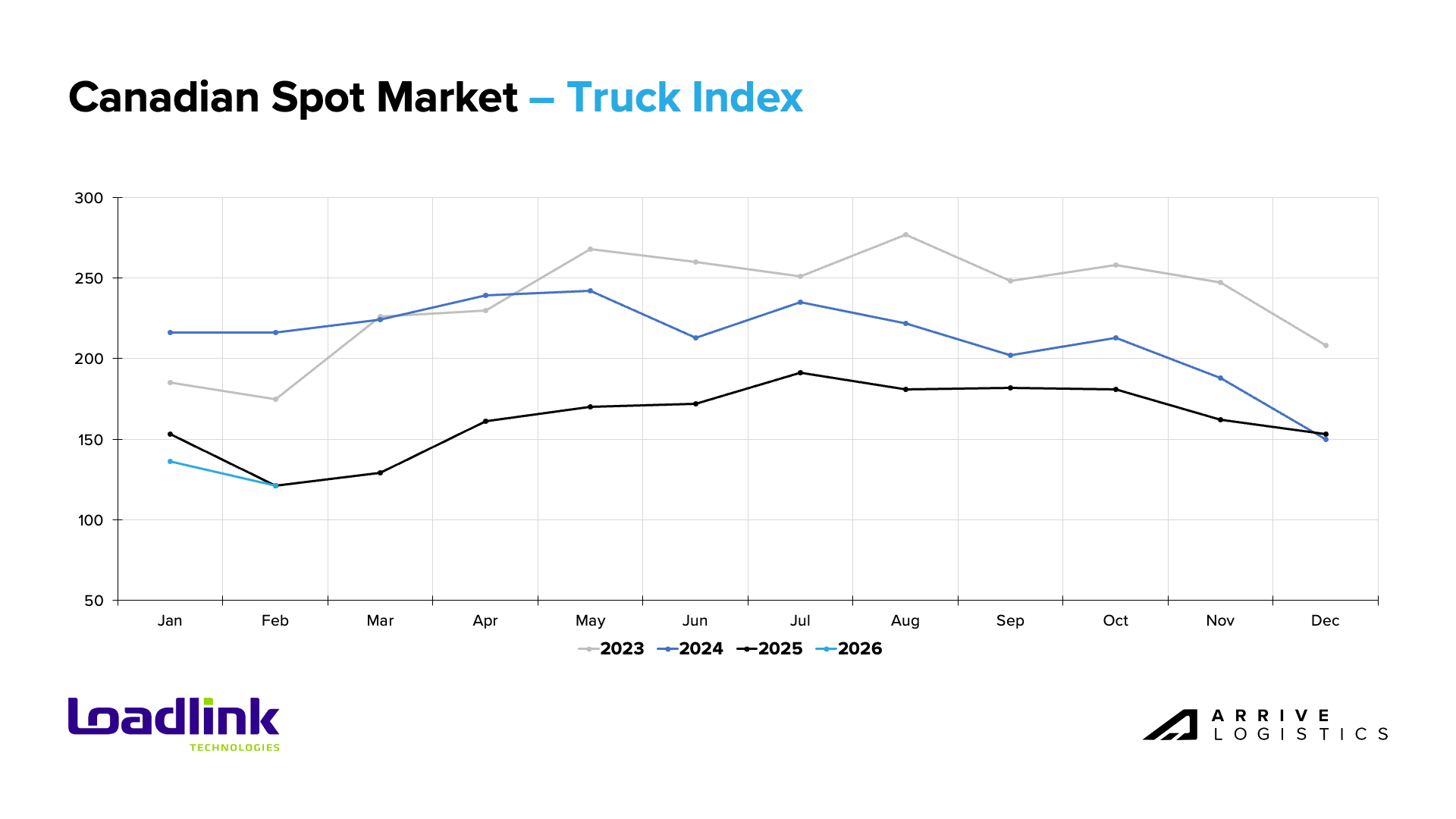
Declines in truck postings align with tighter capacity conditions: Truck postings declined in February as the spot market stayed hot and truck availability tightened. Loadlink reported truck postings were down 11% month-over-month, bringing them flat year-over-year in February.
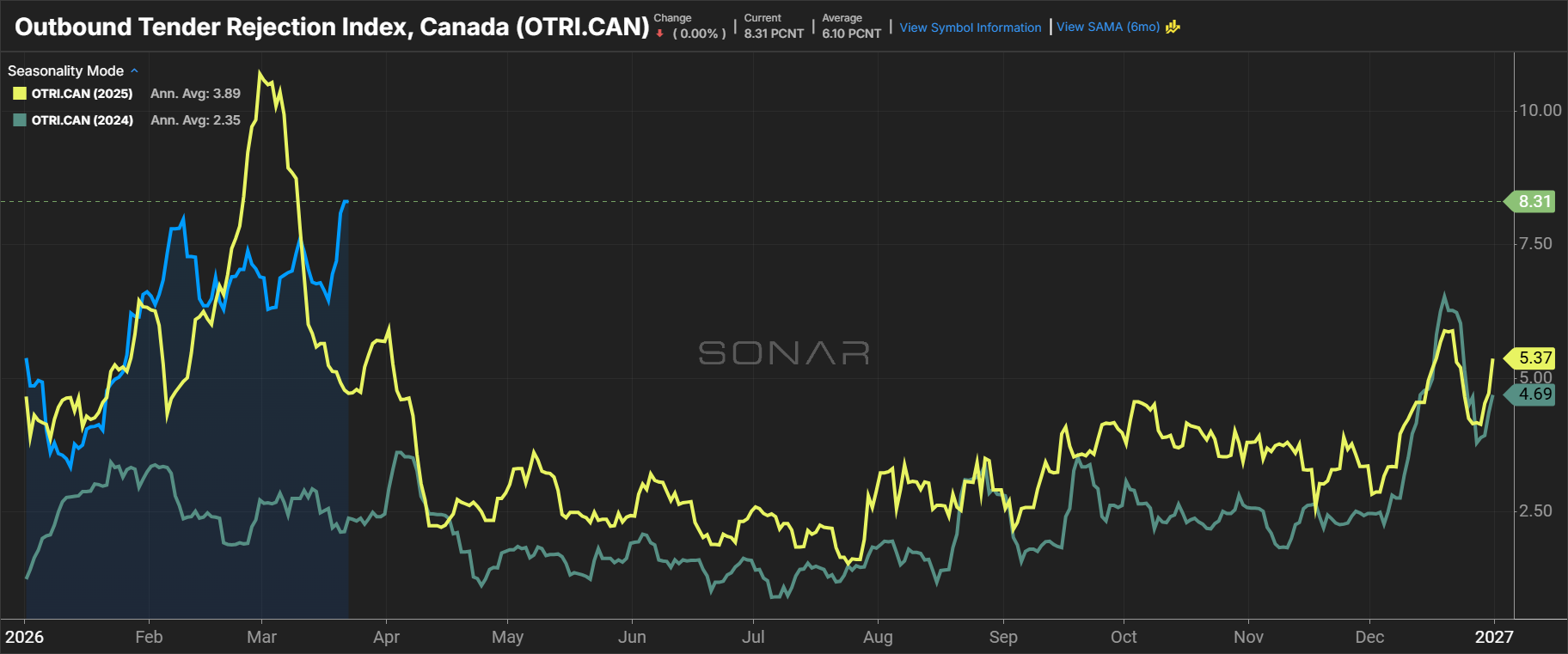
Outbound Tender Rejection Index
Outbound tender rejections remain elevated: Outbound tender rejections continue to be indicative of southbound capacity challenges. At 8.31%, they are trending higher than in recent years as driver shortages and increased fuel costs continue to restrict capacity.
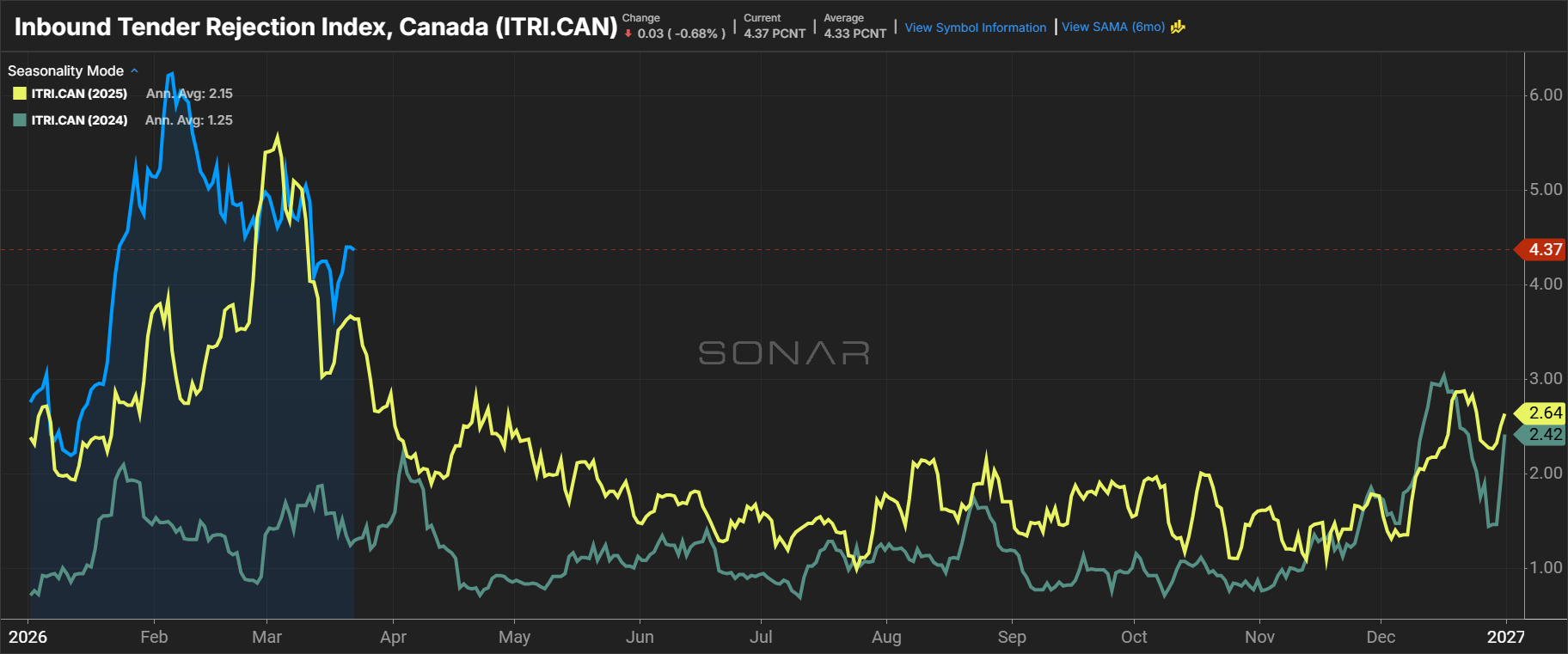
Inbound Tender Rejection Index
Inbound tender rejections normalize but remain elevated: Inbound tender rejections decreased but remain above prior-year levels.
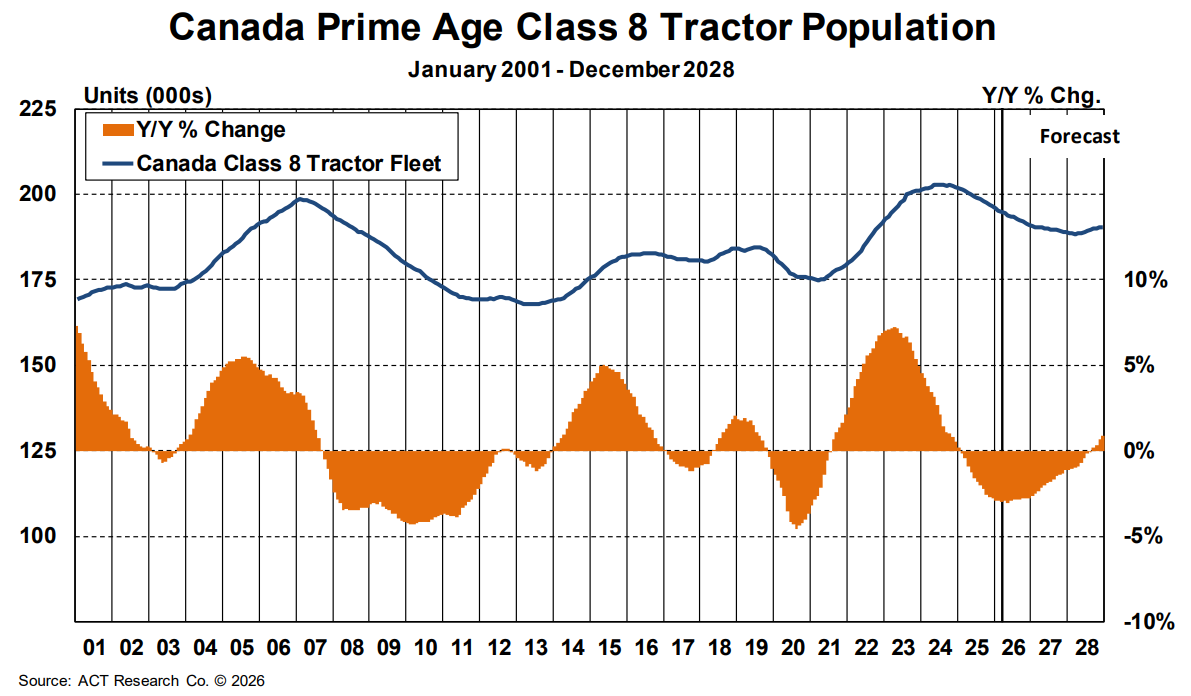
Canada Prime Age Class 8 Tractor Population
Tractor population contraction continues: The total tractor count is down 3% year-over-year in March and is expected to fall another 2.8% in 2026, according to ACT Research. Ongoing declines increase market vulnerability as capacity tightens throughout the year.
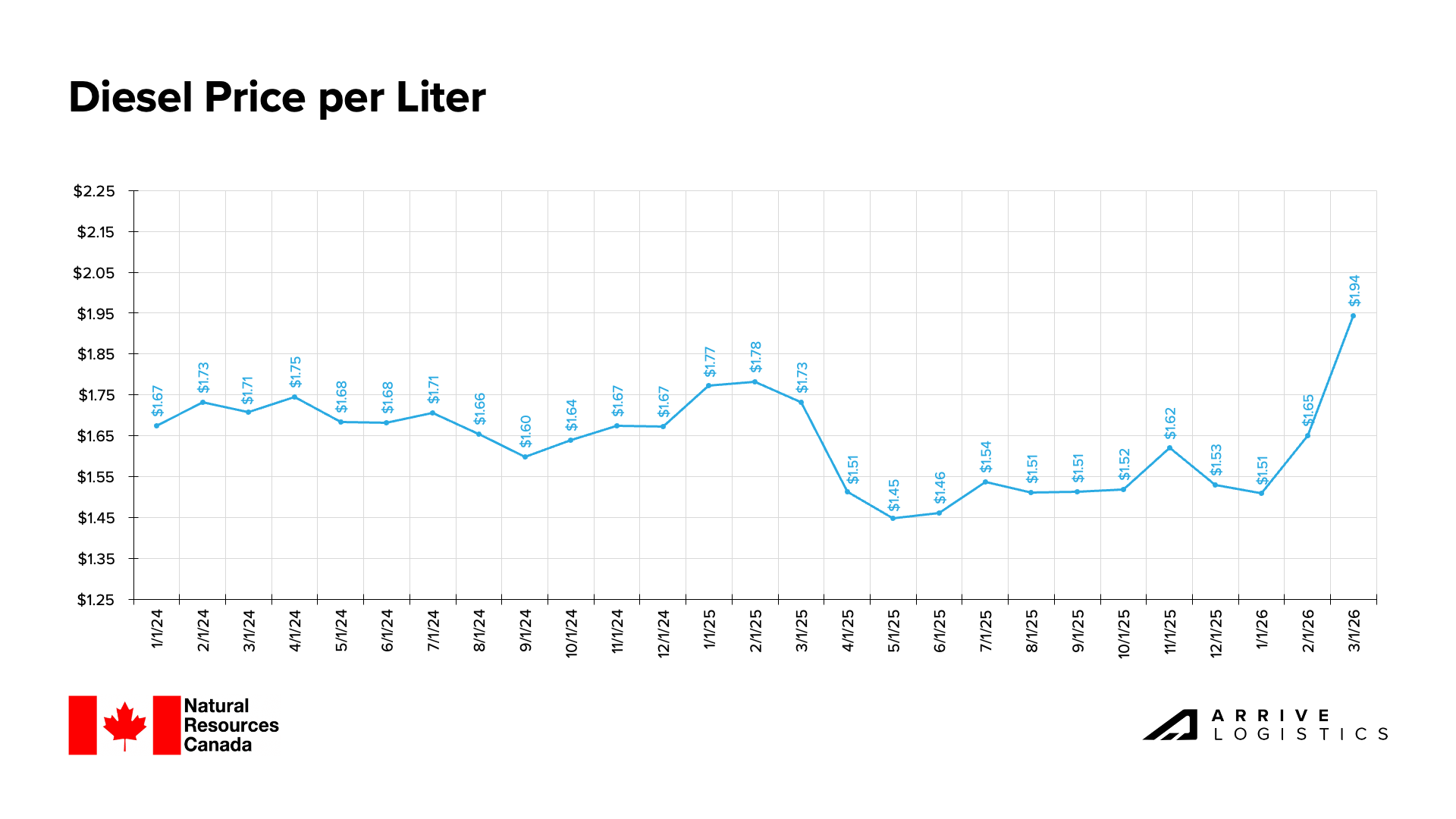
Canadian Diesel Price per Liter
Canadian diesel prices rise: Canadian diesel prices soared to the highest levels in recent history as the war in Iran commenced. Smaller carriers exposed to the spot market will feel the largest financial burden, further tightening capacity while keeping all-in rates elevated.
Navigate the freight market with confidence.
Get this free report delivered straight to your inbox every month.