

"*" indicates required fields
"*" indicates required fields
"*" indicates required fields


Successfully navigating freight market cycles begins with understanding the relationship between rates and the core drivers of truckload supply and demand. High or rising demand in a tight capacity environment puts upward pressure on rates, while weak or easing demand amid ample capacity pushes rates down.
By tracking directional trends in truckload demand (volume) and available capacity (trucks), we can forecast rate trends with a high degree of accuracy and consistency. With that, we present our outlook through the end of 2027.
With diesel prices set to drive up transportation costs well into next year, Arrive’s Market Intelligence team also created this guide to help you plan ahead.

The domestic truckload market has moved past its inflection point and into a period of rate inflation that peaks around the turn of the year. Our base case treats the 2026 run-up as an overdue rate correction that resolves into a new floor: spot rates crest in January 2027 around summer peak 2026 levels and then ease modestly through the first quarter, landing near today’s levels rather than falling further. Contract rates hold up better and stabilize through Q1, reflecting the structural supply-side support now embedded in the market.
Through the middle of 2027, spot rates stabilize at a level meaningfully higher than the lows of the prior cycle. Year-over-year comparisons moderate sharply as the market laps the 2026 highs, with spot rate growth dipping toward flat or slightly negative by mid-year even as absolute levels hold. The shape of the risk around this base case is deliberately asymmetric, with downside limited by the new floor and significant upside if demand accelerates or capacity is further disrupted.
Van contract rate year-over-year growth will peak at 22% in November 2026 before fading to 18% in January 2027 and regressing to flat year-over-year in Q4 2027.
Reefer spot rate year-over-year growth will fade from 41% in July 2026
to 22% in January 2027 and eventually level out near flat year-over-year
throughout the back half of 2027.
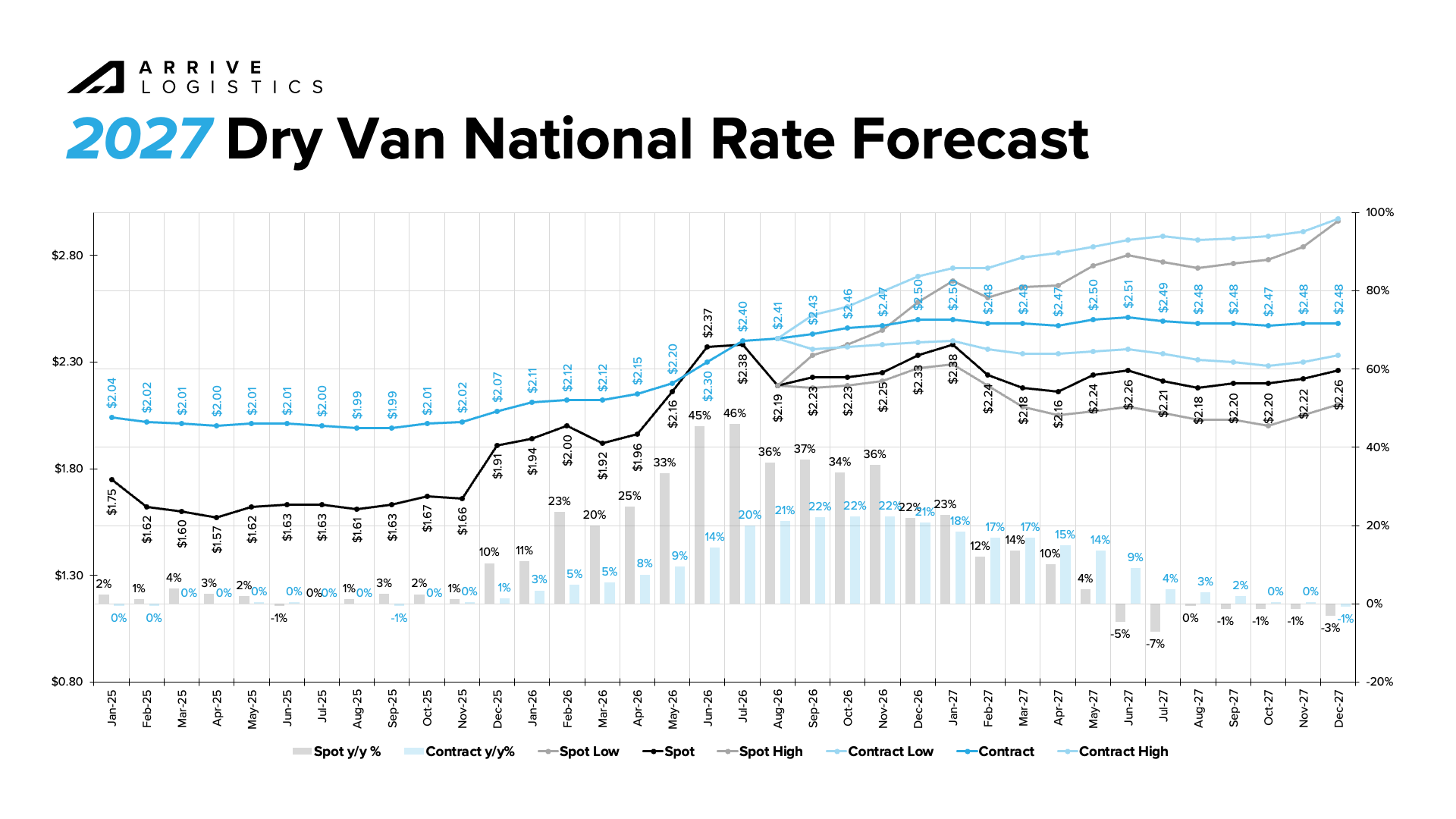
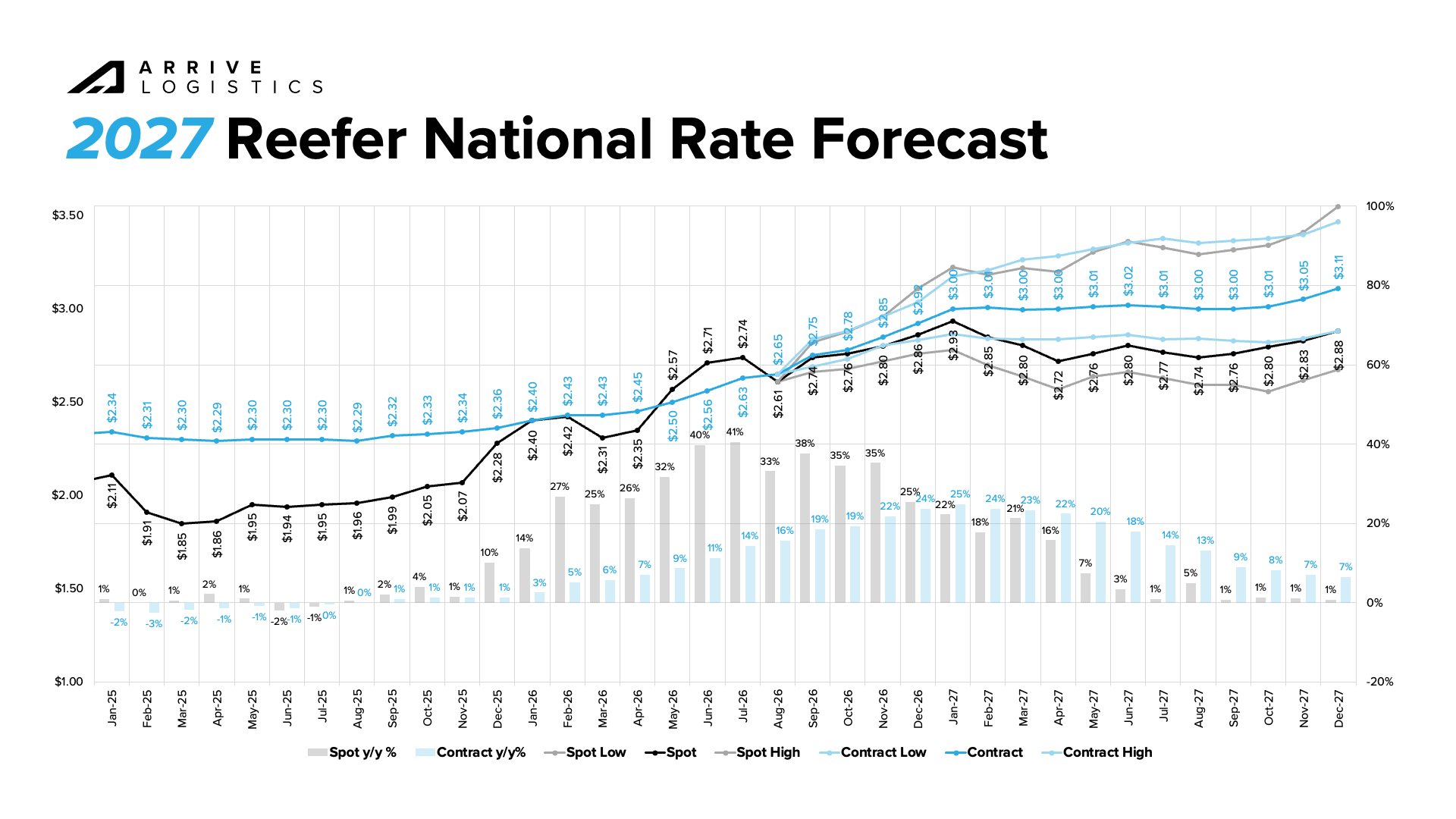
Demand is not the engine of this cycle, and increasingly, it’s not even keeping pace. Freight volumes remain soft on balance: the LTL-heavy Cass Freight Index showed shipments down 4.8% year-over-year in July, and while spot demand has technically remained above prior-year levels since late spring, that comparison flatters a weak base rather than signaling genuine strength. Forward indicators are mixed at best, with little evidence of a demand inflection in either direction.
Because the cycle is supply-led, the rate floor doesn’t require stronger demand. Demand is more likely to remain a passive backdrop than drive the next leg of the cycle. That said, the flip side is worth flagging: capacity is tight enough that any real demand spark, even a modest one, would land on a market with little slack to absorb it, making any upside surprise disproportionately disruptive relative to how muted the current demand signal is.
Supply will decide the course of this cycle. Structural capacity constraints, rising operating costs and a persistently tight driver pool are the primary reasons rates cannot fall back to prior-cycle lows. Even if demand softens from current levels, these forces maintain a firm floor for both spot and contract rates. Simply put, it’s not getting any cheaper or easier to run a truck, so carriers will continue to prioritize rates that support their businesses.
This forecast reflects our base-case scenario given the information available at the time of writing. The following factors could introduce upside or downside risk:
The downstream effects of the Supreme Court’s broker/carrier liability ruling on insurance pricing, insurability and carrier usability remain to be seen. A sharp increase in renewal premiums or a meaningful reduction in the insurable carrier base would tighten usable capacity and represent a clear upside risk to rates.
Structural driver constraints, amplified by ongoing ELP, non-domiciled CDL and cabotage enforcement, underpin the rate floor. Any further tightening would raise the floor and increase the market’s sensitivity to disruption.
Rising insurance and wage costs mean rates must remain elevated for a sustained period before carriers invest in maintaining or expanding their fleets. This lag can extend the cycle.
Shifting trade policy, including tariffs, changing trade relationships and the timing of implementation, makes import volumes and freight demand difficult to predict. The direction of this risk remains two-sided, but the elevated uncertainty complicates network planning for shippers and carriers alike.
Ongoing conflicts, most notably the war in Iran and Russia’s war in Ukraine, pose a persistent risk to the outlook. Their primary transmission channel to domestic freight is through energy prices. Escalation in the Middle East can quickly drive up diesel prices, disproportionately squeezing smaller, spot-exposed carriers and accelerating capacity exits. Inflation driven by elevated energy prices also poses a risk to consumer demand.
Our base case does not require demand growth. A demand spike is therefore an upside risk and the most direct path to the high-case scenario, where rates extend well above the base path into late 2027.
This report projects linehaul rates excluding fuel, but diesel price swings, driven in part by the geopolitical risks above, influence carrier economics and shipper behavior and can complicate forecast-error measurement.
With the market already at a firm floor, significant weather events can push rates higher more quickly than they would in a deflationary environment.
The national average spot and contract rates per mile used in this report are sourced from DAT and are not further processed by Arrive. DAT may revise previously published rates, which can create variations between this report and DAT materials. Using the macroeconomic factors shaping supply and demand in the domestic truckload freight market, we aim to set reasonable expectations for the directional movement of DAT’s national average spot and contract rates.
Get this free report delivered straight to your inbox every month.
"*" indicates required fields
"*" indicates required fields

As VP and Senior Analyst at ACT Research, Tim analyzes commercial vehicle demand and alternative powertrain development (i.e. electrification), and authors the ACT Freight Forecast, U.S. Rate and Volume Outlook. He previously spent fifteen years in equity research focused primarily on the transportation, machinery, and automotive industries, and co-founded leading equity research firm Wolfe Research.
Barry Conlon is the CEO and founder of Overhaul, the global leader in active supply chain risk management and intelligence. With a remarkable career spanning over 30 years in supply chain security, he is widely regarded as a trailblazer in modern-day supply chain security standards and best practices.
Chad Eichelberger is the President of Reliance Partners. Since 2015, he’s leveraged his extensive experience in risk management, compliance, best practices and contracts to lead the company’s logistics and truck insurance strategy and operations. Chad was previously the President of Access America Transport, where he led the company from $8M to over $600M in revenue.
Asanka Jayasuriya is the CTO at 8VC. He is an accomplished engineering and product leader with 20+ years of experience in the cloud. He has a strong background in enterprise SaaS, PLG products, infrastructure, and security. Notably, he served as CTO and SVP of Engineering at SailPoint, leading their successful transition to the cloud and successful exit event. He also held senior leadership roles at InVision, Atlassian, and Amazon, driving growth, operational excellence, and innovation. At 8VC, Asanka works with the entrepreneurs and leaders in our portfolio as a virtual CTO supporting their growth.
Dean Croke is a Market Analyst at DAT Solutions, where he focuses on freight market intelligence and data analytics. His 35 years of experience with data analytics, transportation, supply chain management, mining and insurance risk management include time as co-founder of FleetRisk Advisors and in a number of other high-level roles with FreightWaves, Spireon, Lancer Insurance, Omnitracs Analytics (formerly Qualcomm) and more.
Andrew Clarke is Board Chairman for Global Critical and DCLI, Inc., and a board member for Arrive Logistics and Element Fleet Management Corp. His 20 years of global transportation and logistics experience include time as CFO of C.H. Robinson, CEO of Panther Expedited Services, Inc. and SVP and CFO roles at Forward Air Corporation.
David Spencer is the Vice President of Market Intelligence at Arrive Logistics. David joined Arrive in 2017 after spending six years at AFN focused on business intelligence. His department provides critical market data and expert analysis to internal teams and publishes monthly market updates for shippers and carriers under the Arrive Insights banner.
Eric Dunigan is the President of Arrive Logistics. He began his career at Command Transportation before co-founding Arrive with Matt Pyatt in 2014. As president, he is responsible for driving revenue and growth, as well as leading the Strategic Partnerships team — a veteran group of supply chain experts who work with Arrive’s customers to reimagine their shipping strategy.
Matt Pyatt is the Chief Executive Officer of Arrive Logistics. He co-founded Arrive with President Eric Dunigan in 2014 after building his career at Command Transportation. As CEO, he is responsible for overseeing the company’s financial health, strategic vision and culture, as well as building a scalable leadership team to support Arrive’s growth.
Scott Sandager is the Chief Administrative Officer at Arrive Logistics. He joined Arrive in 2018, bringing over 14 years of logistics and brokerage experience, with expertise in project and change management, organizational design, talent development and customer satisfaction. Scott previously held many diverse roles of increasing responsibility with AFN, a Chicago-based freight brokerage.
"*" indicates required fields
If you’re not an Arrive customer, please join our network to access the portal.
Fraud Prevention
Freight fraud continues to impact our industry. We encourage shippers and carriers to reach out to Arrive immediately if there is ever a shipment in question that may be subject to fraud (including fictitious actors and websites). Arrive will not ask you to pay upfront for any dedicated lane or committed capacity program. If the offer you are receiving sounds too good to be true or unrealistic, it may be fraud. Arrive Logistics recommends verifying all communications come from our registered email domain is @arrivelogistics.com and notes that access via VPN or Proxy is prohibited on Arrive systems. Our 24/7 phone number is 888-861-0650 and our leadership team can also be reached at feedback@arrivelogistics.
Use of Cookies
We use cookies to enhance your browsing experience, serve personalized ads or content, and analyze site traffic. By continuing to use this website, you acknowledge and consent to our use of cookies as detailed in our privacy policy.
Please have the following info ready to complete registration
"*" indicates required fields