Need Help
close button

How can we help?

Select One:
Arrive Insights™

August 2026 Freight Market Update

Arrive Logistics VP of Market Intelligence David Spencer Headshot
David Spencer
VP of Market Intelligence
Joel Gullickson
Managing Editor

Table of Contents

Market Memo

From the Desk of David Spencer

Spot market conditions have shifted significantly over the last month. One of the most impactful drivers has been contract reconfigurations, which have improved routing guide performance as peak seasonal demand faded. This in turn has helped bring down spot demand and rates, while higher fuel prices have made contract pricing even more favorable amid elevated surcharges.

Another byproduct of persistently elevated truckload rates has been increased intermodal utilization. As more shippers take advantage of the savings offered by rail, the shift has compounded declining truckload demand as seasonal softening takes hold.

The supply story remains largely unchanged amid the shifting spot market environment. Regulatory enforcement continues at a steady pace, while new issues like the recent Montgomery ruling could affect insurance, insurability and carrier usability. But rather than creating a sudden capacity shock, these pressures are more likely to remain a sustained headwind to supply recovery.

Interestingly, while elevated rate environments typically encourage carriers to invest in fleet expansion, most are instead opting to simply maintain current supply by replacing aging equipment and increasing wages to attract and retain drivers. If current headwinds last as expected, the capacity pool is unlikely to grow meaningfully in the near term.

The demand picture is also somewhat complicated. Summer import activity, healthy consumer spending and manufacturing expansion have all contributed to volumes. Even so, most of the recent year-over-year growth has come from AI- and data-center-related freight, leaving the broader demand environment fragile as critical areas like housing and discretionary spending remain weak.

Taken together, these conditions point toward relative market stability amid a broad range of risks. Improved routing guide performance should continue to mitigate spot volatility as the market settles to a post-summer floor. Seasonal tightening could still create pockets of volatility through year-end, particularly in the reefer market, while any slowdown in demand would increase downside risk to the spot rate environment. 

Read on for a deeper look at the demand, supply, rate and economic data shaping the road ahead.

David Spencer, VP of Market Intelligence

Key Takeaways

  • Overall tender rejections have returned to roughly 13.5%, near pre-summer levels, as contract reconfigurations improve routing guide performance and reduce the need for spot capacity.
  • Intermodal continues to take additional truckload market share as shippers seek lower-cost alternatives.
  • Fleet growth remains limited as carriers continue prioritizing equipment replacement and higher driver wages over fleet expansion.
  • Regulatory enforcement remains a major headwind to supply recovery. ELP violations continue at a consistent pace, while uncertainty around insurance and carrier usability could further constrain fleet expansion.
  • Demand has softened so far in Q3 as summer seasonality faded and tariff-related import pull-forward activity subsided.
  • While manufacturing expanded for a seventh consecutive month and AI- and data-center-related activity remains a key driver of freight volumes, weakness in housing and discretionary sectors leaves the broader demand environment fragile.
  • Consumer spending remains healthy, but if inflation continues to outpace wage growth and the labor market softens further, consumer activity could slow.

Truckload Demand

Looking Back

Spot demand softened in July as the market moved past the summer peak and into Q3. Imports increased, though tariff-related pull-forward activity has since begun to fade. Manufacturing expansion and strong consumer spending remained bright spots, as did AI- and data-center-related demand.

Looking Ahead

The broader demand environment is likely to remain relatively stable but fragile through year-end. Imports will likely soften after stronger activity arrived earlier than usual, while greater use of intermodal may limit truckload volume growth. On the upside, AI- and data-center-related activity, resilient consumer spending and holiday demand should provide support.

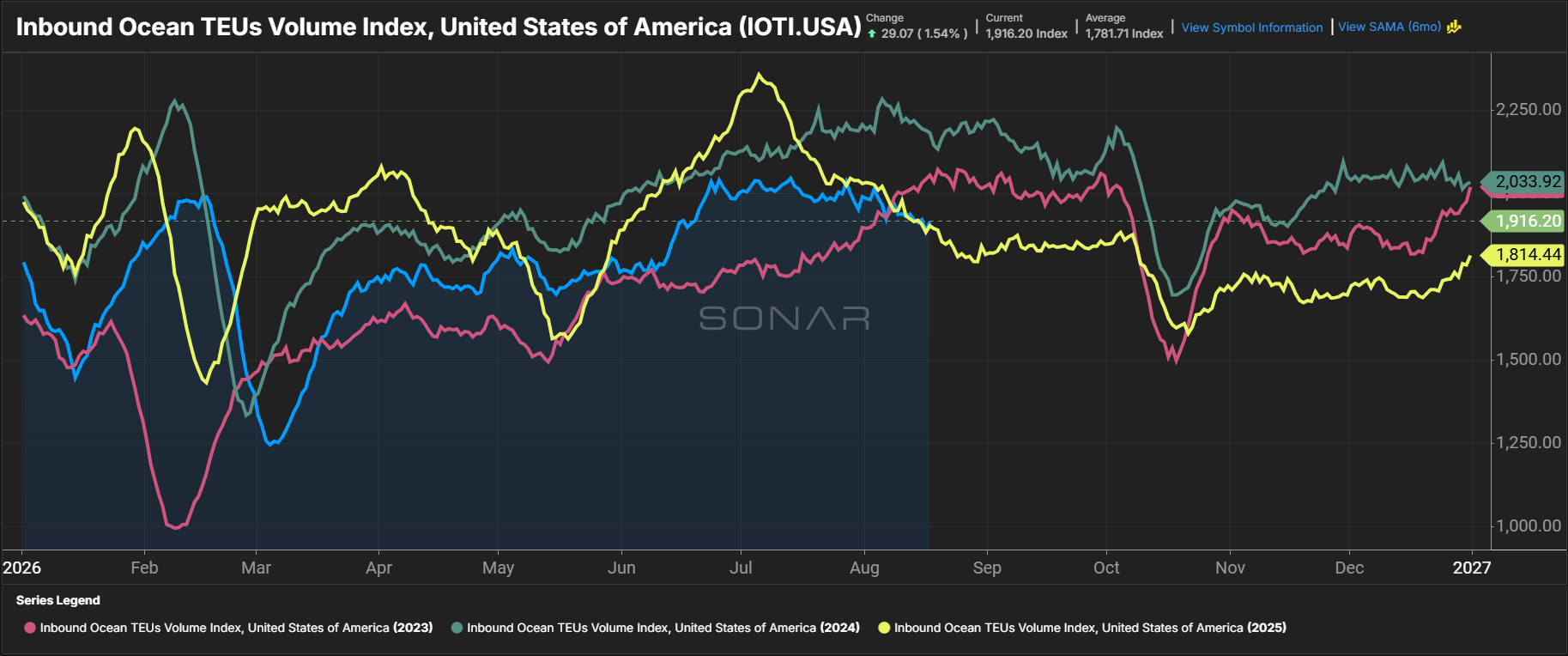
Inbound Ocean TEUs Volume Index, SONAR

Chart Notes
  • Import orders ease: SONAR data shows orders have trended lower since early July as tariff-related pull-forward activity fades. The early peak will likely leave activity softer than usual through year-end.

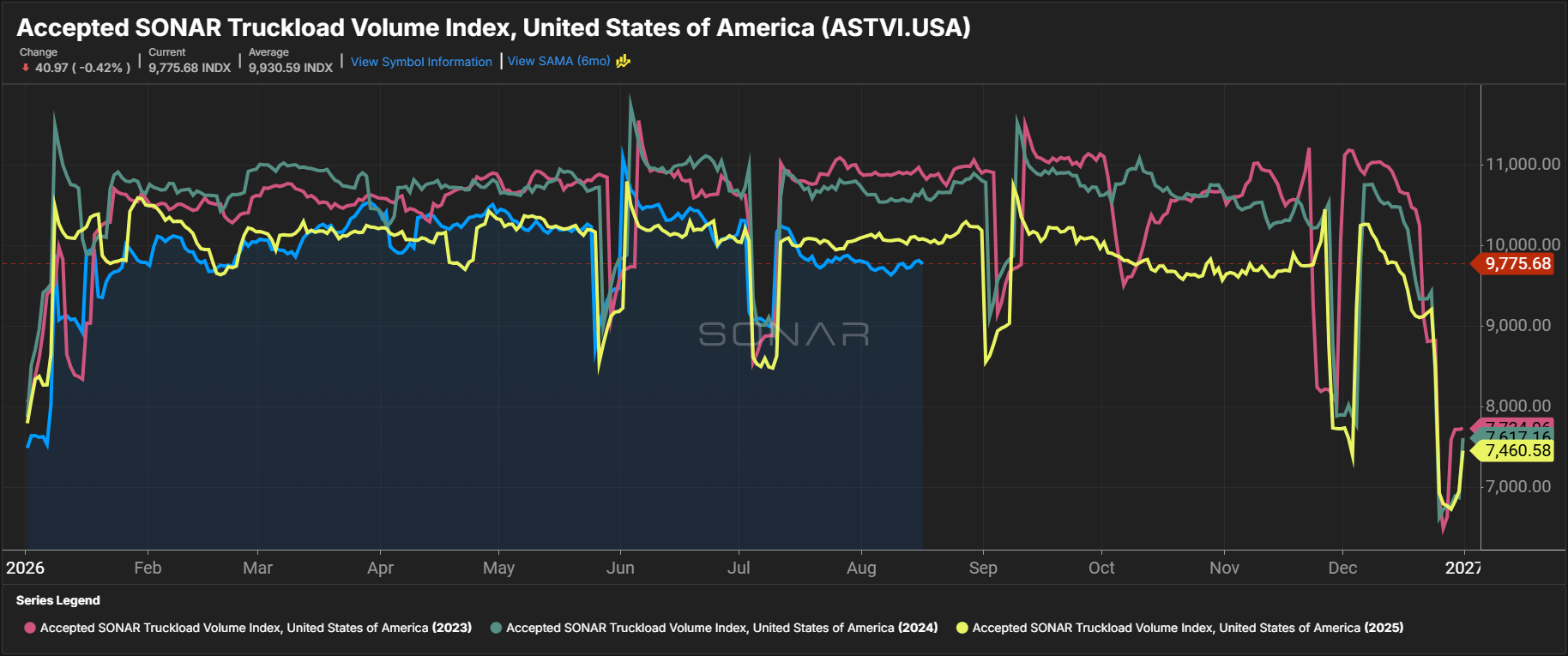
Accepted SONAR Truckload Volume Index, SONAR

Chart Notes
  • Accepted truckload volumes fall below prior-year levels: FreightWaves SONAR data shows accepted truckload volumes have trended roughly 2% to 4% below 2025 levels through most of August.

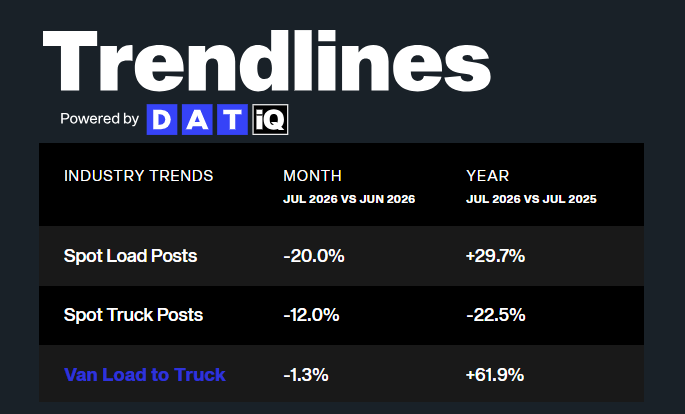
DAT Trendlines

Chart Notes
  • Spot market loses momentum: DAT data shows spot load postings fell 20.0% month-over-month in July, leaving year-over-year growth at 29.7%, down from more than 62% in June.

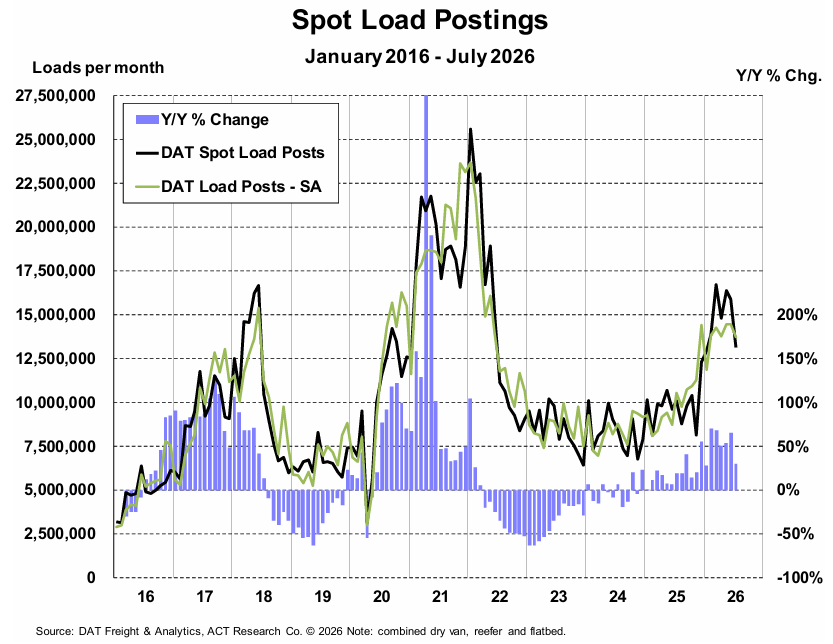
ACT DAT Spot Load Postings

  • Spot load postings turn lower: ACT/DAT data shows a sharp decline in July after climbing through much of the second quarter, providing further evidence of weakening spot market demand.

Cass Freight Index Report

Chart Notes
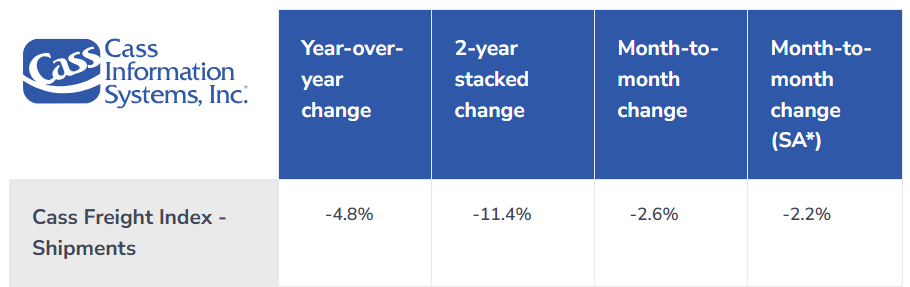
  • Cass Freight Index shows weaker demand: July shipment volumes declined 4.8% year-over-year, compared with a 4.1% decline in June. Volumes also fell 2.6% month-over-month and 2.2% on a seasonally adjusted basis.

Cass Freight Index Shipments Forecast

Chart Notes
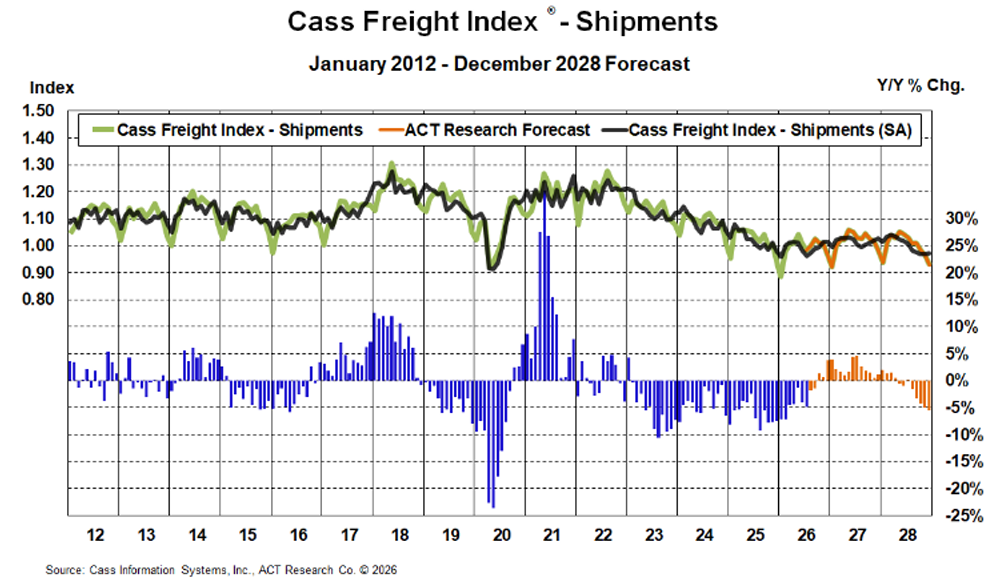
  • Demand outlook weakens: After pointing to the potential for a recovery later this year just one month ago, ACT lowered its Cass Freight Index forecast for the second half of 2026 and 2027 as rising interest rates, elevated fuel prices and a stalling labor market weigh on the outlook.

Descartes U.S. Container Import Volume

Chart Notes
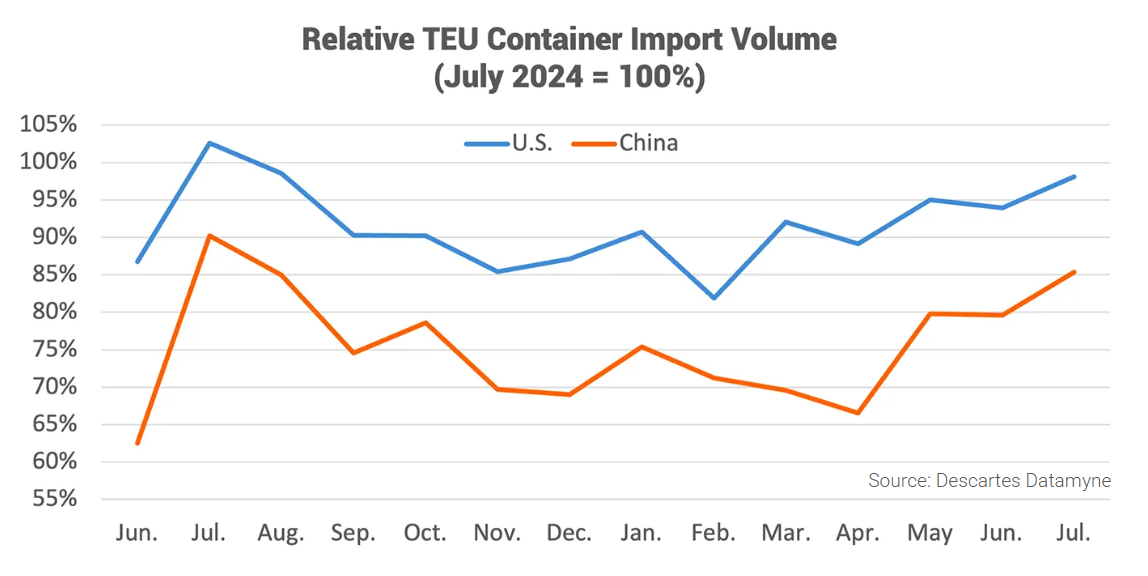
  • Import volumes rise in July: While volumes increased 4.5% month-over-month amid resilient seasonal demand, year-to-date imports remained essentially flat, down 0.9% from 2025 through July.

China CoO Imports

  • Chinese imports drive July gains: Shipments from China rose 7.2% month-over-month, outpacing the 4.9% increase across the top 10 countries of origin.

Manufacturing at a Glance, Manufacturing ISM

Chart Notes
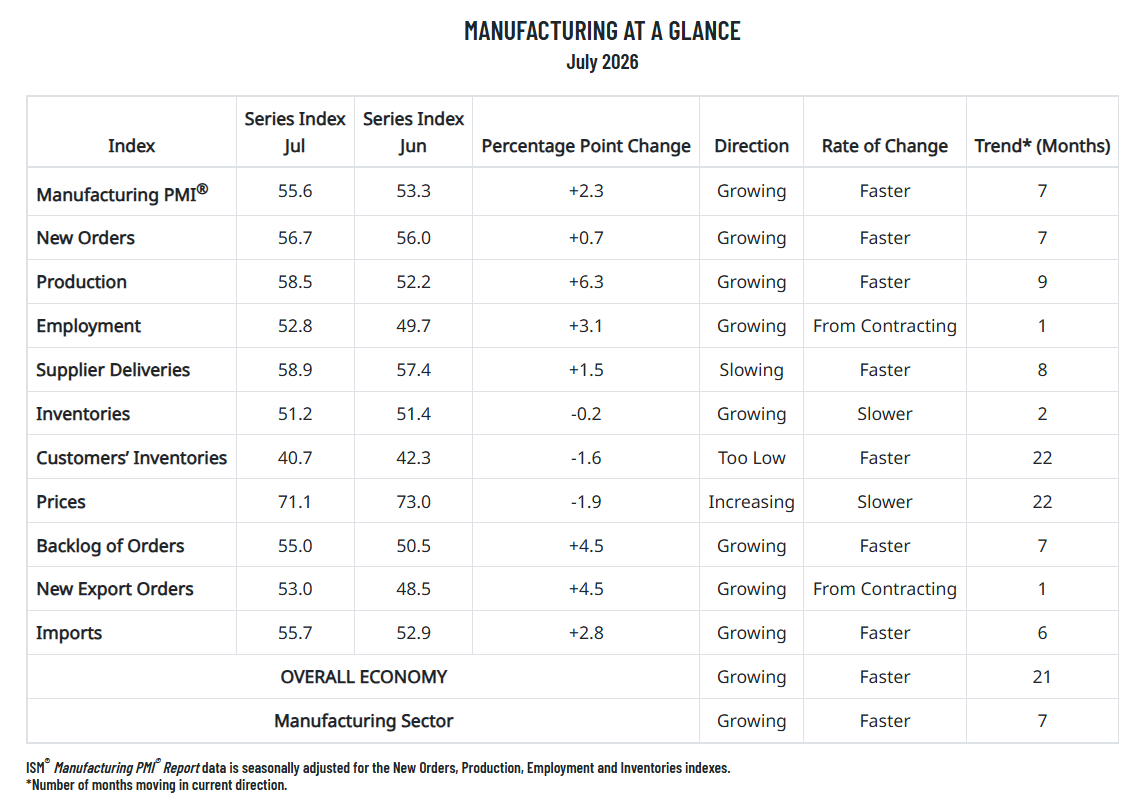
  • Manufacturing gains momentum: The ISM Manufacturing Index rose 2.3 points to 55.6 in July, marking a seventh consecutive month in expansion territory. New orders, order backlogs and new export orders all grew, while industries representing 20% of manufacturing GDP declined but none fell into strong-contraction territory.

Trucking Ton-Miles Index

Chart Notes
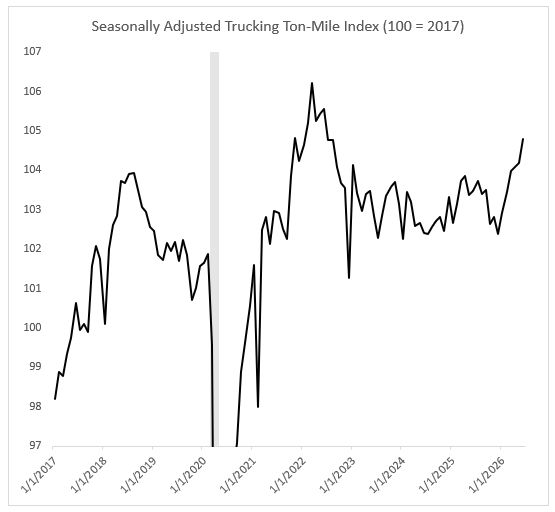
  • Ton-miles post strongest year-over-year gain since 2022: The Trucking Ton-Miles Index  from Jason Miller, Eli Broad Endowed Professor of Supply Chain Management at Michigan State University, rose 1.3% year-over-year in June as AI- and data-center-related activity continued to drive freight demand. However, weakness in housing and discretionary sectors points to a fragile overall demand environment.

Truckload Supply

Looking Back

Capacity eased in late July and early August as seasonal pressures faded and routing guide compliance improved. However, the market was still tight relative to prior years, and carriers continued to prioritize equipment replacement and driver wages over fleet expansion.

Looking Ahead

Truckload capacity should remain relatively stable in the near term outside periods of increased seasonal demand. Aging equipment, continued regulatory enforcement and uncertainty around insurance and carrier usability will likely further constrain fleet expansion.

SONAR Truckload Rejection Index, SONAR

Chart Notes
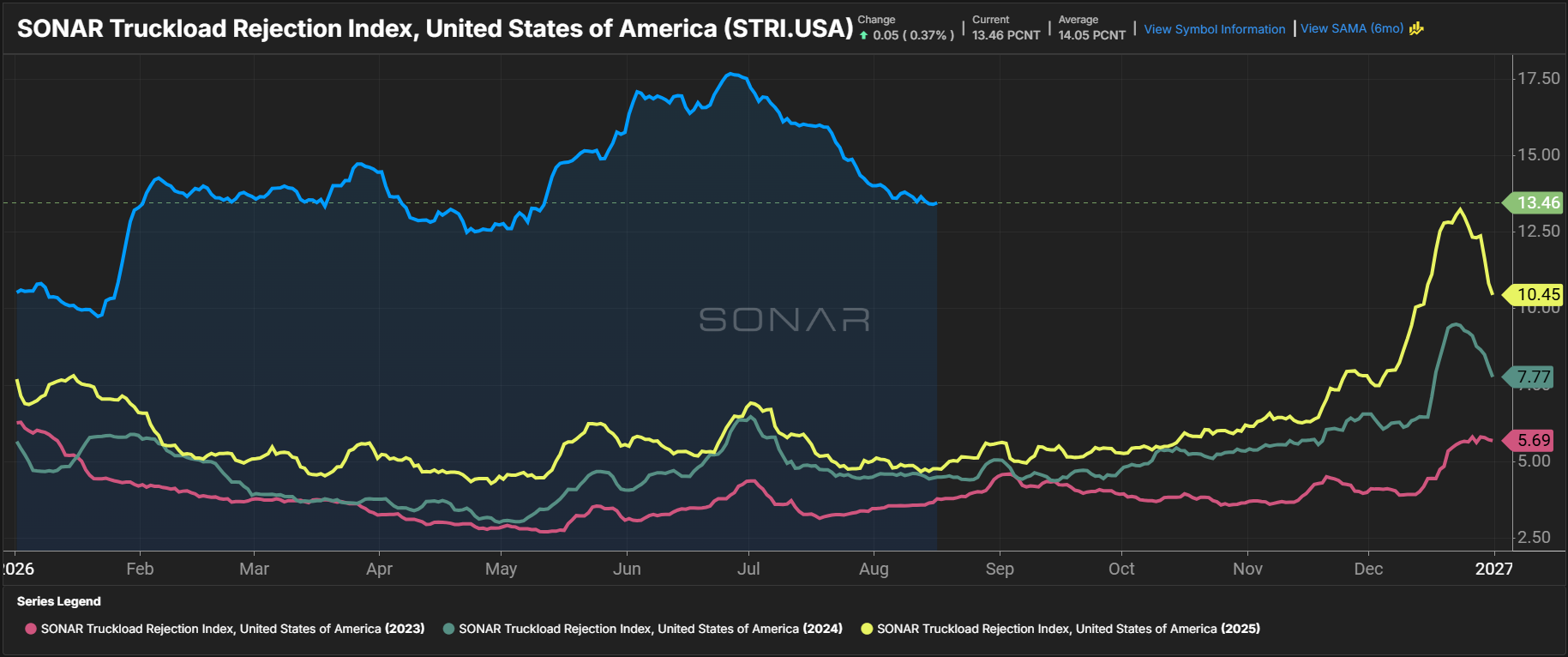
  • Tender rejections return to pre-summer levels: SONAR data shows overall rejection rates have eased to roughly 13.5% in August as improved contract compliance reduces routing guide disruption and spot market activity.

Dry Van SONAR Truckload Rejection Index, SONAR

Chart Notes
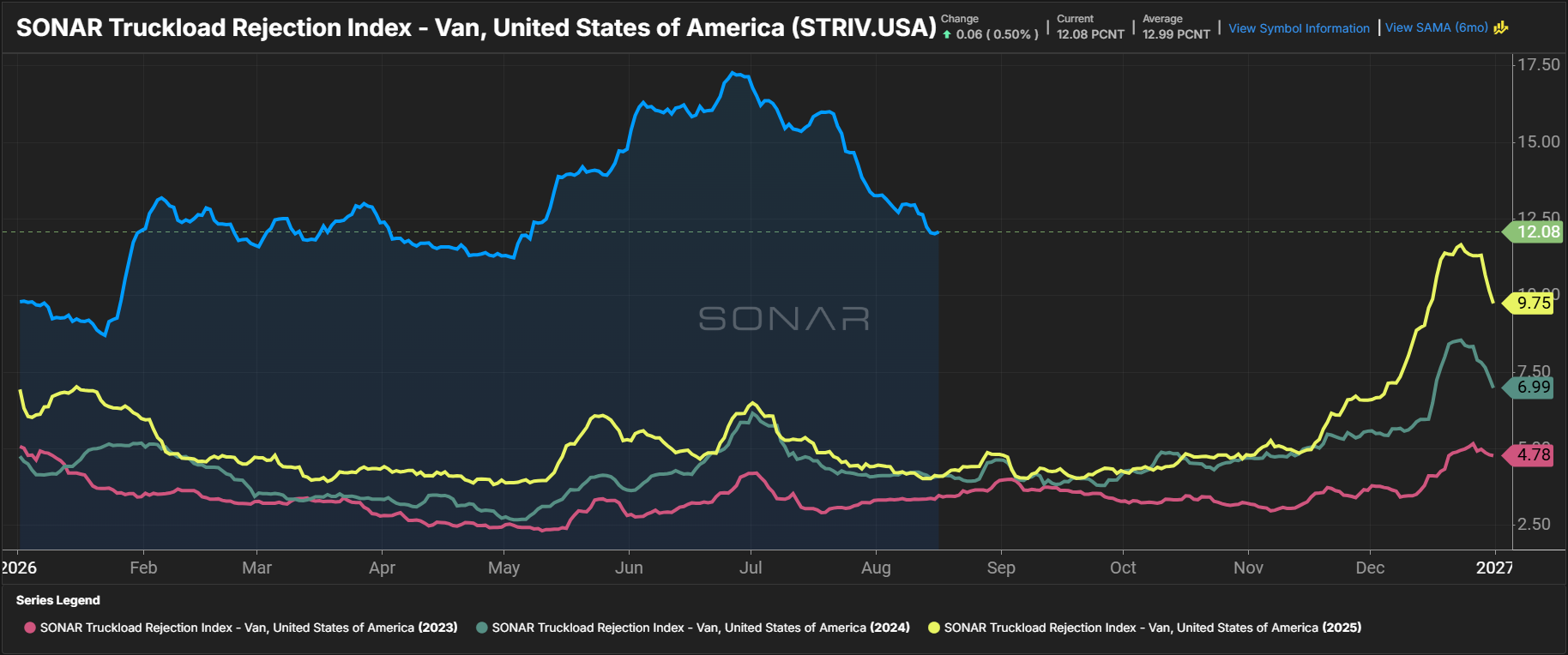
  • Dry van tender rejections continue to normalize: SONAR data shows van rejection rates have fallen sharply from the Fourth of July peak to roughly 12% in August as reconfigured contracts, higher fuel prices and softer seasonal demand are supporting a tender acceptance recovery.

Reefer SONAR Truckload Rejection Index, SONAR

Chart Notes
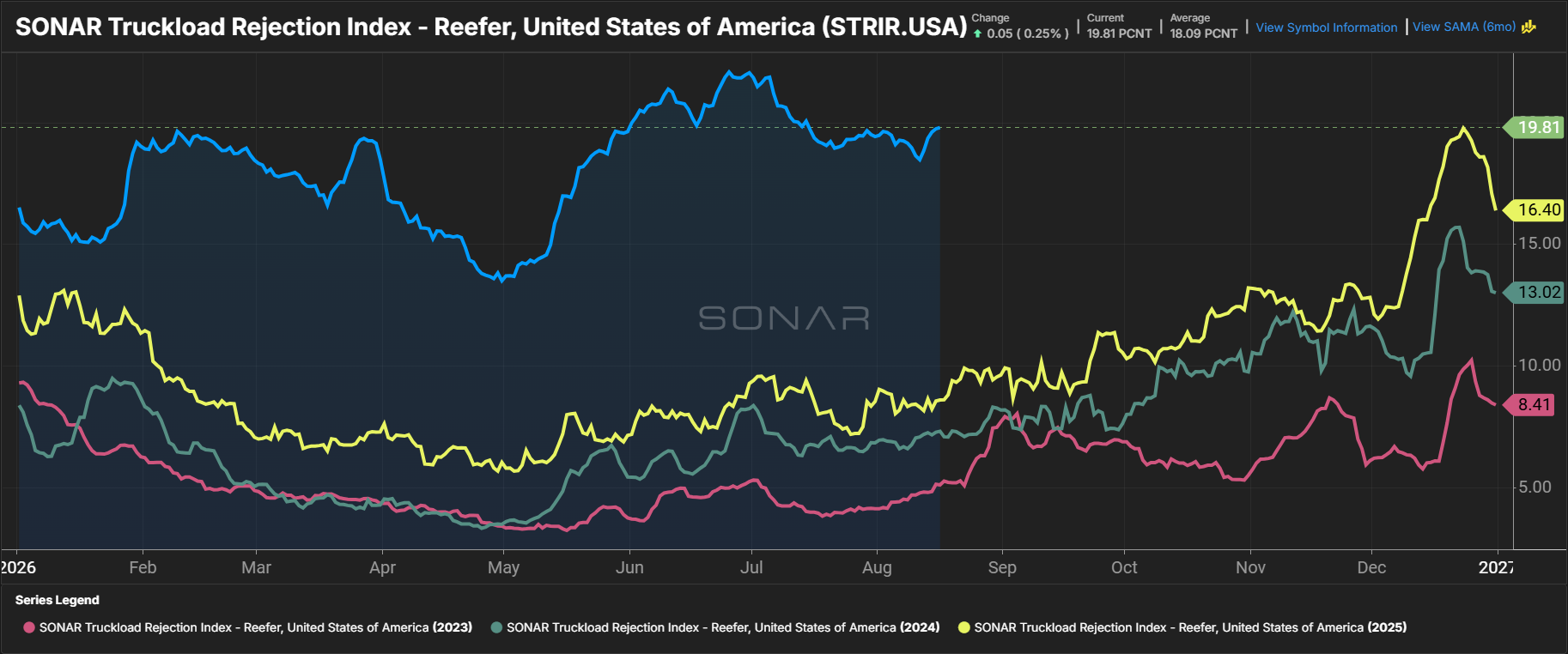
  • Reefer tender rejections remain elevated: SONAR data shows reefer rejection rates have eased from the Fourth of July peak but remain near 20% and appear more stable than dry van. Seasonal pressure from winter weather and holiday food demand could create additional routing guide disruption through year-end.

Flatbed SONAR Truckload Rejection Index, SONAR

Chart Notes
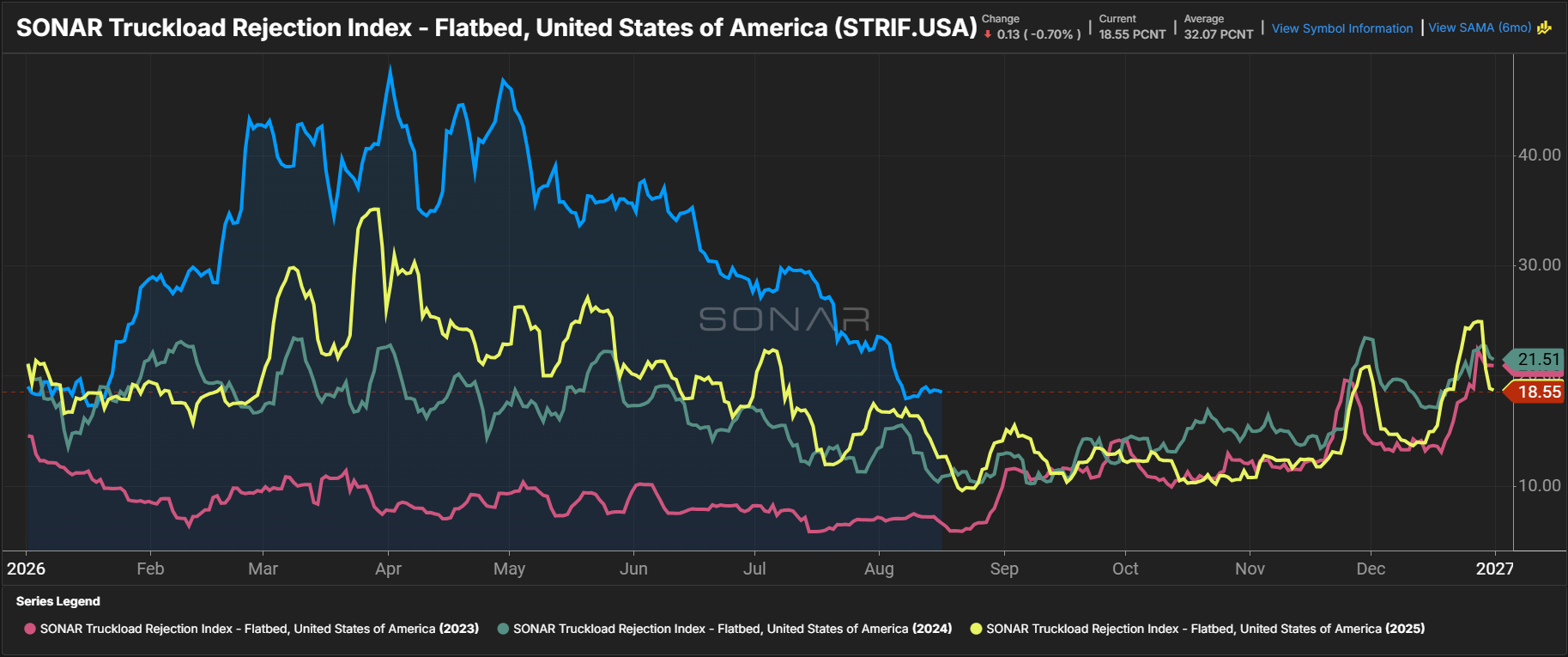
  • Flatbed tightness continues to ease: SONAR data shows rejection rates have fallen to roughly 18.5% as construction activity slows from its seasonal peak.

Van Load-to-Truck Ratio

Reefer Load-to-Truck Ratio

Chart Notes
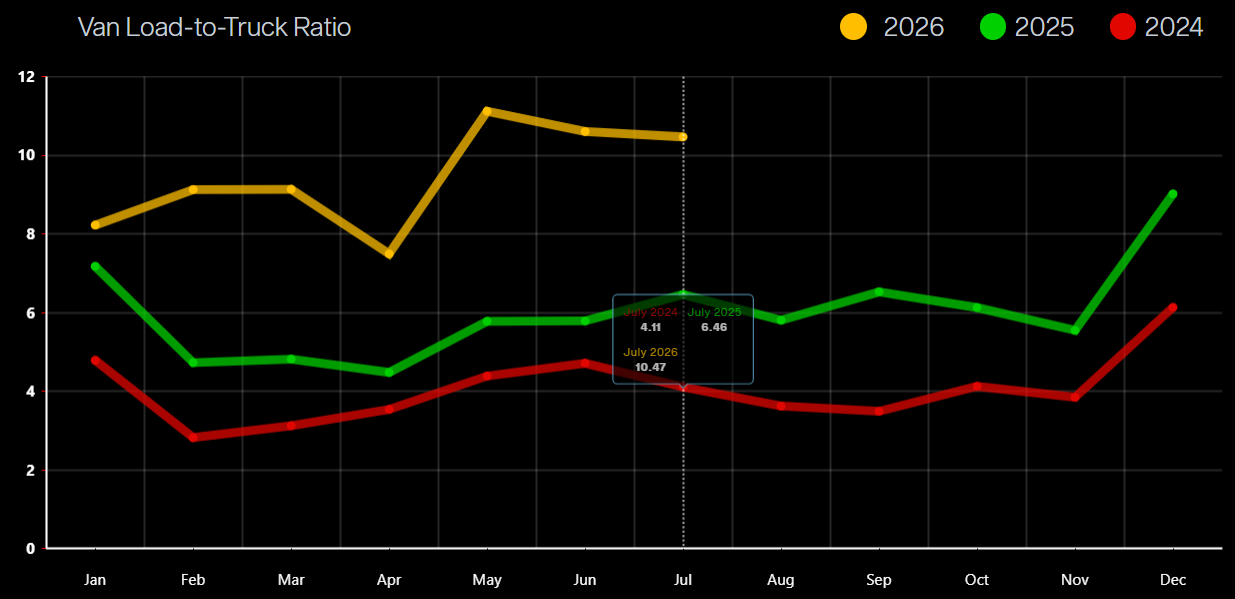
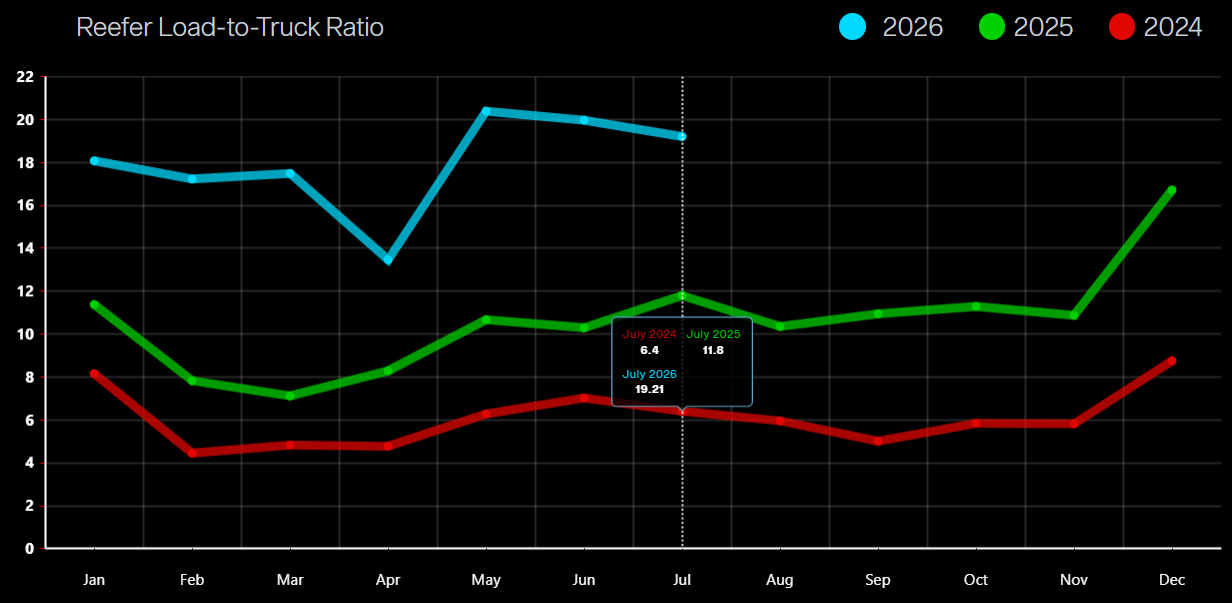
  • Load-to-truck ratios remain elevated: Van and reefer ratios declined slightly month-over-month in July but remained well above prior-year levels, indicating easing but still tight conditions.

Flatbed Load-to-Truck Ratios

Chart Notes
  • Flatbed load-to-truck ratio continues to normalize: The ratio declined again in July as construction demand eased but remained roughly 80% above prior-year levels.

Morgan Stanley Dry Van ONLY Truckload Freight Index

Chart Notes
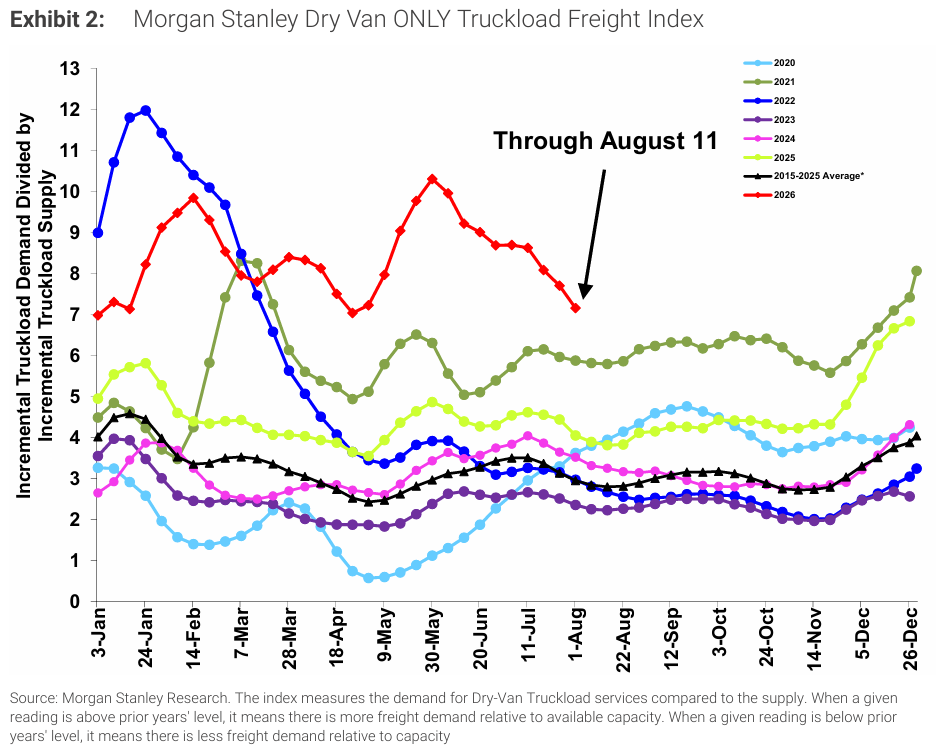
  • Dry van conditions remain historically tight: The Morgan Stanley Dry Van Index has eased from its early-June peak but remains at its highest level for this time of year since its inception nearly 30 years ago.

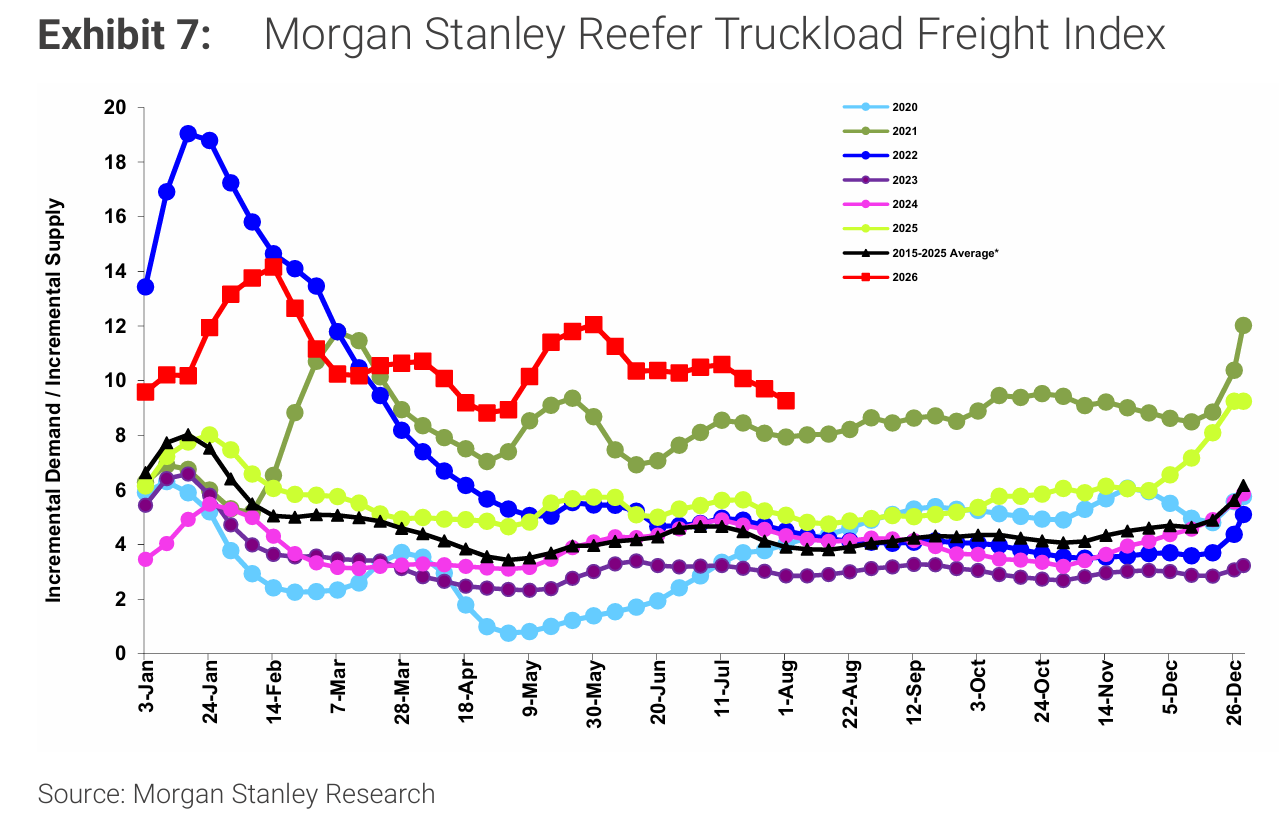
Morgan Stanley Reefer Truckload Freight Index

  • Reefer conditions ease gradually: The index declined month-over-month but still outperformed typical seasonality and was more stable than dry van.

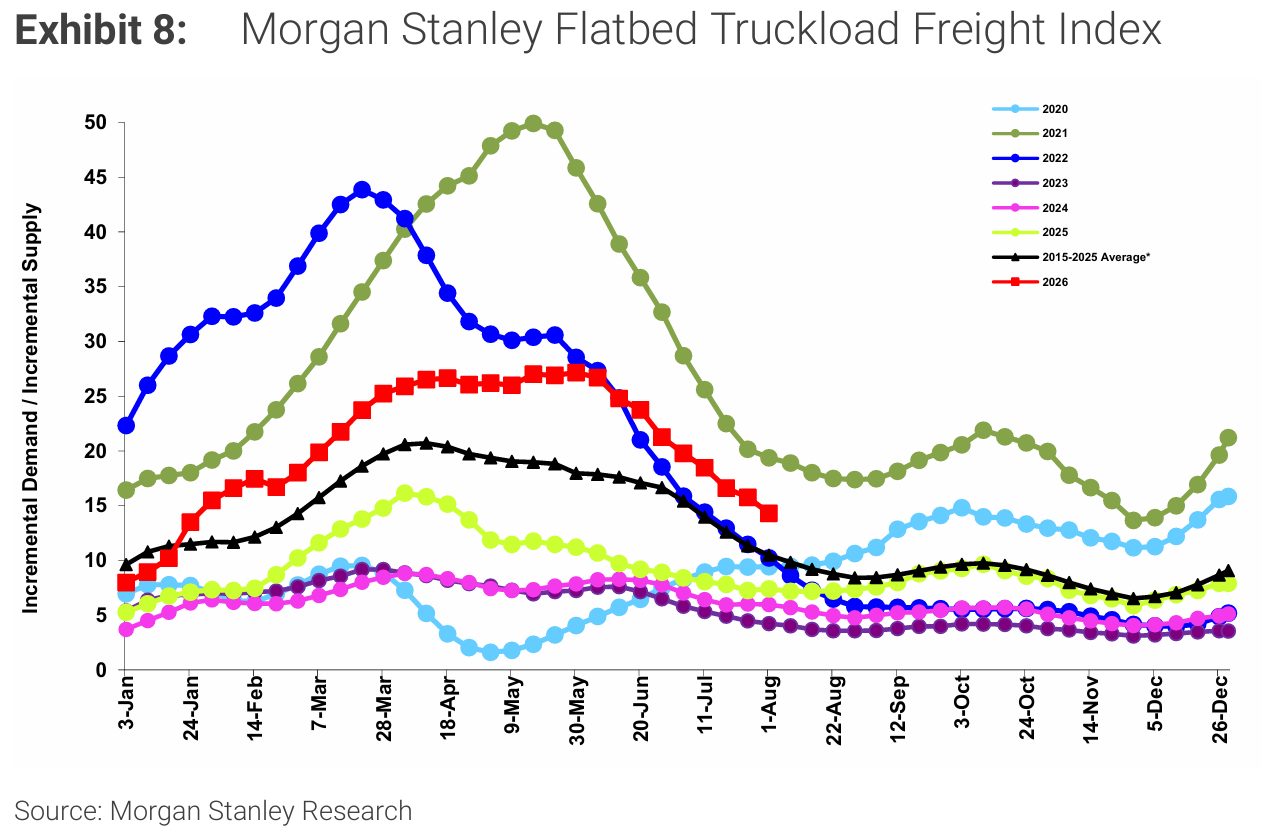
Morgan Stanley Flatbed Truckload Freight Index

  • Flatbed market cools after seasonal peak: The index declined month-over-month as the market moved beyond peak construction demand but still outperformed typical seasonality.

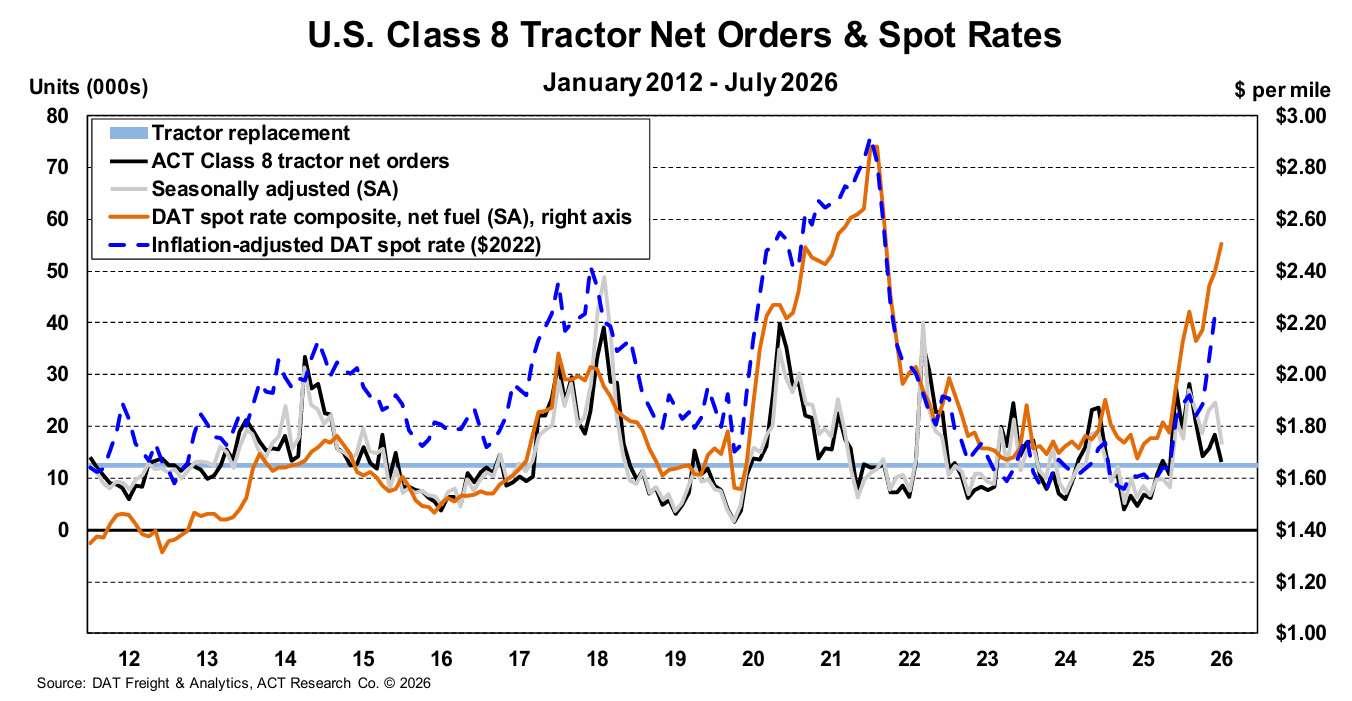
Class 8 Tractor Net Orders, ACT Research

Chart Notes
  • Fleet growth remains limited: ACT data shows Class 8 tractor orders fell to about 12,000 units in July from 18,444 in June. Orders have not increased as they typically do in an elevated spot rate environment, suggesting fleets are prioritizing replacing aging equipment over investing in expansion.

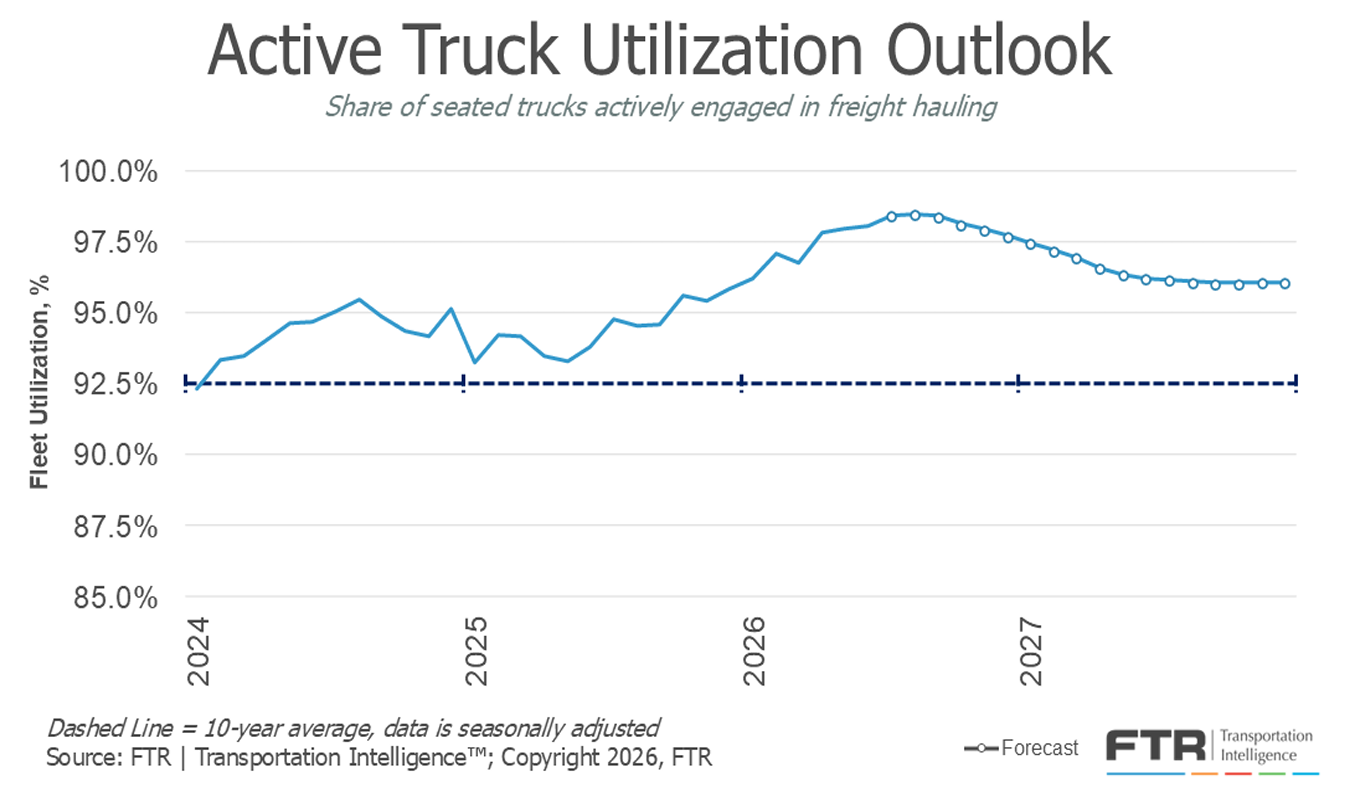
Active Truck Utilization, FTR

Chart Notes
  • Truck utilization expected to strengthen: FTR projects utilization will hold relatively steady in the near term before rising through year-end and 2027 as carriers remain unable or unwilling to add capacity.

Monthly Change in Trucking Jobs, FRED Economic Data

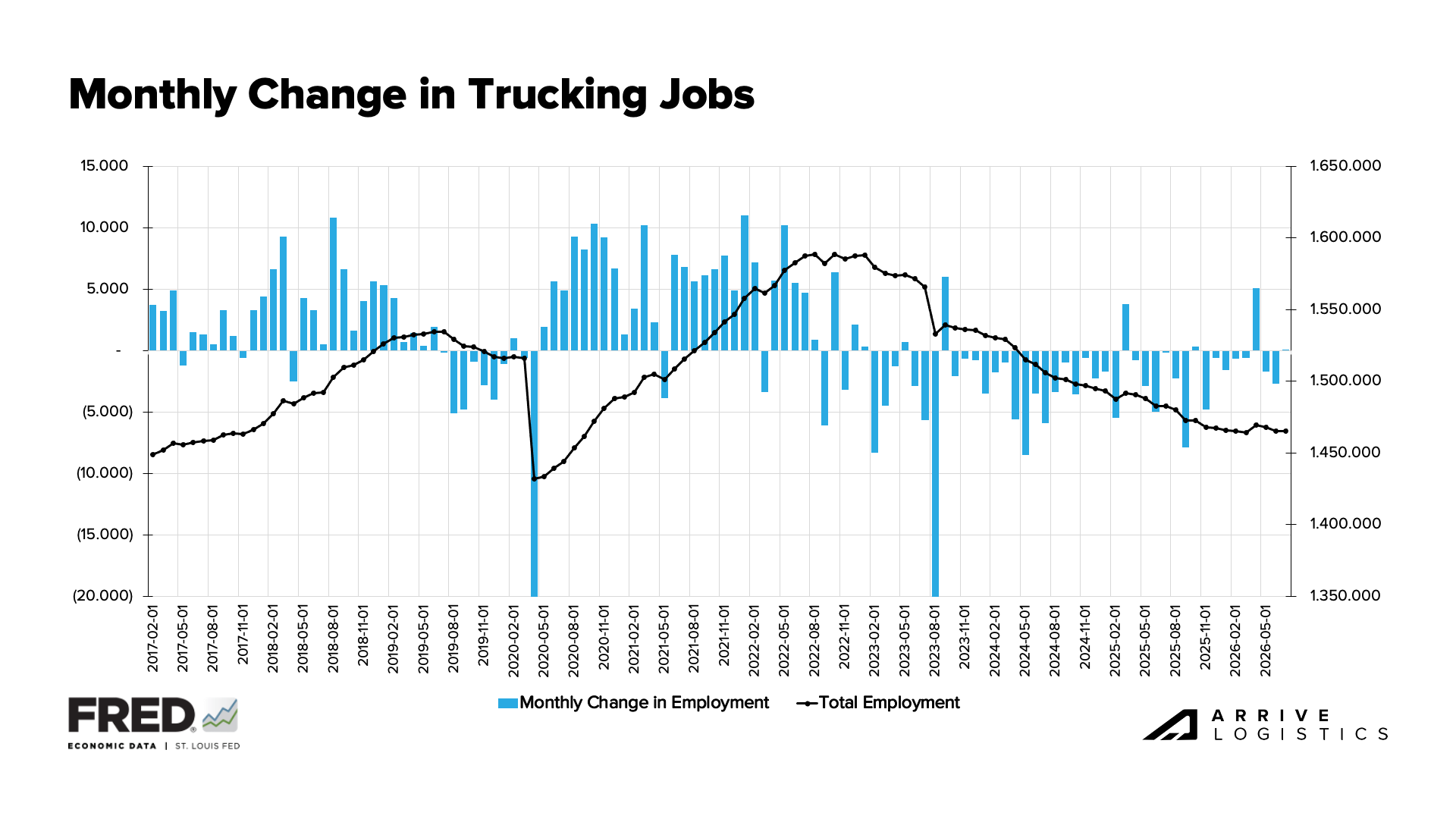
  • Trucking employment remains stable: The industry added just 100 jobs in July, while a revision to June data left total employment 1,500 jobs below last month’s report. Continued stability despite improved rates suggests carriers are prioritizing replacing aging equipment and increasing driver wages over fleet growth.

U.S. Prime Age Class 8 Tractor Population, ACT Research

Chart Notes
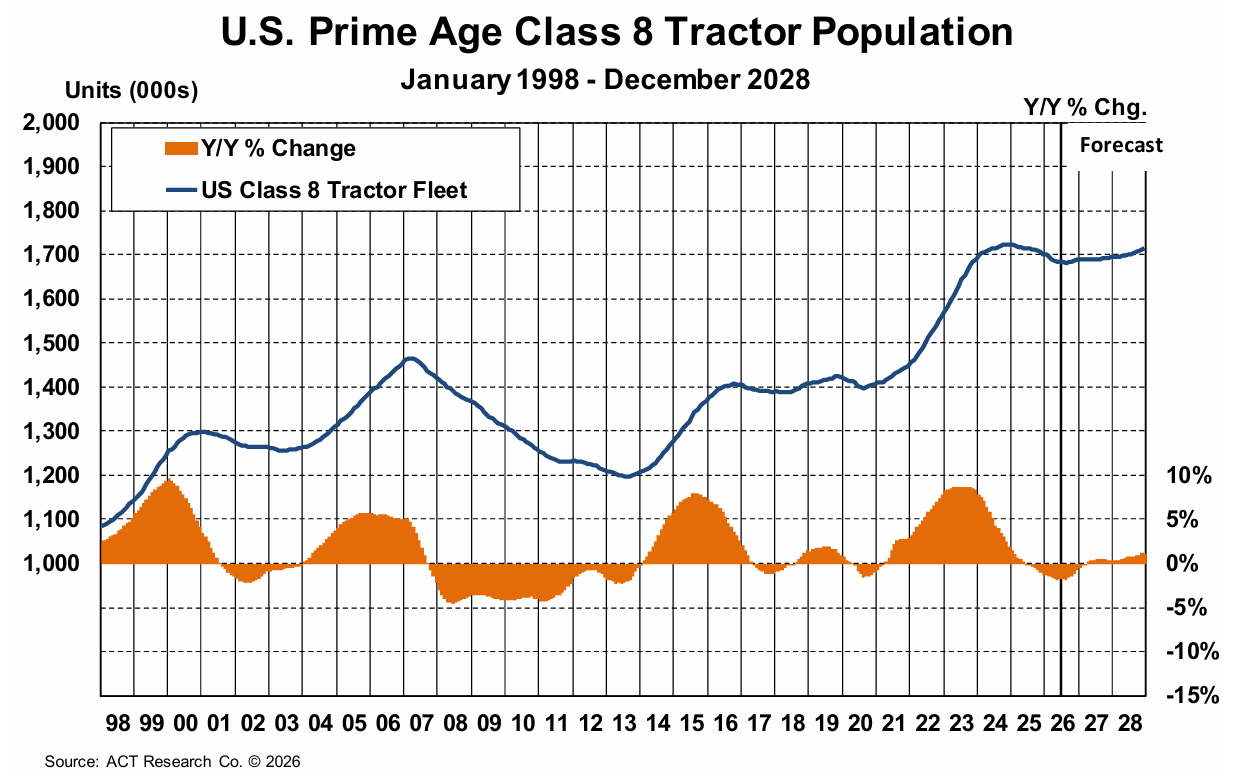
  • Tractor population remains relatively stable: ACT estimates the Class 8 fleet count was unchanged month-over-month in August and down 1.8% year-over-year. Despite stronger truckload rates, only modest growth is expected through 2028 as carriers continue to face barriers to expansion.

For-Hire Trucking Survey: Supply-Demand Balance, ACT Research

Chart Notes
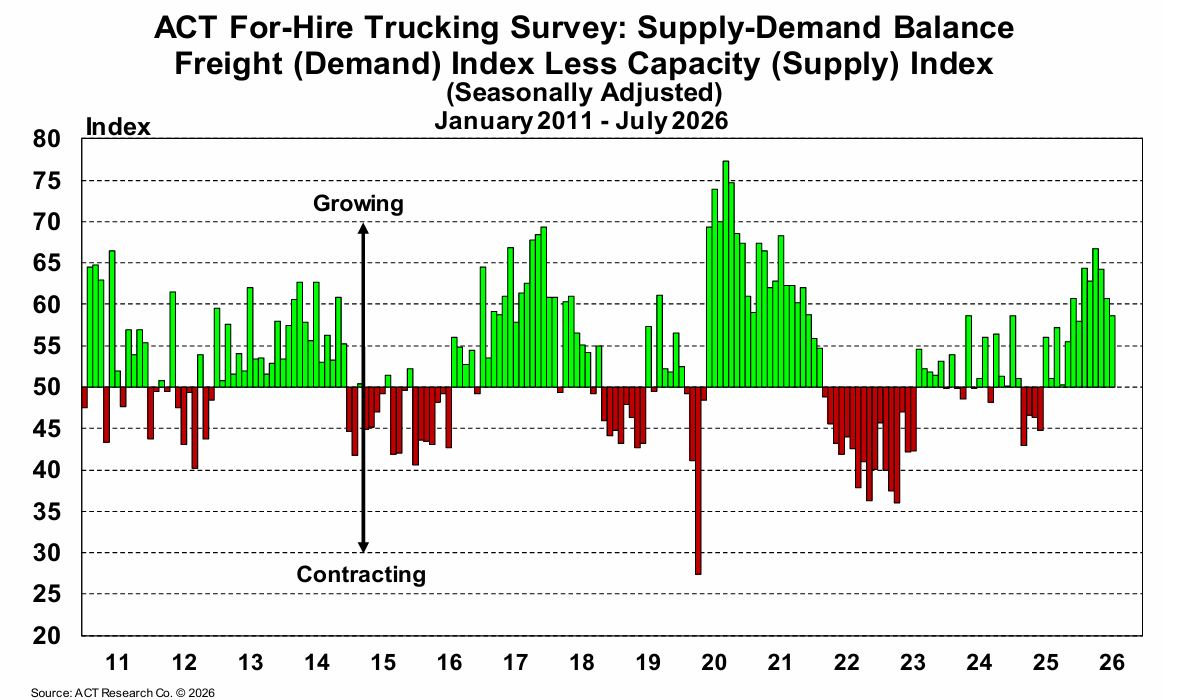
  • Supply-demand balance continues to improve: ACT’s index fell to 58.6 in July from 60.7 in June as volumes improved and larger for-hire fleets added some capacity.

Enforcement Data – FTR Transportation

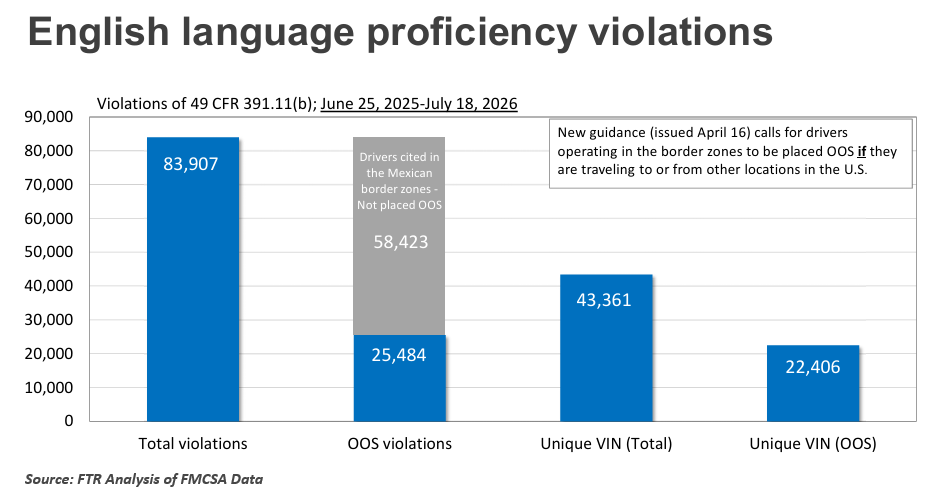
  • ELP enforcement continues at a steady pace: Out-of-service violations reached 25,484 through July 18, up roughly 2,000 from the prior month and consistent with recent trends.

U.S. Active Class 8 Tractor Population Average Age

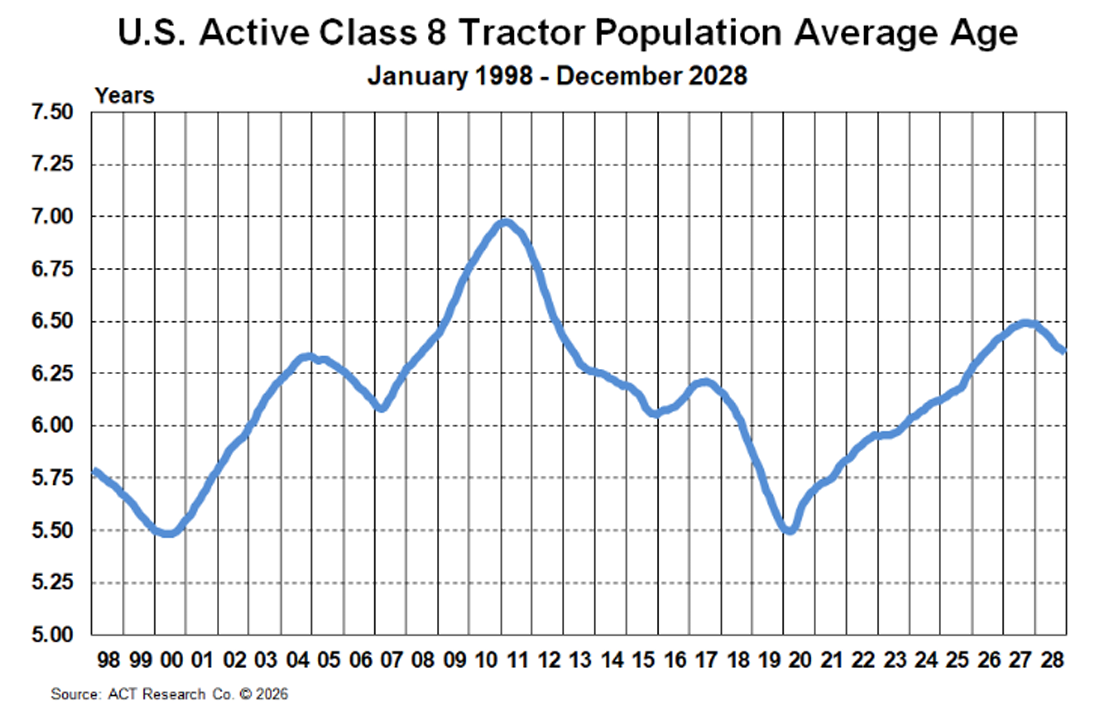
  • Equipment age continues to rise: The average tractor age remains at its highest level in more than a decade at 6.3 years. As a result, fleet investment will likely prioritize replacing older units before adding new capacity.

Truckload Rates

Looking Back

Spot rates moved lower in July and early August as peak season volatility faded and routing guide compliance improved, limiting spot market demand. Van rates saw the steepest decline, while reefer pricing was more stable and flatbed followed a typical seasonal decline.

Looking Ahead

Spot rates should continue to ease in the near term as improved routing guide performance reduces spot market demand and pricing pressure. However, persistent structural supply constraints will likely limit sustained rate relief as the market begins to find its post-summer floor.

Truckstop Weekly National Average Spot Rates

Chart Notes
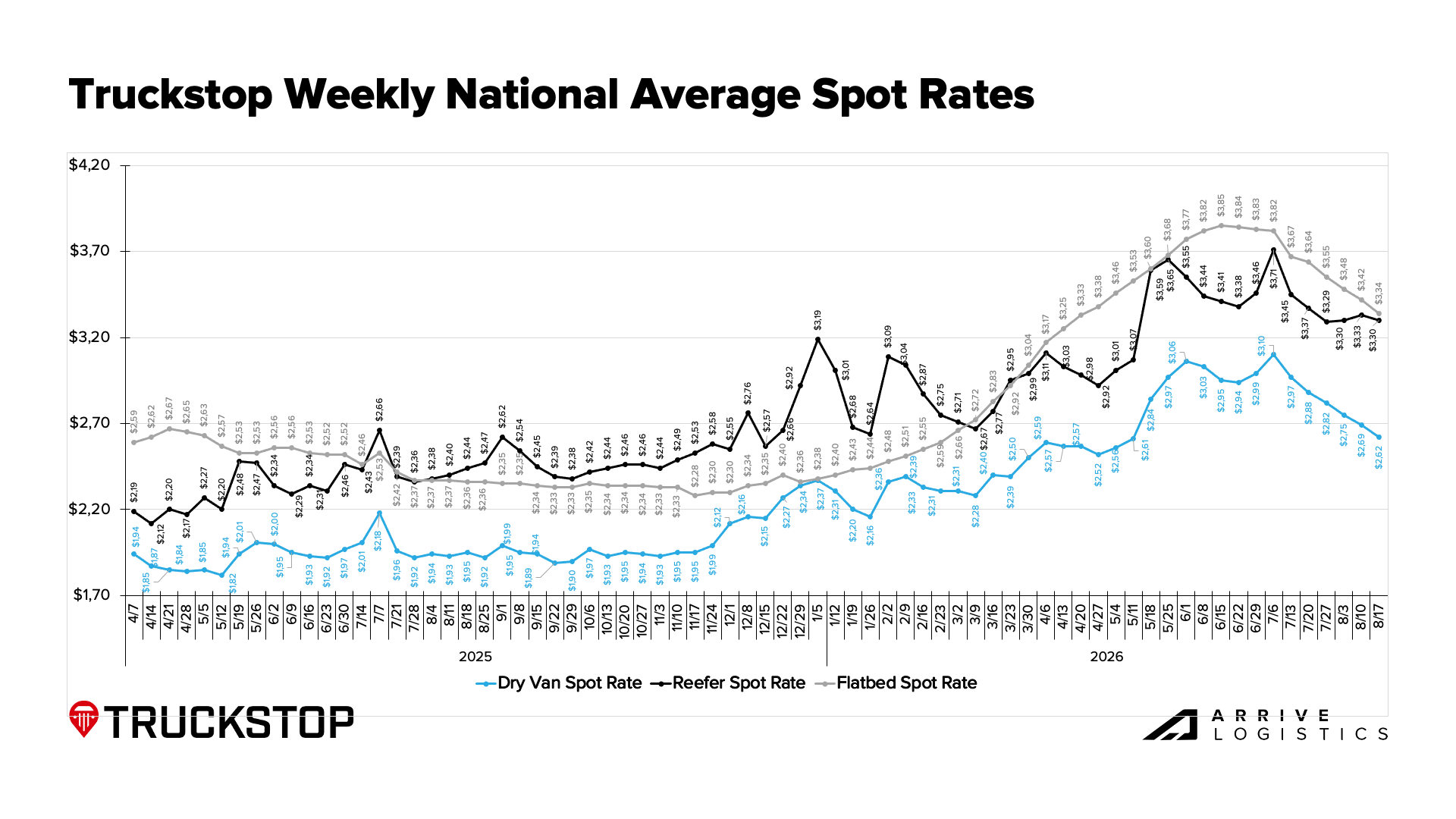
  • Weekly spot rates pull back across all modes: Dry van rates have fallen steadily from their early-July peak, while reefer rates have eased and held relatively steady over the past month. Flatbed rates have continued to soften as peak construction season winds down.

DAT Monthly Rate Trends

Chart Notes
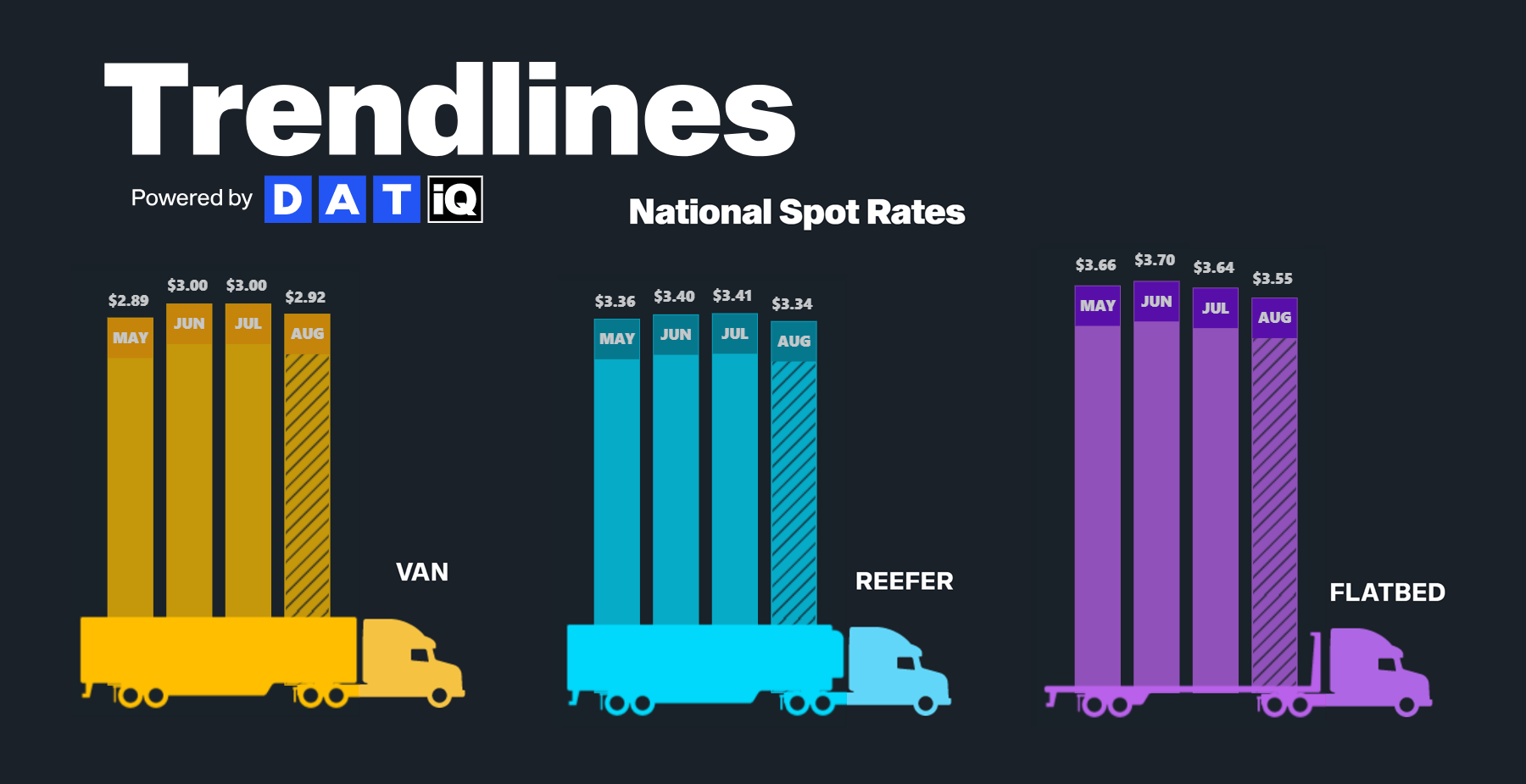
  • Monthly spot rates retreat from summer peak: DAT data shows August averages are down $0.08 per mile for van, $0.07 for reefer and $0.09 for flatbed from July. Higher fuel prices have partially contributed to steeper declines in inferred linehaul rates.

DAT Fuel Trends

Chart Notes
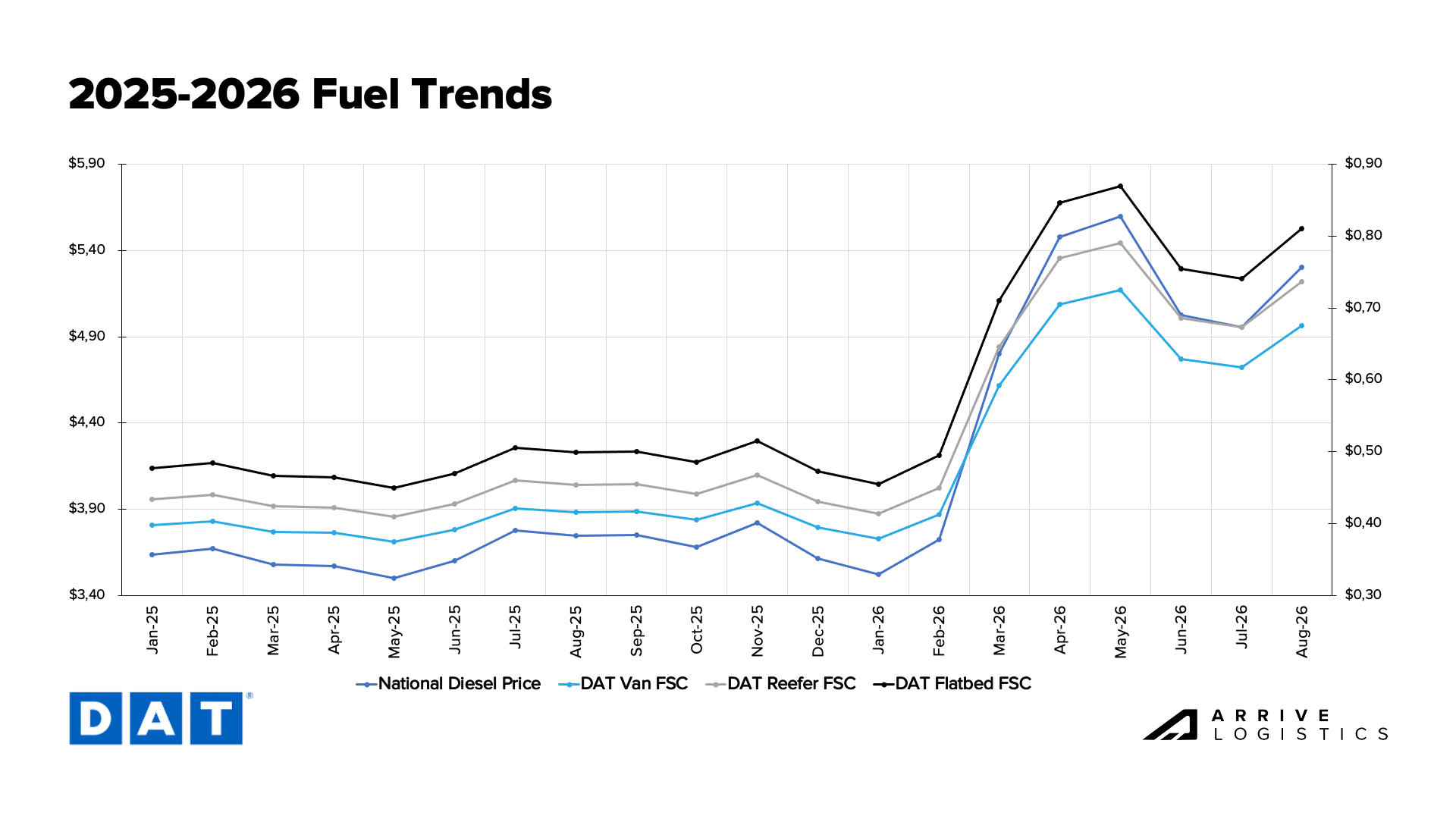
  • Diesel prices rise: Renewed fuel-price volatility in July and August has put additional downward pressure on linehaul rates, with higher fuel costs likely accounting for some portion of the decline.

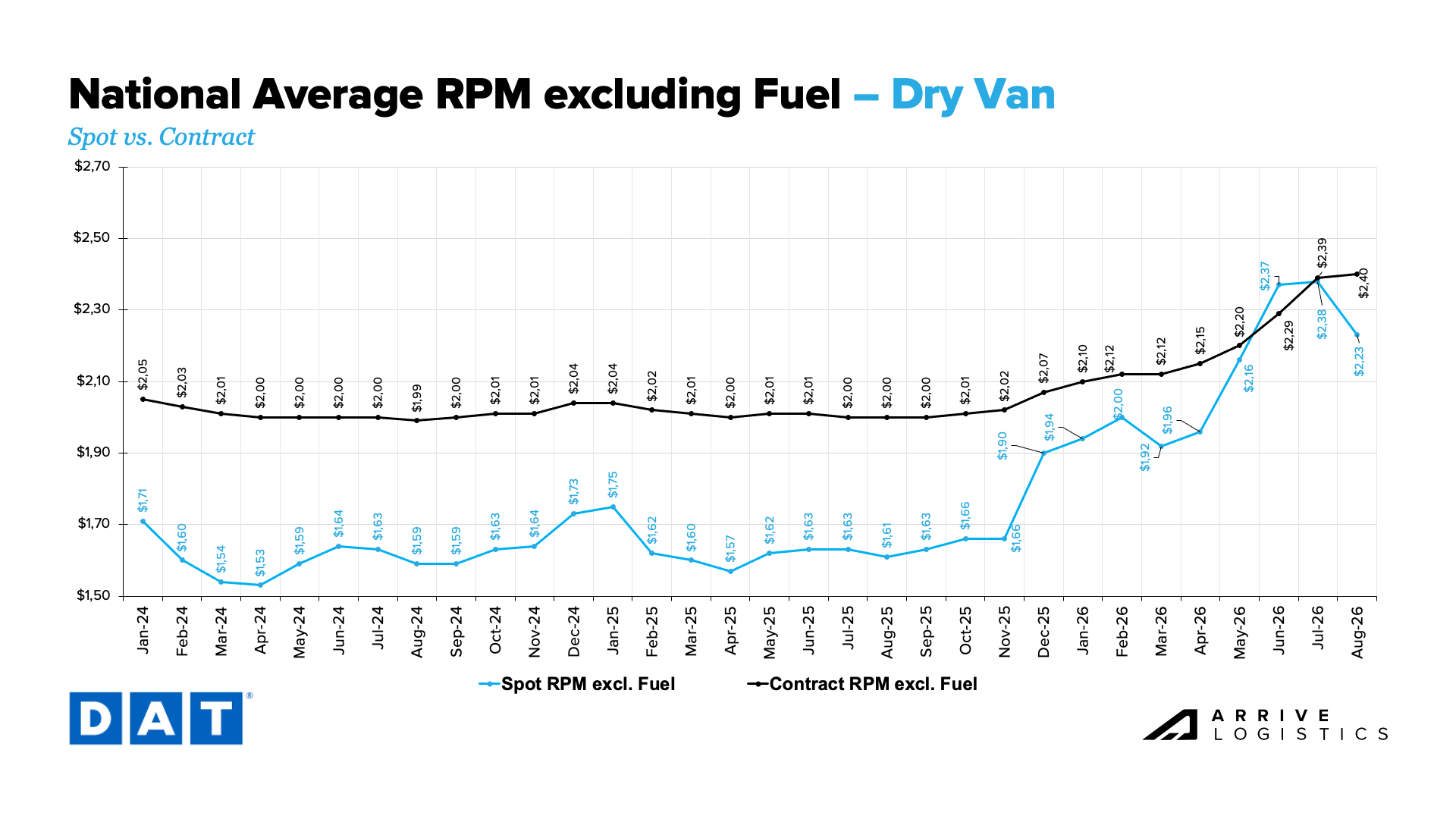
DAT Dry Van National Average RPM Spot vs. Contract

Chart Notes
  • Dry van spot rates move lower: Spot linehaul rates have declined in August as improved routing guide compliance reduces spot demand, while contract rates remain relatively steady.

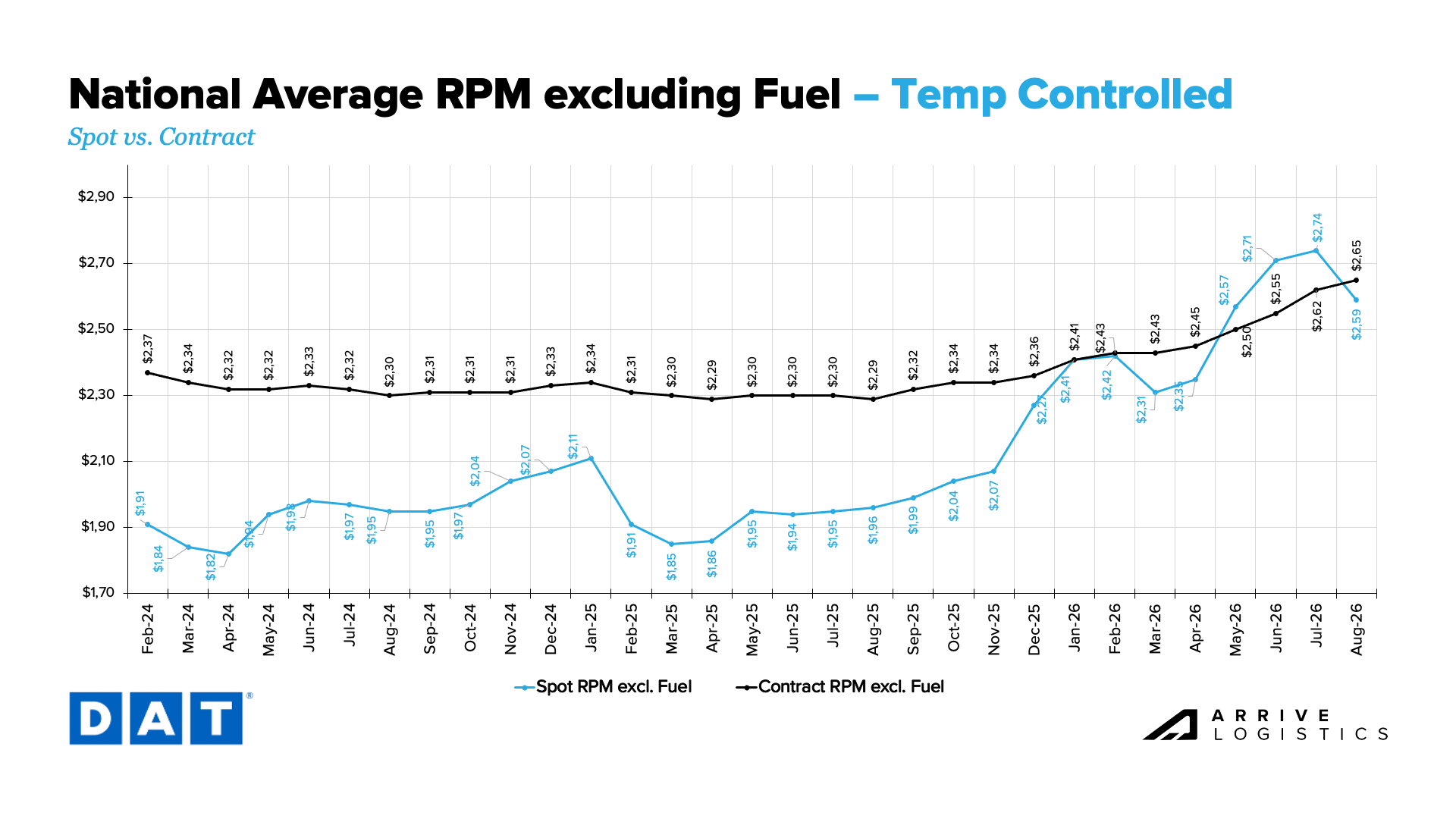
DAT Temp Controlled National Average RPM Spot vs. Contract

Chart Notes

  • Reefer spot rates begin to ease: Linehaul pricing has moved lower in August as spot demand softens, but contract rates have held steadier as routing guide compliance improves.

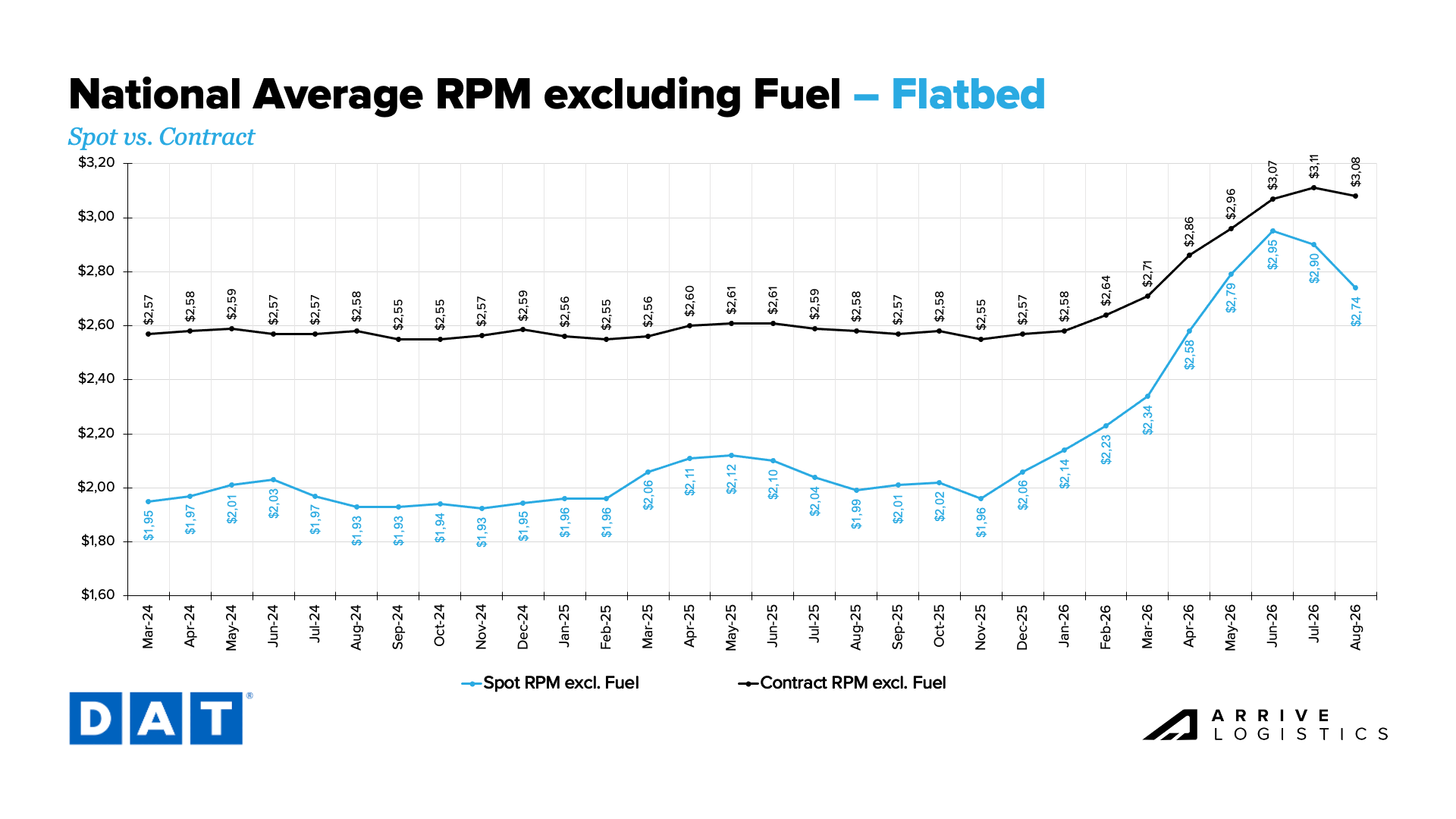
DAT Flatbed National Average RPM Spot vs. Contract

Chart Notes

  • Flatbed spot rates show seasonal pullback: Spot linehaul rates have declined in back-to-back months for the first time since last summer as peak construction season passes. Contract rates remain elevated.

Economic Conditions

Looking Back

Consumer spending remained strong in July but cooled as temporary summer boosts faded. The labor market remained relatively stable despite a decline in payrolls, while inflation eased slightly but stayed above target.

Looking Ahead

Economic conditions should remain relatively stable in the near term, but inflation continuing to outpace wage growth could eventually weigh on consumer spending. Further labor market softening would add another risk to the outlook, while renewed escalation in the Middle East could push fuel prices and inflation higher.

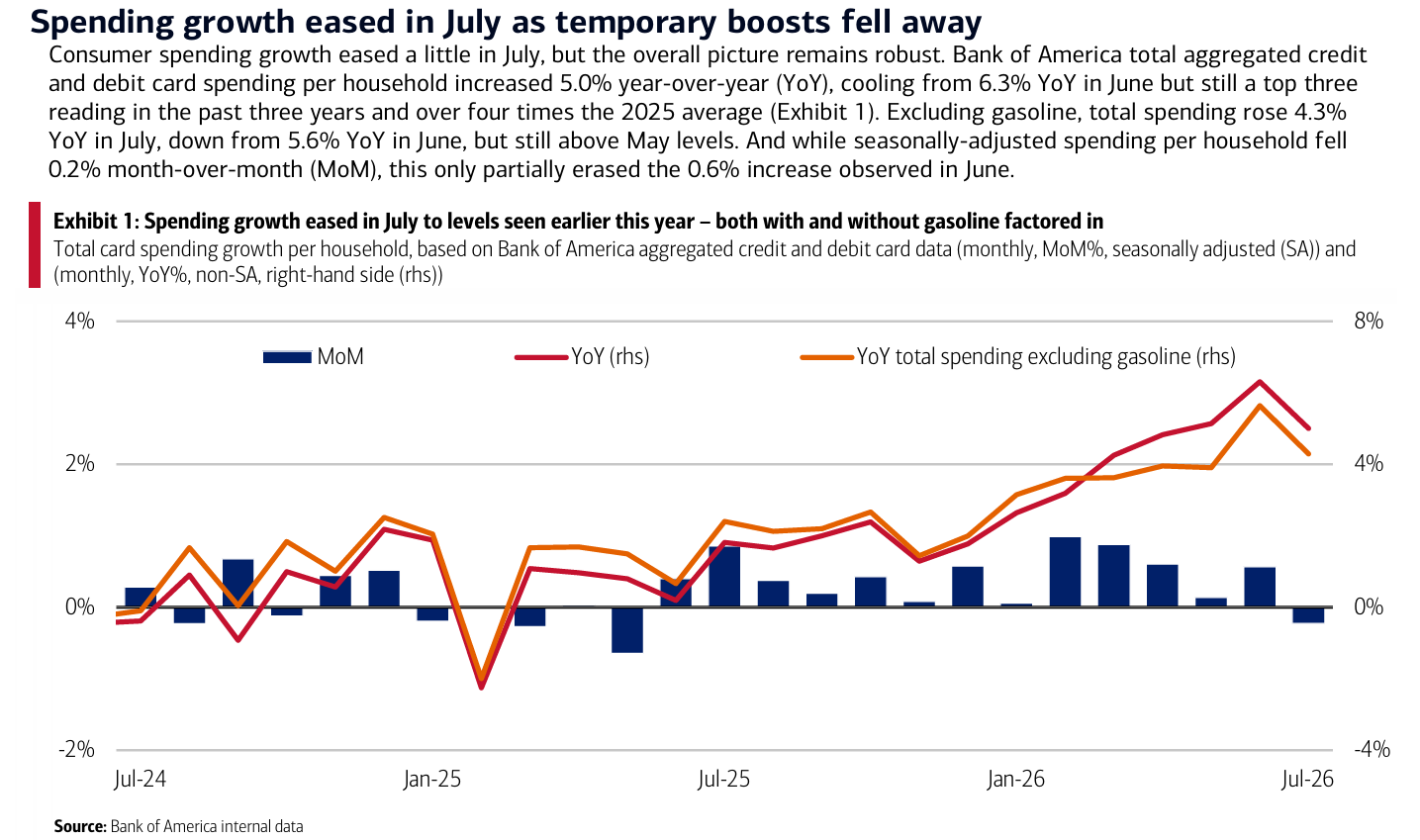
Bank of America Total Card Spending, Bank of America Consumer Checkpoints

Chart Notes
  • Consumer spending growth cools: Bank of America data shows total card spending rose 5.0% year-over-year in July, down from 6.3% in June as temporary boosts such as World Cup-related spending faded. A 4.3% increase excluding gasoline points to continued underlying consumer strength.

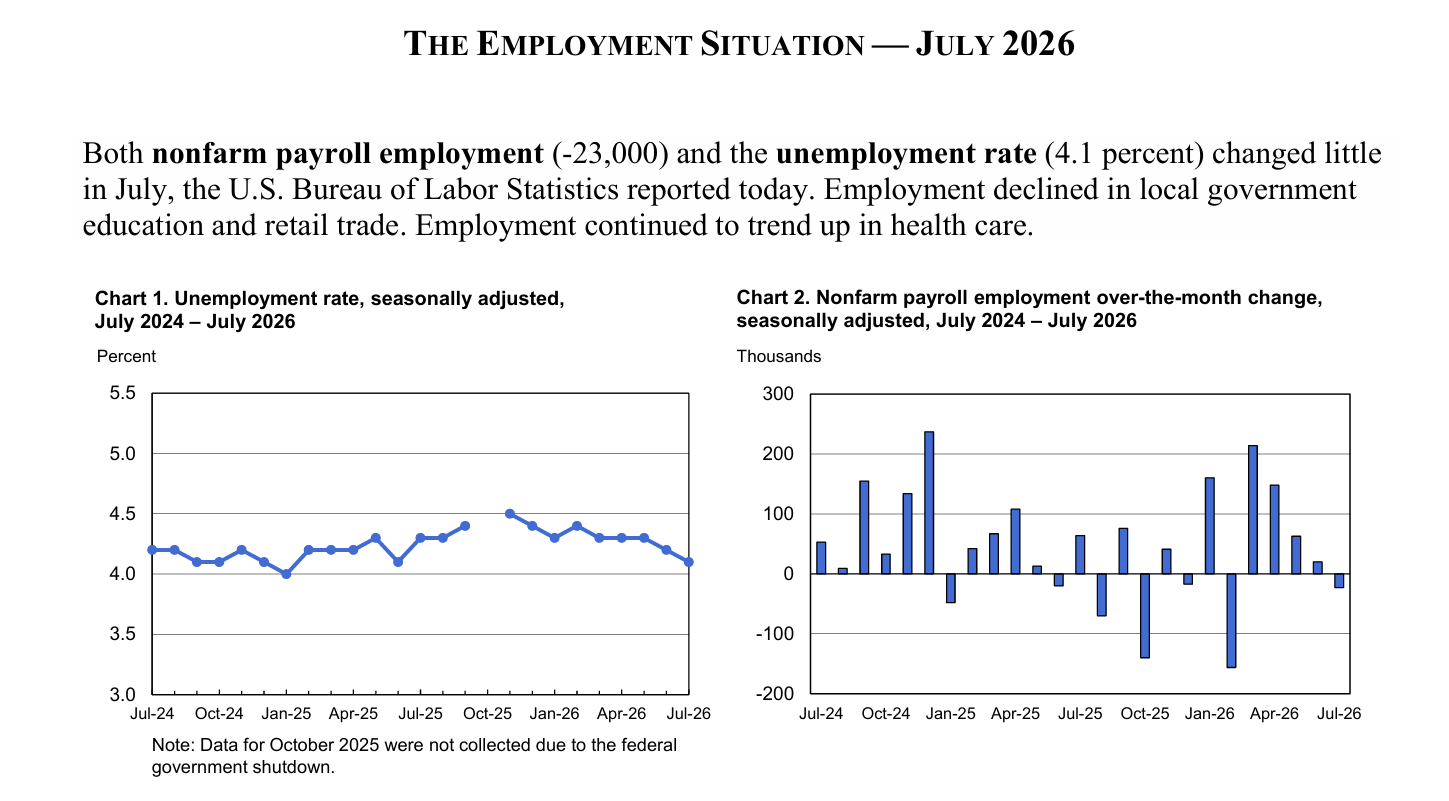
The Employment Situation

  • Employment declines in July: The Bureau of Labor Statistics reported a loss of 23,000 jobs while the unemployment rate changed little at 4.1%. The pullback could be an early sign of labor market softening, though broader conditions remain relatively stable.

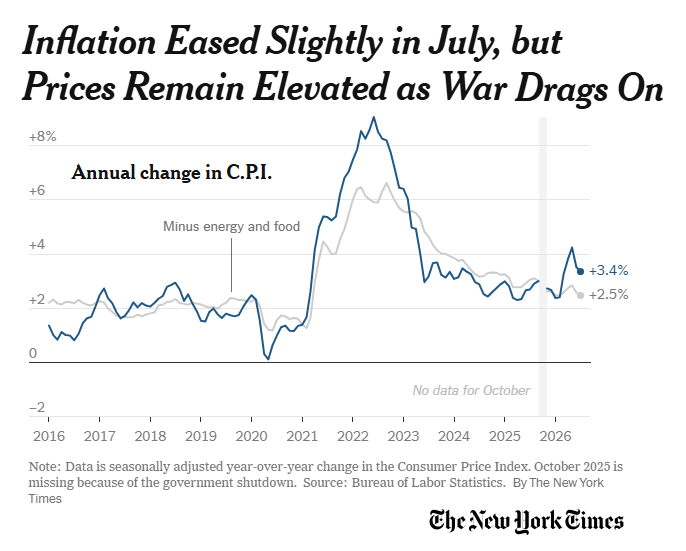
New York Times Annual change in C.P.I.

  • Inflation remains elevated: The U.S. annual inflation rate eased to 3.4% in July but remains above target and is outpacing wage growth, which could weigh on consumer spending over time.

Navigate the freight market
with confidence.

Get this free report delivered straight to your inbox every month.

Start shipping with Arrive

"*" indicates required fields

This field is hidden when viewing the form

Matt Pyatt, Chief Executive Officer

Matt Pyatt is the Chief Executive Officer of Arrive Logistics. He co-founded Arrive with President Eric Dunigan in 2014 after building his career at Command Transportation. As CEO, he is responsible for overseeing the company’s financial health, strategic vision and culture, as well as building a scalable leadership team to support Arrive’s growth.

Subscribe to receive freight market updates​​

Subscribe to receive freight market updates

Quick Apply

Arrive Carrier Requirements

Please have the following info ready to complete registration

  • MC, MX, DOT, or state reg #
  • Tax ID & W9 info
  • Cert of Insurance: $100k cargo, $1M Auto, & $1M commercial general liability coverage
  • Active Common or Contract Authority (365+ days)
  • Safety Rating of at least Satisfactory (or None)

Fraud Prevention

Freight fraud continues to impact our industry. We encourage shippers and carriers to reach out to Arrive immediately if there is ever a shipment in question that may be subject to fraud (including fictitious actors and websites). Arrive will not ask you to pay upfront for any dedicated lane or committed capacity program. If the offer you are receiving sounds too good to be true or unrealistic, it may be fraud. Arrive Logistics recommends verifying all communications come from our registered email domain is @arrivelogistics.com and notes that access via VPN or Proxy is prohibited on Arrive systems. Our 24/7 phone number is 888-861-0650 and our leadership team can also be reached at feedback@arrivelogistics.com.

Use of Cookies

We use cookies to enhance your browsing experience, serve personalized ads or content, and analyze site traffic. By continuing to use this website, you acknowledge and consent to our use of cookies as detailed in our privacy policy.

Get Access to the Shipper Portal

Current Customers

Already shipping with Arrive?

Connect with your representative to get access to your ARRIVEnow Shipper Portal. Can’t connect with your rep? Use this form to reach out.

New Customers

Not shipping with Arrive yet?

If you’re not an Arrive customer, please join our network to access the portal.

Carrier Scorecard Feedback

Contact Us

"*" indicates required fields

Scott Sandager,
Chief Administrative Officer 

Scott Sandager is the Chief Administrative Officer at Arrive Logistics. He joined Arrive in 2018, bringing over 14 years of logistics and brokerage experience, with expertise in project and change management, organizational design, talent development and customer satisfaction. Scott previously held many diverse roles of increasing responsibility with AFN, a Chicago-based freight brokerage.

Eric Dunigan,
President & Co-Founder

Eric Dunigan is the President of Arrive Logistics. He began his career at Command Transportation before co-founding Arrive with Matt Pyatt in 2014. As president, he is responsible for driving revenue and growth, as well as leading the Strategic Partnerships team — a veteran group of supply chain experts who work with Arrive’s customers to reimagine their shipping strategy.

Start shipping with Arrive

"*" indicates required fields

This field is hidden when viewing the form
Arrive Logistics VP of Market Intelligence David Spencer Headshot

David Spencer,
VP of Market Intelligence

David Spencer is the Vice President of Market Intelligence at Arrive Logistics. David joined Arrive in 2017 after spending six years at AFN focused on business intelligence. His department provides critical market data and expert analysis to internal teams and publishes monthly market updates for shippers and carriers under the Arrive Insights banner.

Andrew Clarke, Board Chair,
Arrive Logistics and Global Critical Logistics

Andrew Clarke is Board Chairman for Global Critical and DCLI, Inc., and a board member for Arrive Logistics and Element Fleet Management Corp. His 20 years of global transportation and logistics experience include time as CFO of C.H. Robinson, CEO of Panther Expedited Services, Inc. and SVP and CFO roles at Forward Air Corporation.

Dean Croke,
Principal Analyst
at DAT Freight and Analytics

Dean Croke is a Market Analyst at DAT Solutions, where he focuses on freight market intelligence and data analytics. His 35 years of experience with data analytics, transportation, supply chain management, mining and insurance risk management include time as co-founder of FleetRisk Advisors and in a number of other high-level roles with FreightWaves, Spireon, Lancer Insurance, Omnitracs Analytics (formerly Qualcomm) and more.

Asanka Jayasuriya,
CTO and Partner at 8VC

Asanka Jayasuriya is the CTO at 8VC. He is an accomplished engineering and product leader with 20+ years of experience in the cloud. He has a strong background in enterprise SaaS, PLG products, infrastructure, and security. Notably, he served as CTO and SVP of Engineering at SailPoint, leading their successful transition to the cloud and successful exit event. He also held senior leadership roles at InVision, Atlassian, and Amazon, driving growth, operational excellence, and innovation. At 8VC, Asanka works with the entrepreneurs and leaders in our portfolio as a virtual CTO supporting their growth.

Chad Eichelberger,
President at Reliance Partners

Chad Eichelberger is the President of Reliance Partners. Since 2015, he’s leveraged his extensive experience in risk management, compliance, best practices and contracts to lead the company’s logistics and truck insurance strategy and operations. Chad was previously the President of Access America Transport, where he led the company from $8M to over $600M in revenue.

Barry Conlon,
CEO & Founder at Overhaul

Barry Conlon is the CEO and founder of Overhaul, the global leader in active supply chain risk management and intelligence. With a remarkable career spanning over 30 years in supply chain security, he is widely regarded as a trailblazer in modern-day supply chain security standards and best practices.

Tim Denoyer,
VP and Senior Analyst at ACT Research

As VP and Senior Analyst at ACT Research, Tim analyzes commercial vehicle demand and alternative powertrain development (i.e. electrification), and authors the ACT Freight Forecast, U.S. Rate and Volume Outlook. He previously spent fifteen years in equity research focused primarily on the transportation, machinery, and automotive industries, and co-founded leading equity research firm Wolfe Research.

Request Arrive's SOC 2 Report

Download August 2026 Freight Market Update

Download this Report

"*" indicates required fields

Add me to the monthly distribution
function custom_enqueue_script() { ?>