Need Help
close button

How can we help?

Select One:
Arrive Insights™

December 2025 Freight Market Update

Table of Contents

Market Memo

From the Desk of David Spencer

The holiday peak season has been anything but quiet. Despite weak overall demand, a stretch of seasonal bumps and winter weather events in early December sent tender rejections soaring to the highest levels since early 2022, sparking a surge of spot activity in turn. The resulting tightness will likely continue building through year-end as winter storms move across the Midwest and Northeast and more drivers take holiday time off.

While this stretch of volatility alone is unlikely to drive a meaningful shift in macro conditions, it does make clear that the market is firmly in balance and vulnerable to sustained disruption in 2026. Exactly when that might occur depends on several variables, starting with demand.

For now, volumes remain weak aside from seasonal influences and should return to pre-holiday levels once conditions normalize in mid to late January. Imports are also down more than 10% year-over-year in Q4 following the summer pull-forward boom, offering little to no near-term relief.

Looking ahead, tariff policy will be a key demand variable in 2026. Greater clarity around enforcement and progress toward a renewed North American trade agreement may help stabilize cross-border flows and spur a manufacturing recovery, but the broader implications for demand remain uncertain until tariff impacts fully work their way through the economy.

On the consumer side, the National Retail Federation expects holiday retail sales to exceed $1 trillion, meaning that spending continues despite inflation. That strength will support near-term demand, but it also carries the risk of pushing inflation higher once tariff-driven price increases reach shoppers, which could ultimately soften freight volumes. Political developments ahead of the 2026 midterms add another layer of uncertainty, with the administration floating potential stimulus measures that would temporarily boost economic activity.

Supply also faces several meaningful risks heading into the new year. Low equipment orders persisted through November, shrinking the tractor population and limiting the market’s ability to absorb future demand shocks. Regulatory uncertainty — from the FMCSA’s non-domiciled CDL rules to sweeping driving-school audits — could also have a significant impact on capacity, depending on how enforcement plays out.

For now, expect volatility to continue well into January before conditions settle into a delayed post-holiday lull. Read on for a detailed breakdown of demand, supply, rates and economic conditions as they stand mid-month.

Arrive Logistics VP of Market Intelligence David Spencer Headshot
David Spencer
VP of Market Intelligence

Key Takeaways

  • Demand indicators remain weak, but recent seasonal and weather-related disruptions have driven a surge in spot market activity.
  • The regulatory environment remains a significant risk to capacity, despite a temporary administrative stay on new FMCSA rules for non-domiciled CDL drivers. Illegally issued licenses also continue to be revoked amid audits of state, carrier and driving schools.
  • Low equipment orders persisted through November, reducing the tractor population and increasing the risk of capacity contraction. Reduced investment in fleet growth will also limit the market’s response to future demand inflections.
  • Import volumes remain challenged following the summer front-loading surge, with Q4 volumes down more than 10% year-over-year.
  • Warehouse utilization contracted for the first time in the measure’s nine-year history, driven by the continued drawdown of inventories built earlier in 2025, which has softened the warehouse market.
  • Spot rates are surging as demand spikes amid rising tender rejections, with winter weather eliminating the typical early-December lull. Seasonal demand and holiday driver time off could further tighten capacity and extend rate volatility into late December and early January.
  • The National Retail Federation estimates holiday retail sales will exceed $1 trillion, up 4% from 2024.
  • A resilient economy and steady spending are helping stabilize freight demand, but tariff-driven price hikes have yet to fully reach shoppers and remain the biggest risk to consumer-driven demand through Q4 2025 and the first half of 2026.

Truckload Demand

Looking Back

Contract volumes moved slightly higher through November, but low imports and manufacturing contraction held overall demand down. Parcel peak activity around Black Friday and Cyber Monday pulled capacity off the road, and seasonal disruptions in early December drove a sharp spike in tender rejections and spot market activity after Thanksgiving. Early bouts of snow and cold across the Midwest and Northeast caused these conditions to persist into early December, a period when a lull in tightness between holidays is common.

Looking Ahead

Outside of seasonal disruptions, demand will likely remain soft through year-end. Trade policy will be the key trend to watch as 2026 begins, especially if restocking efforts begin in late Q1. A potential USMCA renewal could firm up North American trade early in the year, and more certainty around tariff policy could jump-start business investment and related demand.

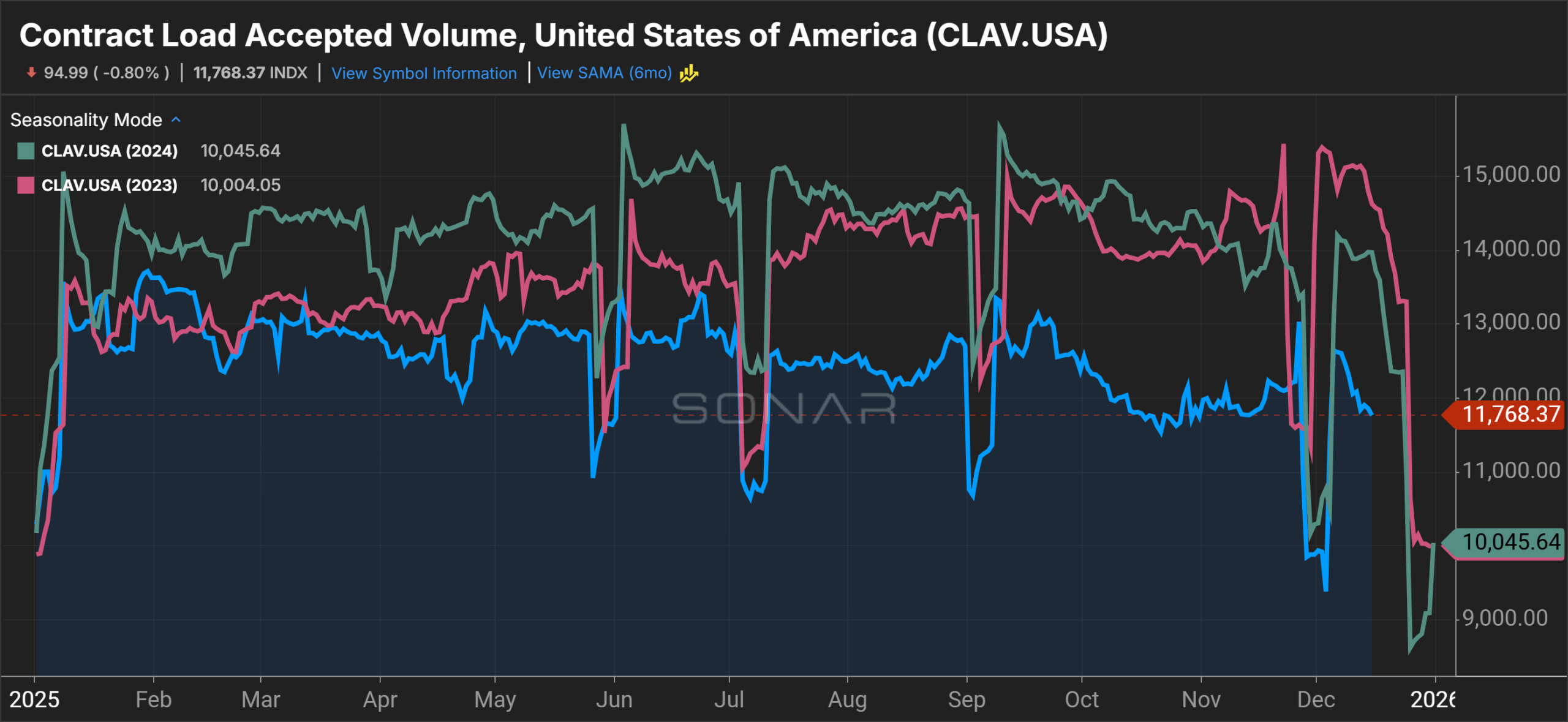
Contract Load Accepted Volume, SONAR

Chart Notes
  • Accepted contract volumes follow holiday seasonality: FreightWaves SONAR data shows accepted contract loads in November closely followed prior year trends, dipping around Thanksgiving and rebounding at the start of December. Volumes currently sit at -14.2% year-over-year.

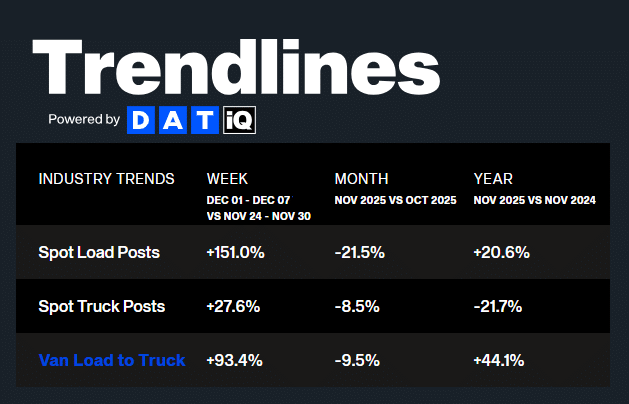
DAT Trendlines

Chart Notes
  • Spot market activity surges at the end of November: DAT data shows a significant increase in spot demand as tender rejections rose amid peak season demand and weather-related disruptions.

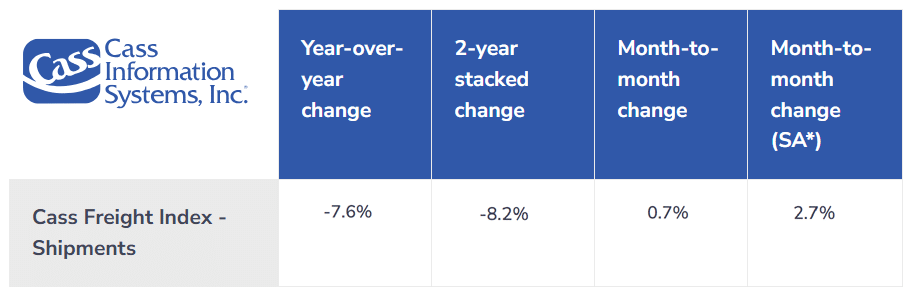
Cass Freight Index Report – November 2025

Chart Notes
  • Cass Freight Index showed weakness in November: Cass reported volumes were down 7.6% year-over-year after a 2.7% seasonally adjusted increase in November. Cass analysts continue to indicate the concentration of declines is in LTL, with TL volumes not seeing the same negative growth.

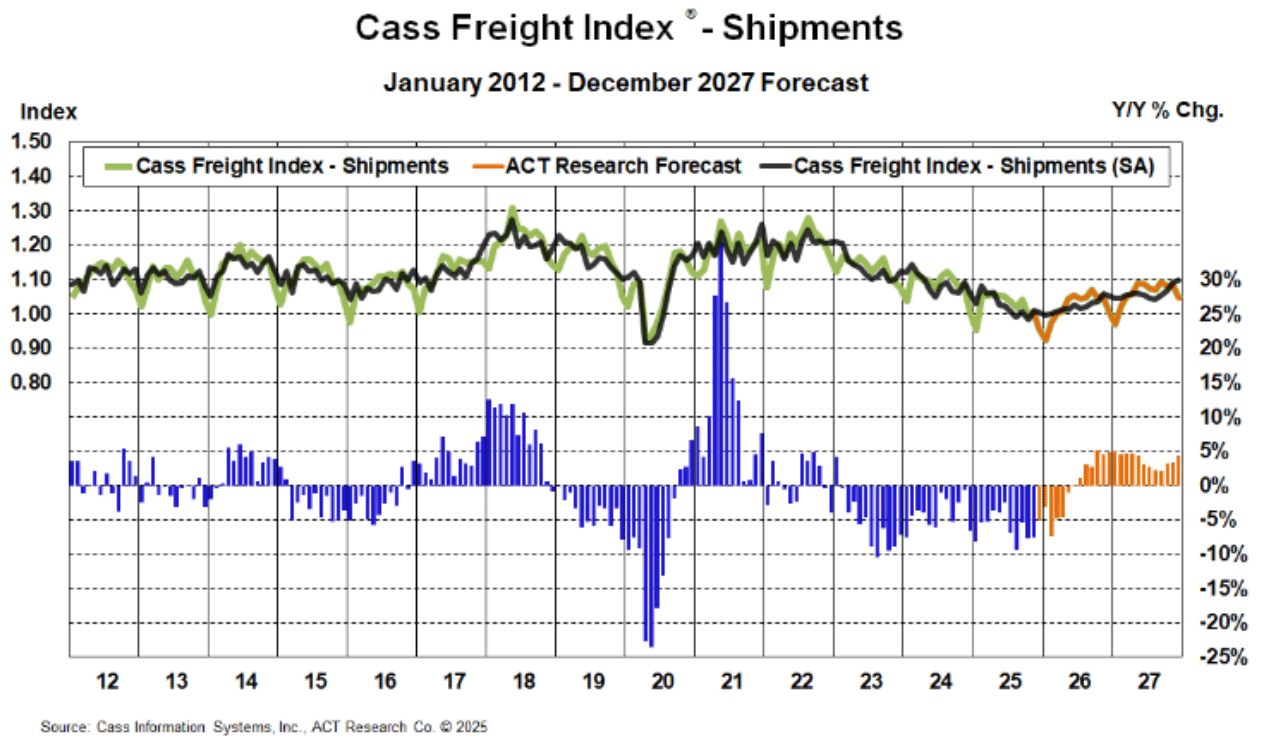
Cass Freight Index Shipments Forecast – November 2025

Chart Notes
  • Goods inflation to weigh on freight demand: Cass and ACT analysts noted, “Resilient early holiday consumer spending data suggest some pent-up demand could be building, but tariffs are likely to continue to press prices higher and affordability lower in 2026.”

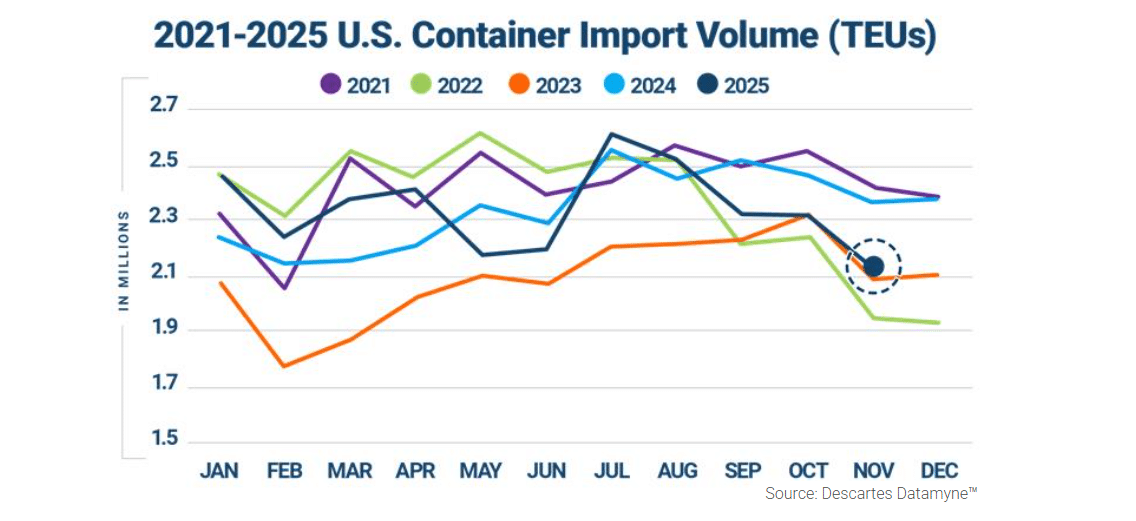
Descartes U.S. Container Import Volume

Chart Notes
  • Container imports decline in November: Descartes data shows imports fell 5.4% month-over-month, in line with seasonal trends, and 7.8% year-over-year amid early-year frontloading and a softer consumer demand outlook.

Inbound Ocean TEUs Volume Index, SONAR

Chart Notes
  • Import orders stable at 10%-15% below prior year levels since late Q3: SONAR data shows import order volumes have trended consistently below prior year levels for the past several months, presumably as pre-buying and front-loading inventories ahead of tariffs limited imports during the typical peak season.

Monthly Imports, National Retail Federation

Chart Notes
  • Retail import forecasts a slow year-end and 1H-2026: The National Retail Federation expects a record holiday season but remains uncertain about the 2026 outlook due to growing tariff impacts. “Stores are stocked up and ready for a record holiday season, but there is still a great deal of uncertainty about what will happen in 2026 with trade policy,” NRF Vice President for Supply Chain and Customs Policy Jonathan Gold said.

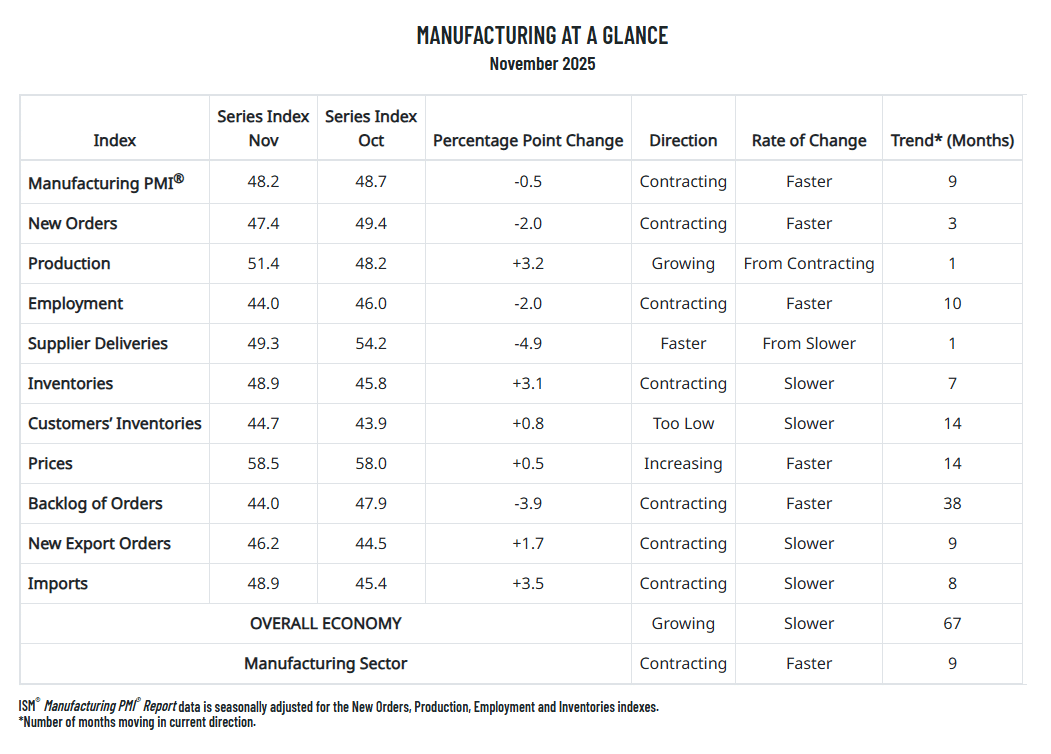
Manufacturing at a Glance, Manufacturing ISM

Chart Notes
  • Manufacturing contraction continues in November: The ISM Manufacturing Index fell for the ninth straight month. Susan Spence, chair of the Institute for Supply Management, noted that 58% of manufacturing GDP remained in contraction, with 39% in strong contraction (registering a composite PMI of 45% or lower) in November.

Truckload Supply

Looking Back

Reefer and van load-to-truck ratios and tender rejections moved higher as freeze-protect and holiday food demand increased around Thanksgiving. Low equipment orders also continued through the month.
Looking Ahead

As of mid-December, SONAR tender rejection data shows the highest levels of non-compliance in shipper routing guides since early 2022, signaling the tightest capacity conditions in more than three years. This trend is likely to persist through year-end due to winter weather, driver time off and holiday demand. As 2026 begins, driver exits, low equipment orders and ongoing regulatory uncertainty could leave the supply environment increasingly fragile.

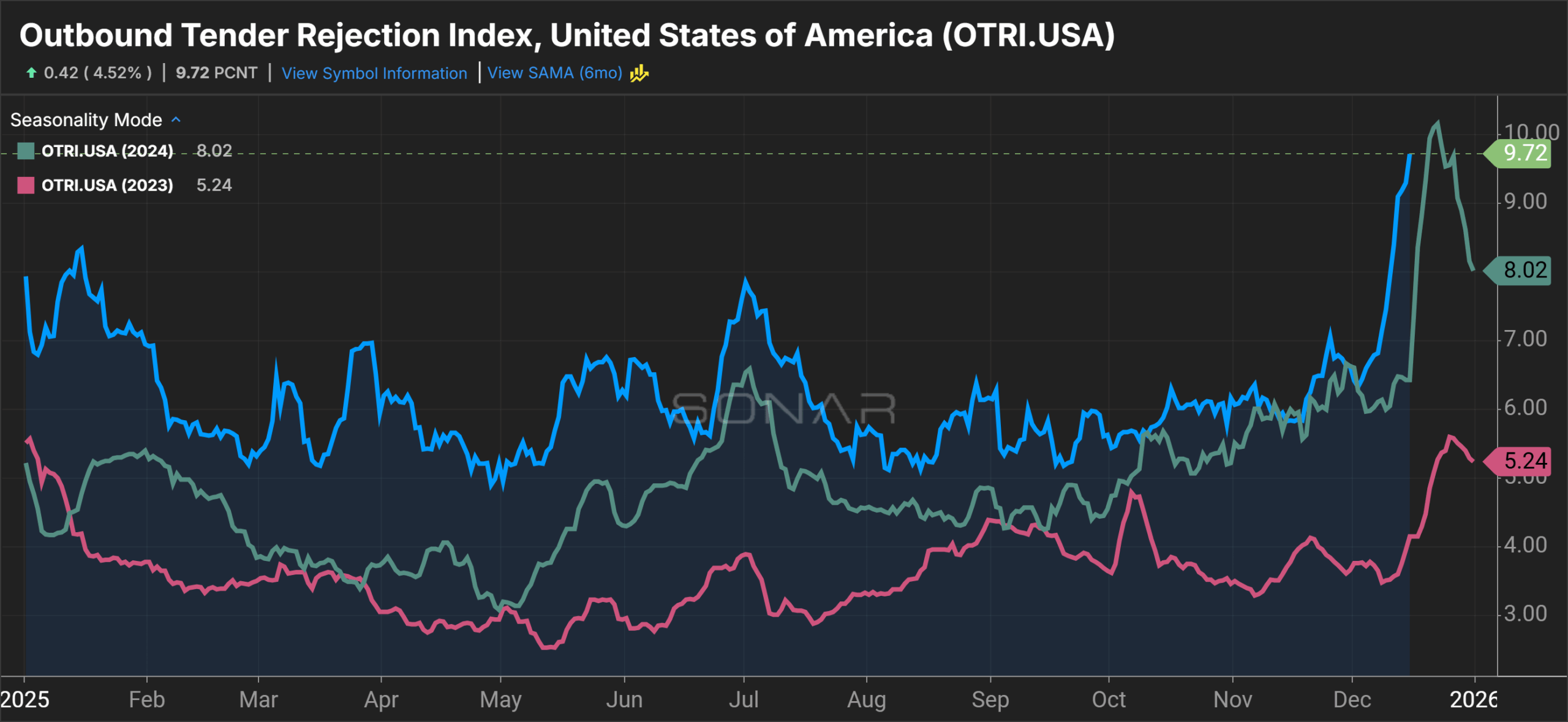
Outbound Tender Reject Index, SONAR

Chart Notes
  • Rejections climb and remain elevated: SONAR data shows rejections rose quickly ahead of Thanksgiving, with no typical post-holiday reprieve due to weather-related disruptions. Rates are now moving toward levels that would mark the highest in more than three years later this month.
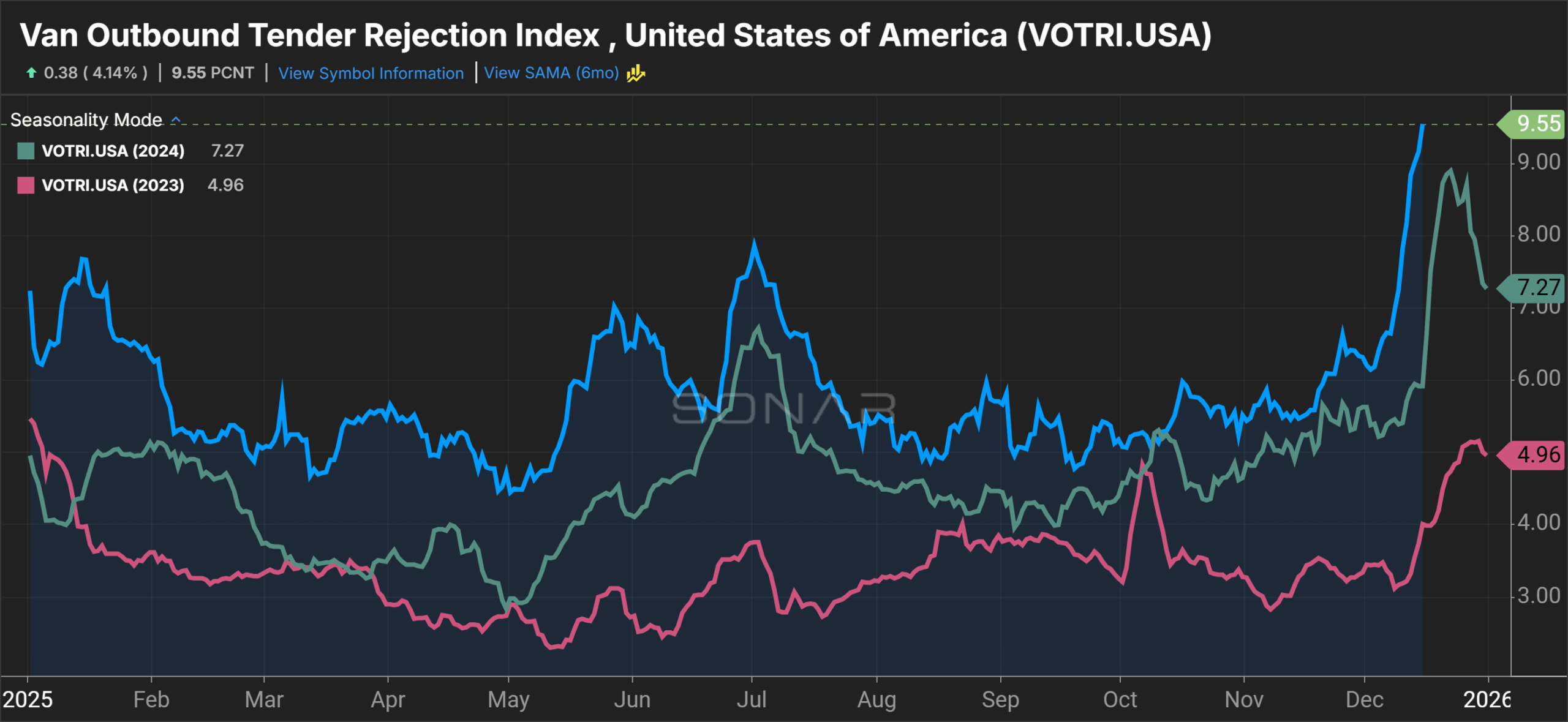
Van Outbound Tender Rejection Index, SONAR

Chart Notes
  • Dry van rejections start an early climb: Rejections rose more sharply during the week of Thanksgiving than in prior years and continued climbing post-holiday, signaling an early start to peak season.

Reefer Outbound Tender Rejection Index, SONAR

Chart Notes
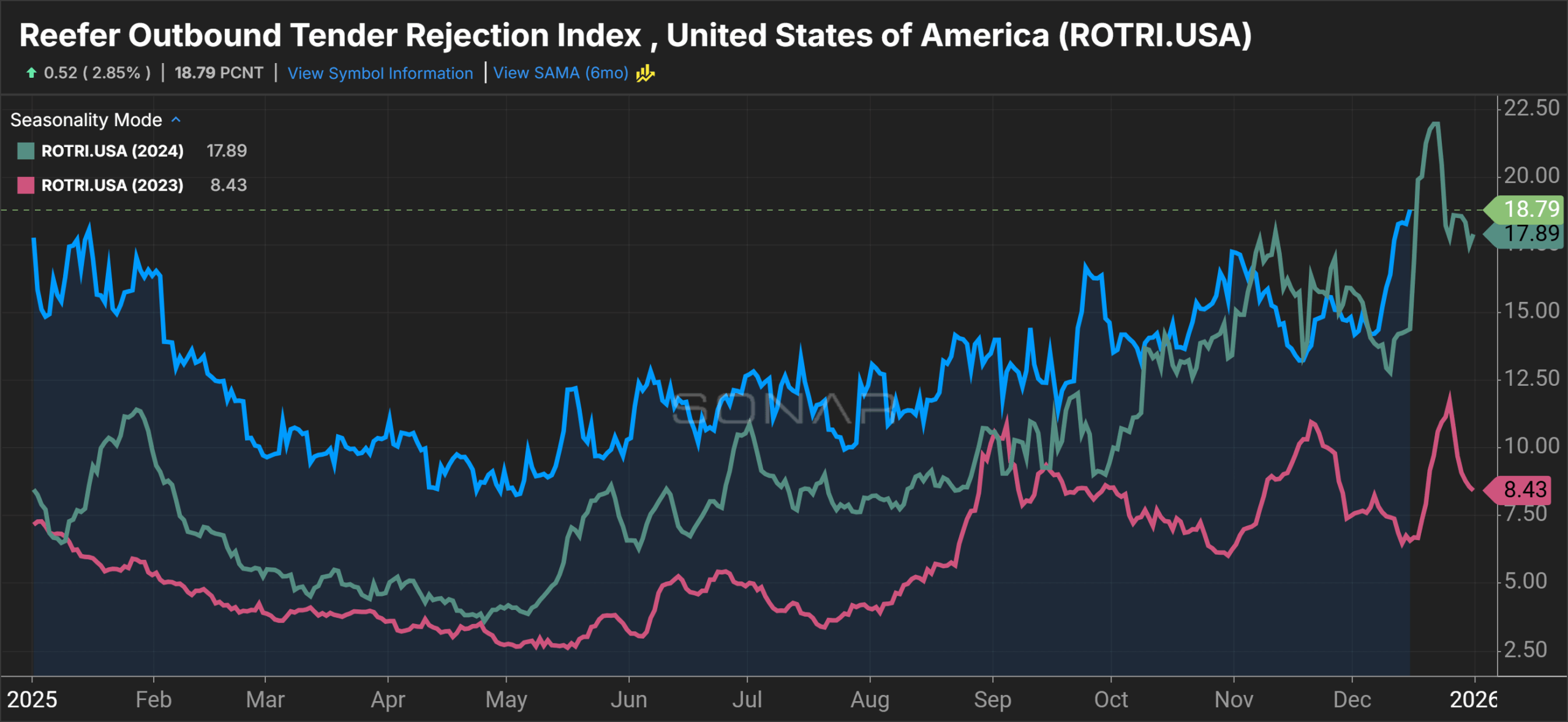
  • Reefer tender rejections remain elevated after Thanksgiving: Reefer rejections began climbing during the Thanksgiving week as expected and have remained elevated as dry van shipments shift to reefer for freeze protection ahead of peak season.

Flatbed Outbound Tender Rejection Index, SONAR

Chart Notes
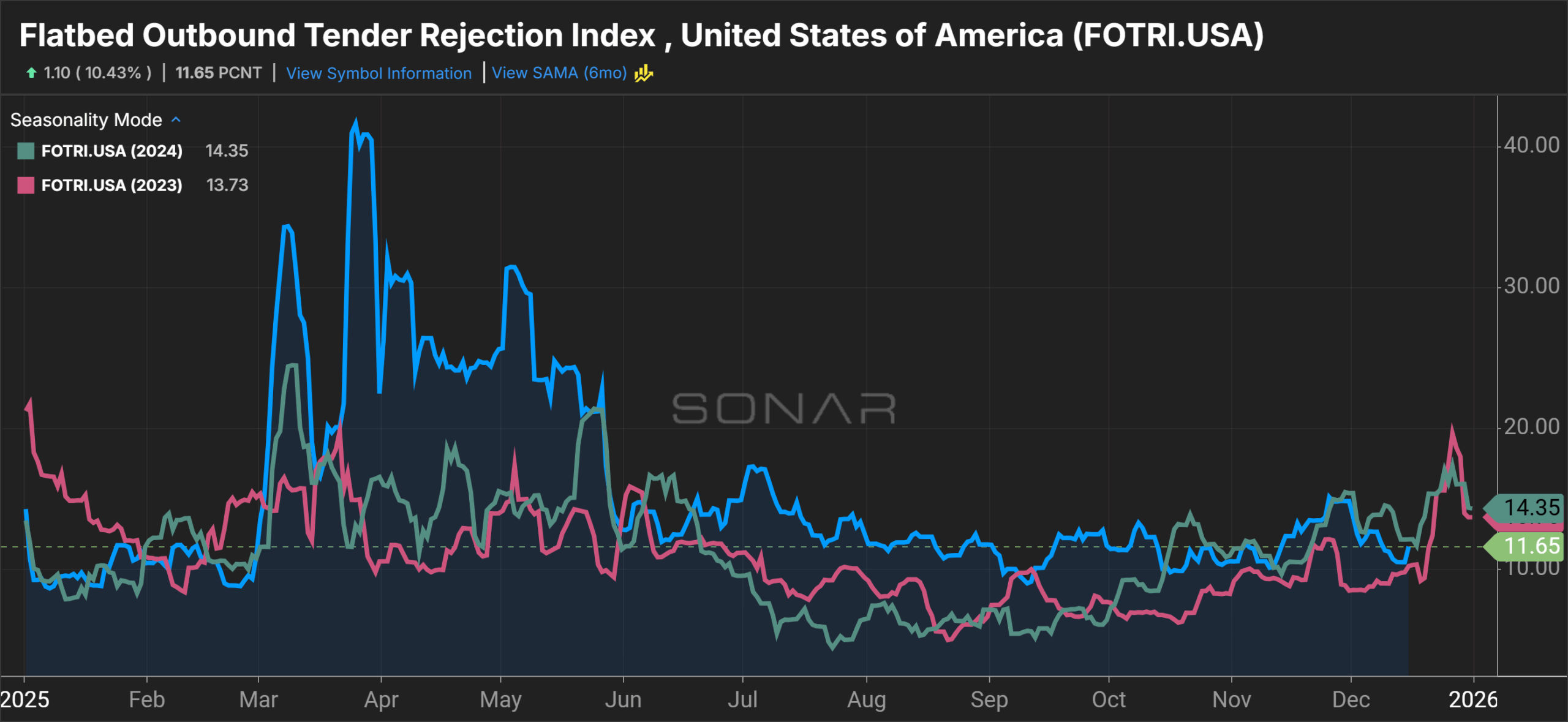
  • 2025 flatbed rejection rates closely follow those of 2024: After a slight uptick tied to winter-related goods, flatbed rejections in 2025 are tracking in line with 2024 levels ahead of the year-end holiday spike.

Van Load-to-Truck Ratios

Reefer Load-to-Truck Ratio

Chart Notes
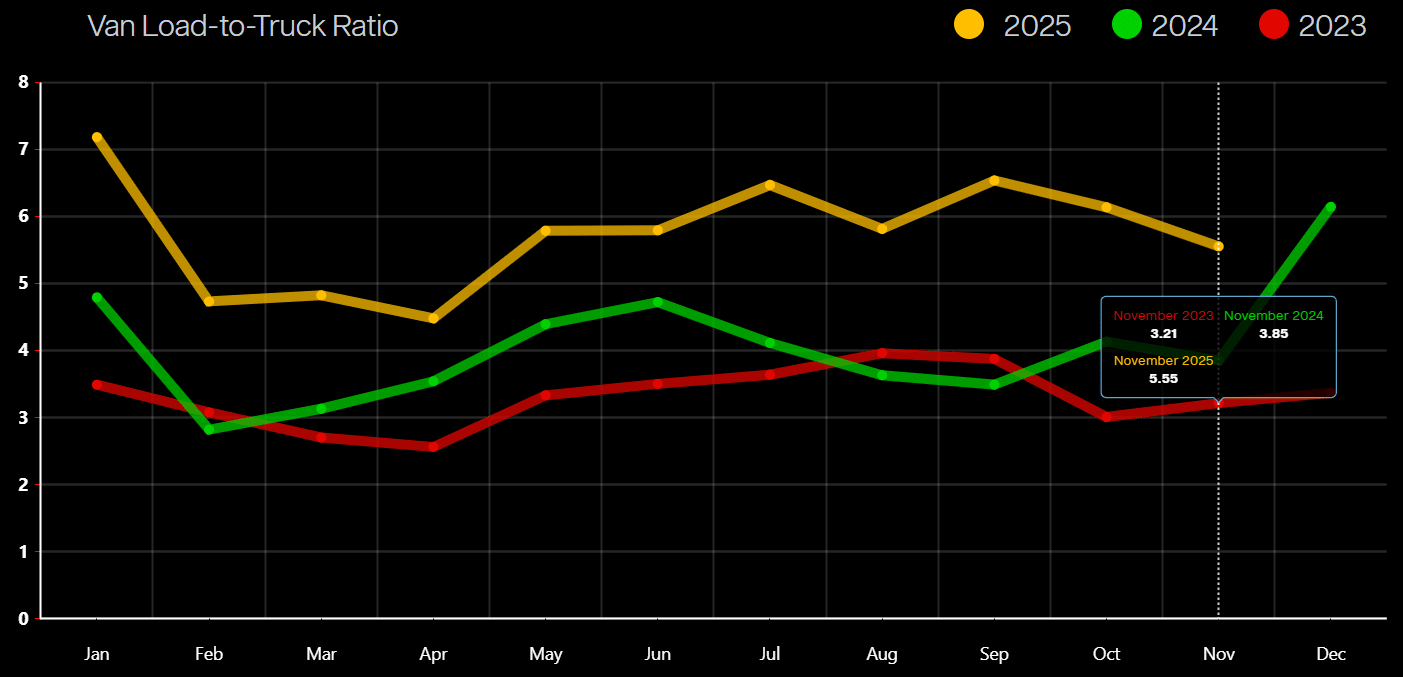
  • Dry van and reefer ratios experienced downward movement in November: DAT reported month-over-month declines in load-to-truck ratios in November, but early indications point to a steep increase in December as peak season demand and weather-related disruptions spiked spot demand.

Flatbed Load-to-Truck Ratios

Chart Notes
  • Flatbed load-to-truck ratio moving downwards: The flatbed load-to-truck ratio fell 23% month-over-month, converging toward last year’s levels.

Morgan Stanley Dry Van ONLY Truckload Freight Index

Chart Notes
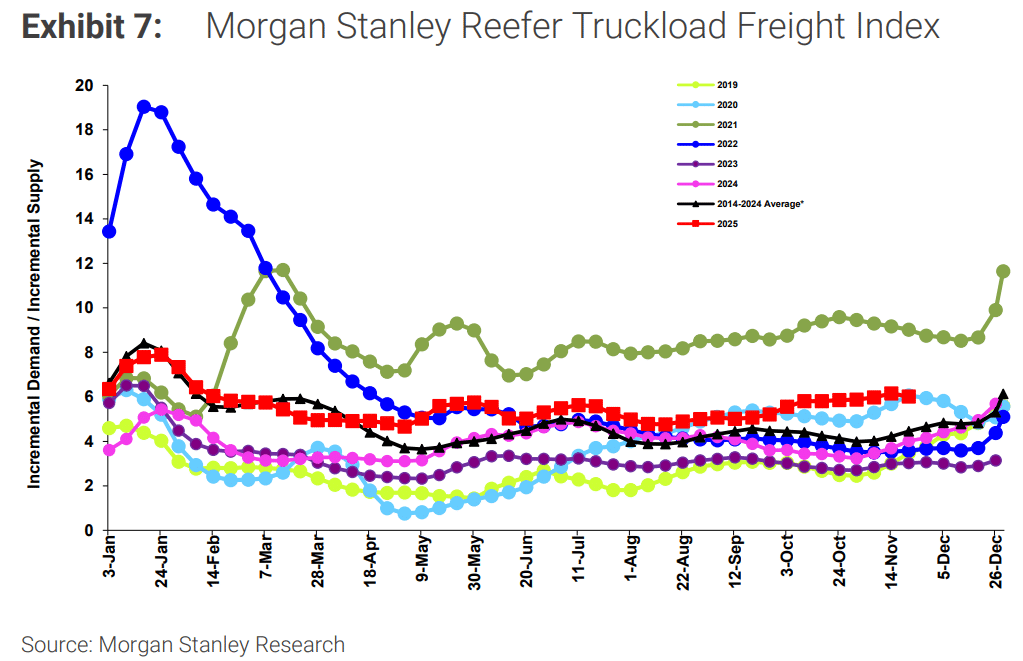
  • Morgan Stanley Index shows elevated seasonality across van and reefer in November and early December: Van and reefer indices trended above historical levels at a stable ratio, while flatbed conditions continue to appear softer in the most recent report. 

Morgan Stanley Reefer Truckload Freight Index

Morgan Stanley Flatbed Truckload Freight Index

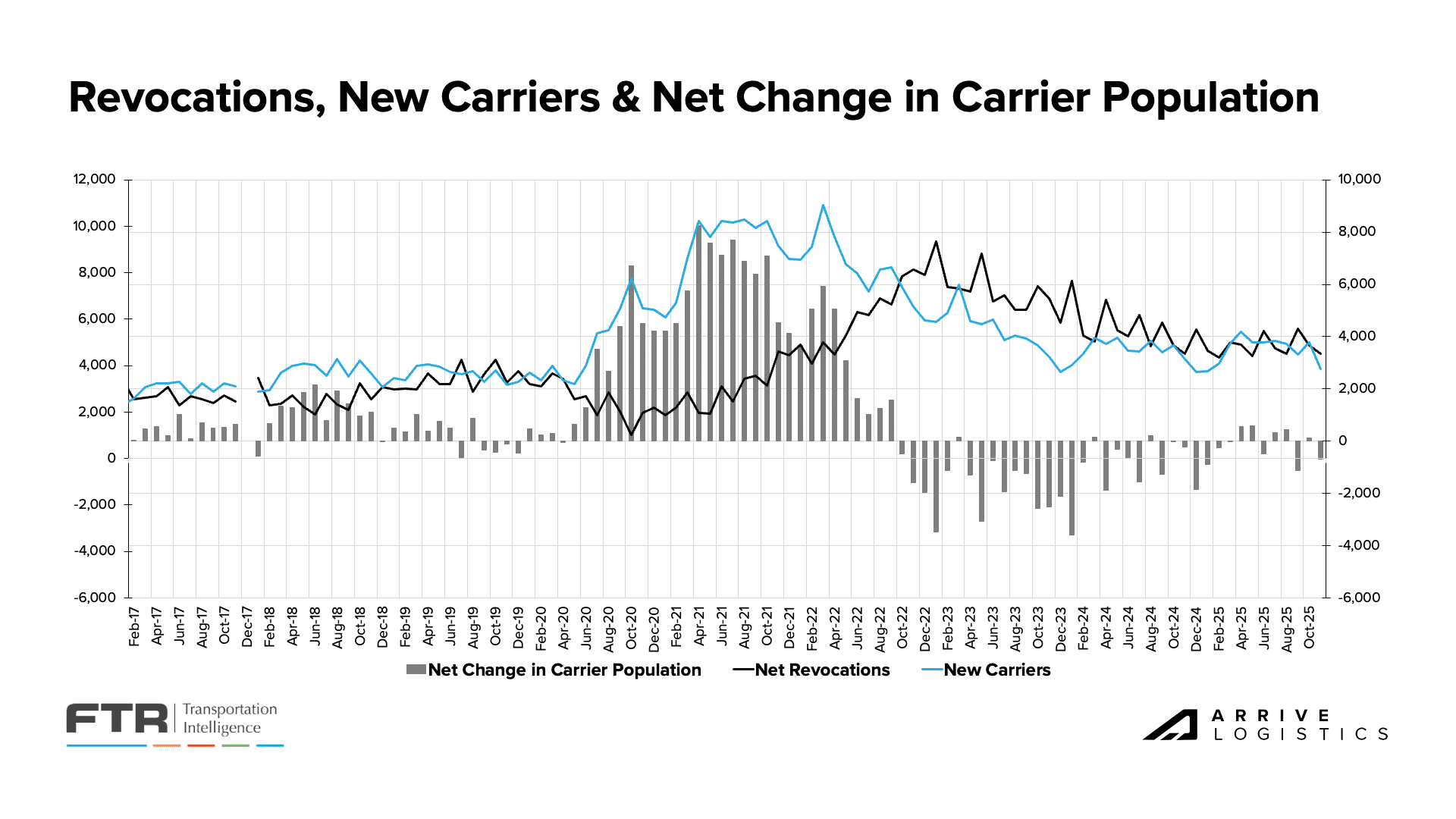
Carrier Revocations, New Carriers & Net Change in Carrier Population, FTR

Chart Notes
  • Carrier population decreases in November: Outside of the typically slow periods of December and January, the decrease of just 630 carriers in November was the result of the lowest total for new carrier authorities in a month since May 2020. “That has to mean something,” said FTR analyst Avery Vise. He noted that one month does not establish a trend and that additional weak months would be needed to confirm a decline in new entrants.

Class 8 Tractor Net Orders, ACT Research

Chart Notes
  • Tractor orders continue to show weakness: ACT data indicates Class 8 orders fell 25% month-over-month in November and remain well below replacement levels as tariff-driven price increases weigh on demand for new equipment.

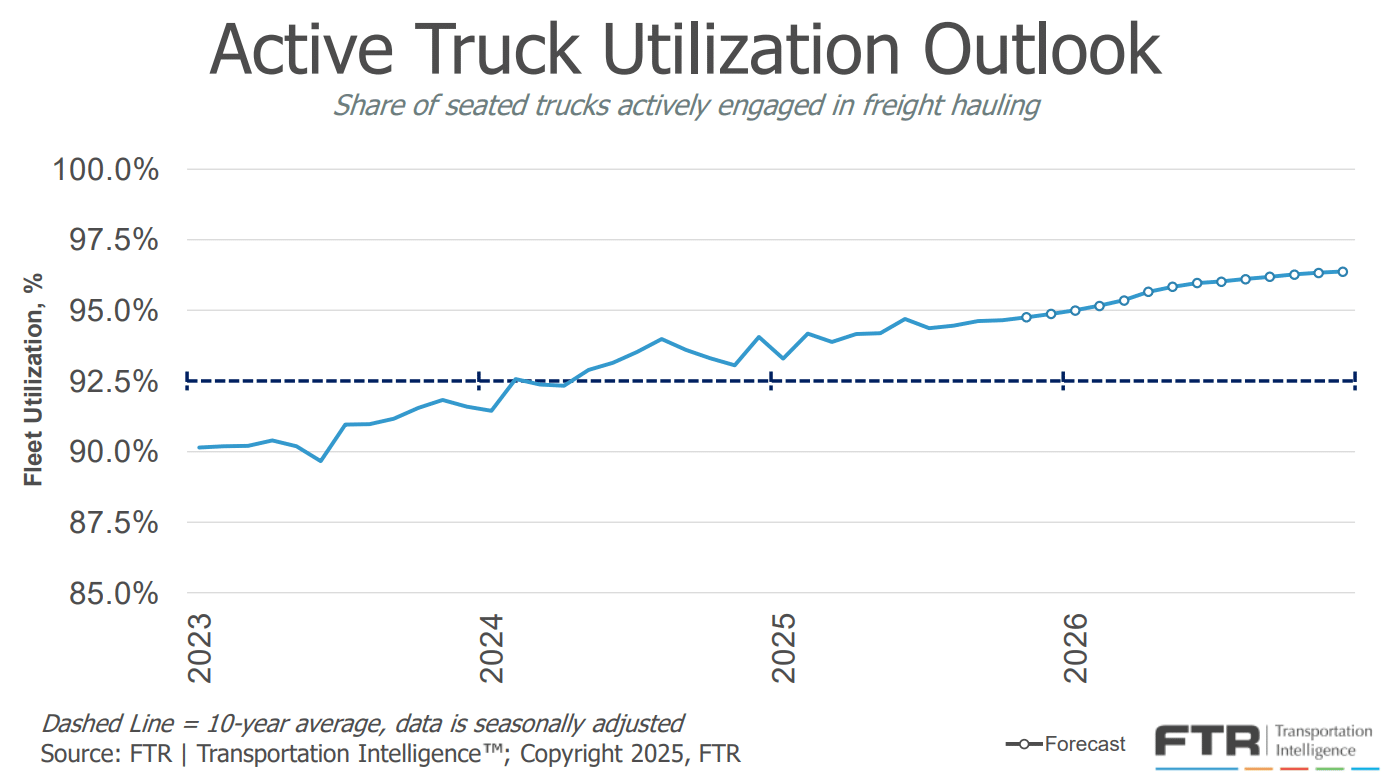
Active Truck Utilization, FTR

Chart Notes
  • Truck utilization forecast mostly unchanged: FTR’s outlook on utilization did not change meaningfully, but did note continued caution around the impact of enforcement on foreign drivers in 2026.

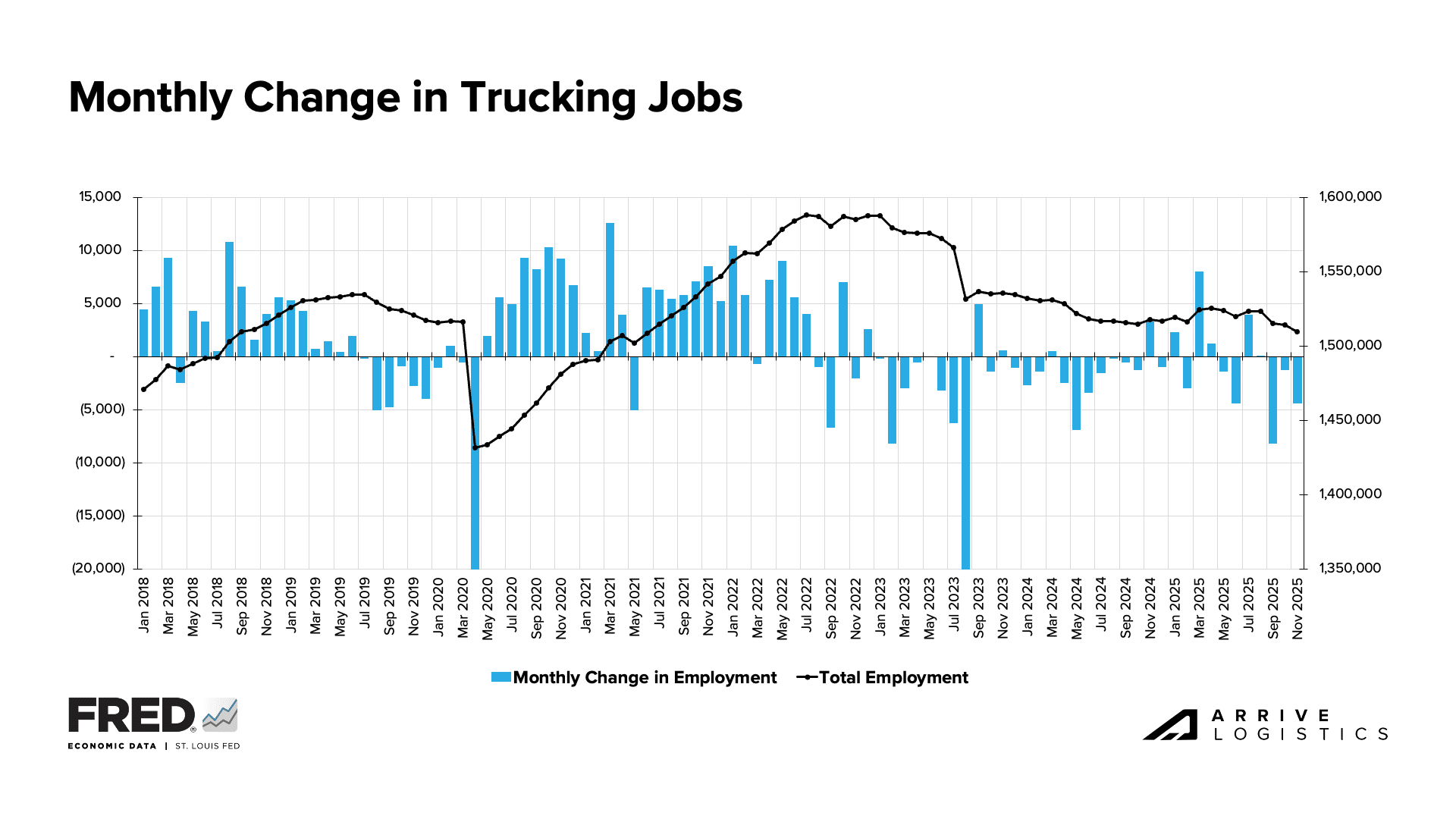
Monthly Change in Trucking Jobs, FRED Economic Data

  • Employment declines: Nearly 14,000 truck transportation jobs were lost over the past three months, marking the largest decline over that span since October 2023. Total employment now sits at its lowest level since June 2021 and about 0.5% below February 2020 levels.

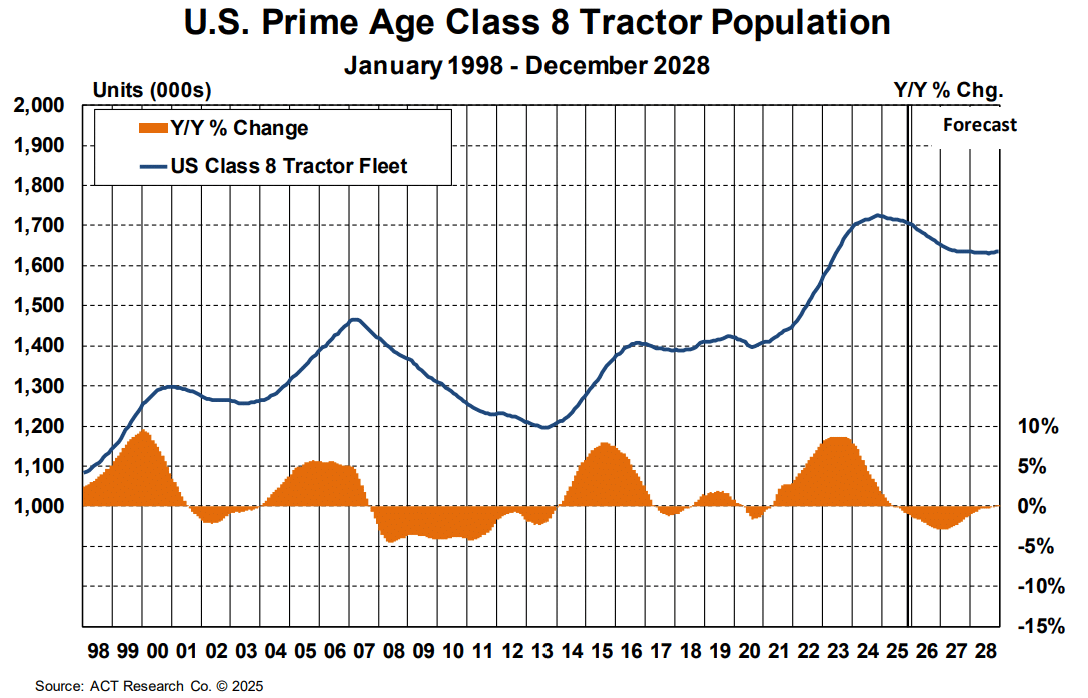
U.S. Prime Age Class 8 Tractor Population, ACT Research

Chart Notes
  • Negative tractor population growth accelerated in Q4: Class 8 tractor counts are down 1.0% year-over-year, with an additional 3.1% decline expected in 2026 and 1.2% in 2027. Decline rates doubled in Q4 after moving lower by roughly 10 basis points per month through the first three quarters.

For-Hire Driver Availability Index, ACT Research

Chart Notes
  • Driver availability not tightening or loosening: ACT Research’s Driver Availability Index showed pressure in both directions. Fleets are not struggling to hire drivers overall, but finding quality drivers is more challenging.

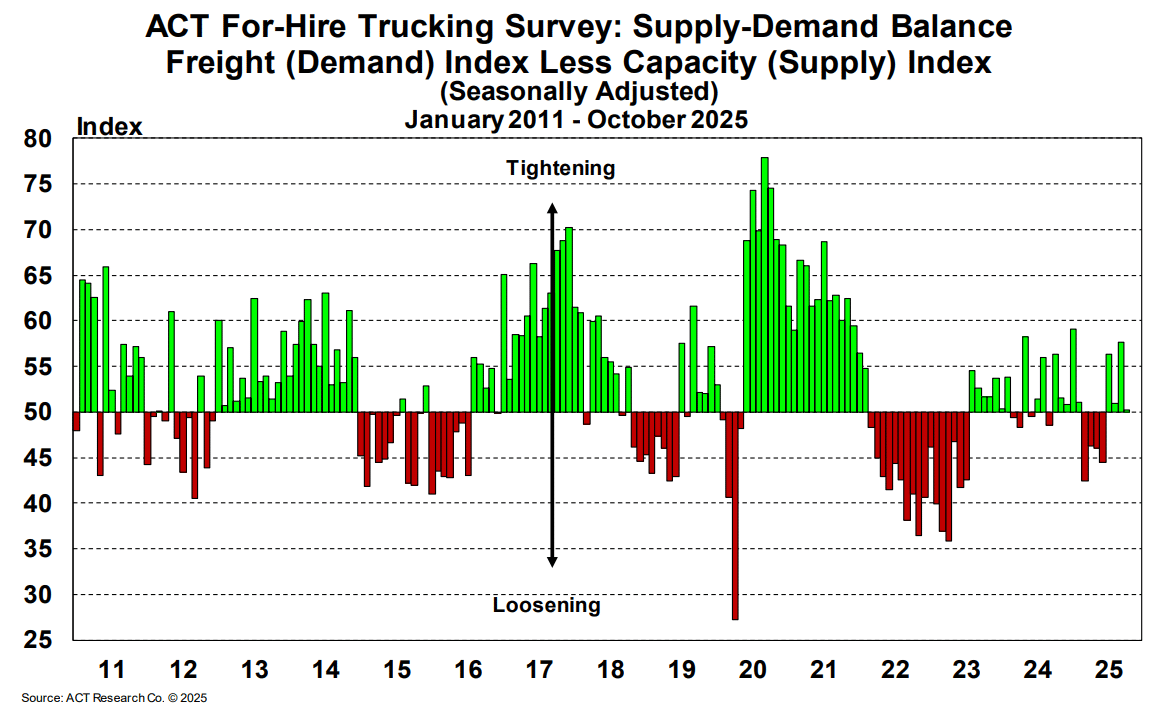
For-Hire Trucking Survey: Supply-Demand Balance, ACT Research

Chart Notes
  • Demand weakness expected to drive softer market balance: ACT reports that weakening economic activity and declining imports will continue to weigh on freight volumes. As a result, capacity is expected to contract, keeping the market at or near equilibrium.

Truckload Rates

Looking Back

Spot rates climbed quickly as tender rejections soared in early December, driven by winter weather, seasonal demand and holiday-related drivers taking time off. The spot–contract rate gap also tightened to cycle lows as disruption intensified.

Looking Ahead

Rates are expected to follow typical seasonal patterns through year-end, with volatility driven by weather and seasonal demand spikes. Beyond the holidays, rates are likely to settle back to an elevated floor, but a meaningful recovery remains unlikely until volumes make a sustained rebound.

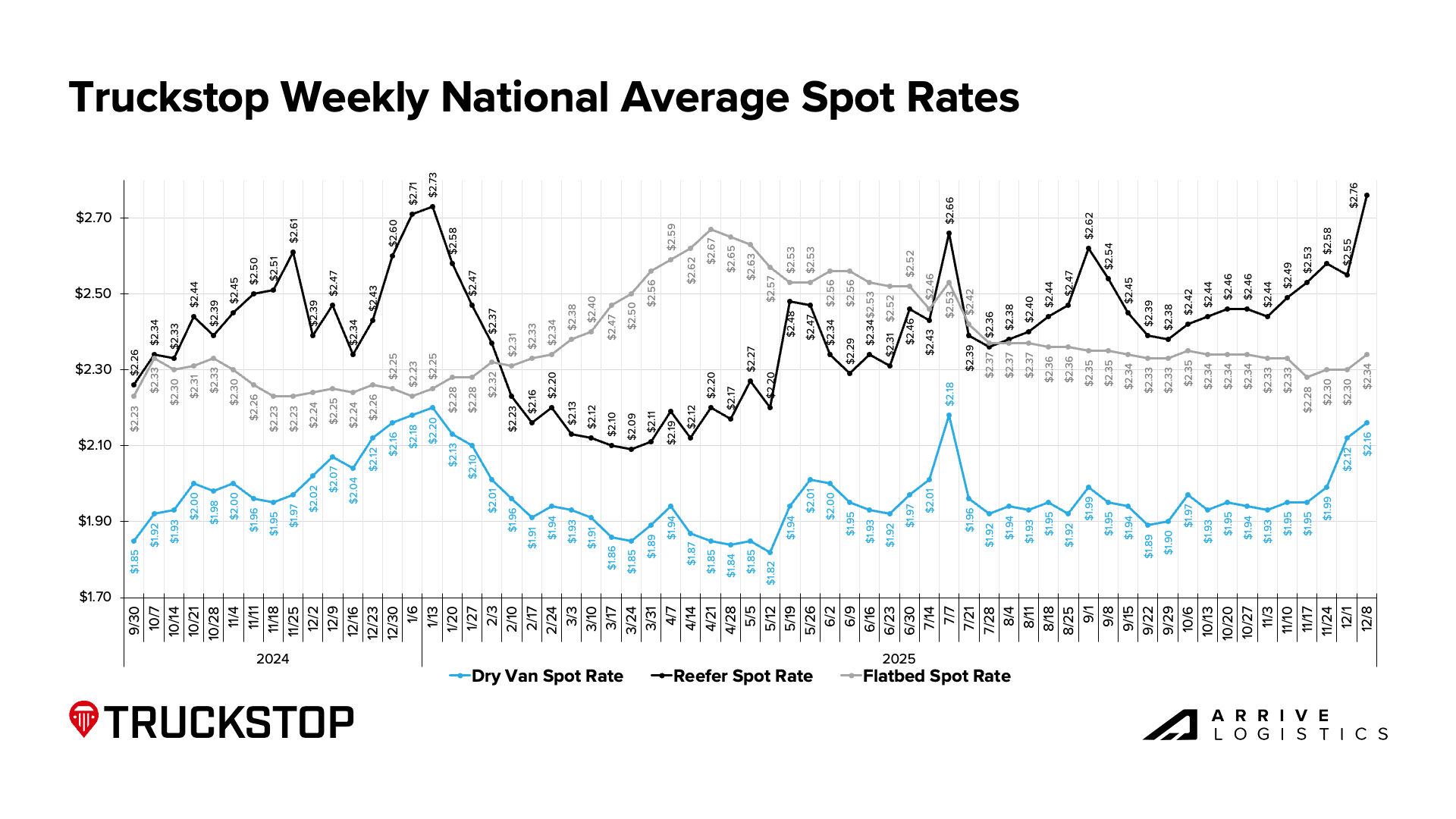
Truckstop Weekly National Average Spot Rates

Chart Notes
  • Van and reefer rates spike in early December: Van rates spiked in early December amid peak season demand pressure and increased spot activity as weather caused travel disruptions across large areas of the Midwest and Northeast.

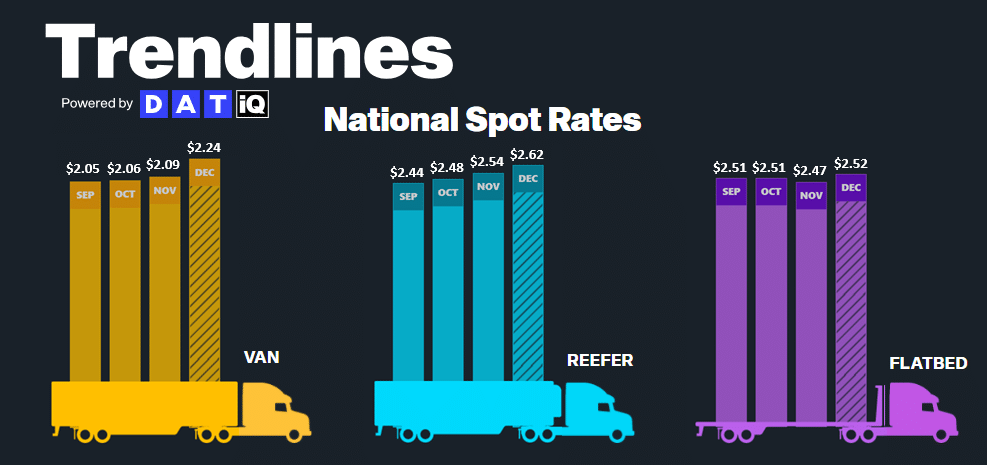
DAT Monthly Rate Trends

Chart Notes
  • Rates up across all equipment types in December: All-in rates have climbed nearly $0.20 per mile since September for both van and reefer equipment, signaling strong seasonal rate volatility, while flatbed rates have remained relatively stable. Declining fuel surcharges mean linehaul rates have increased at a faster rate.

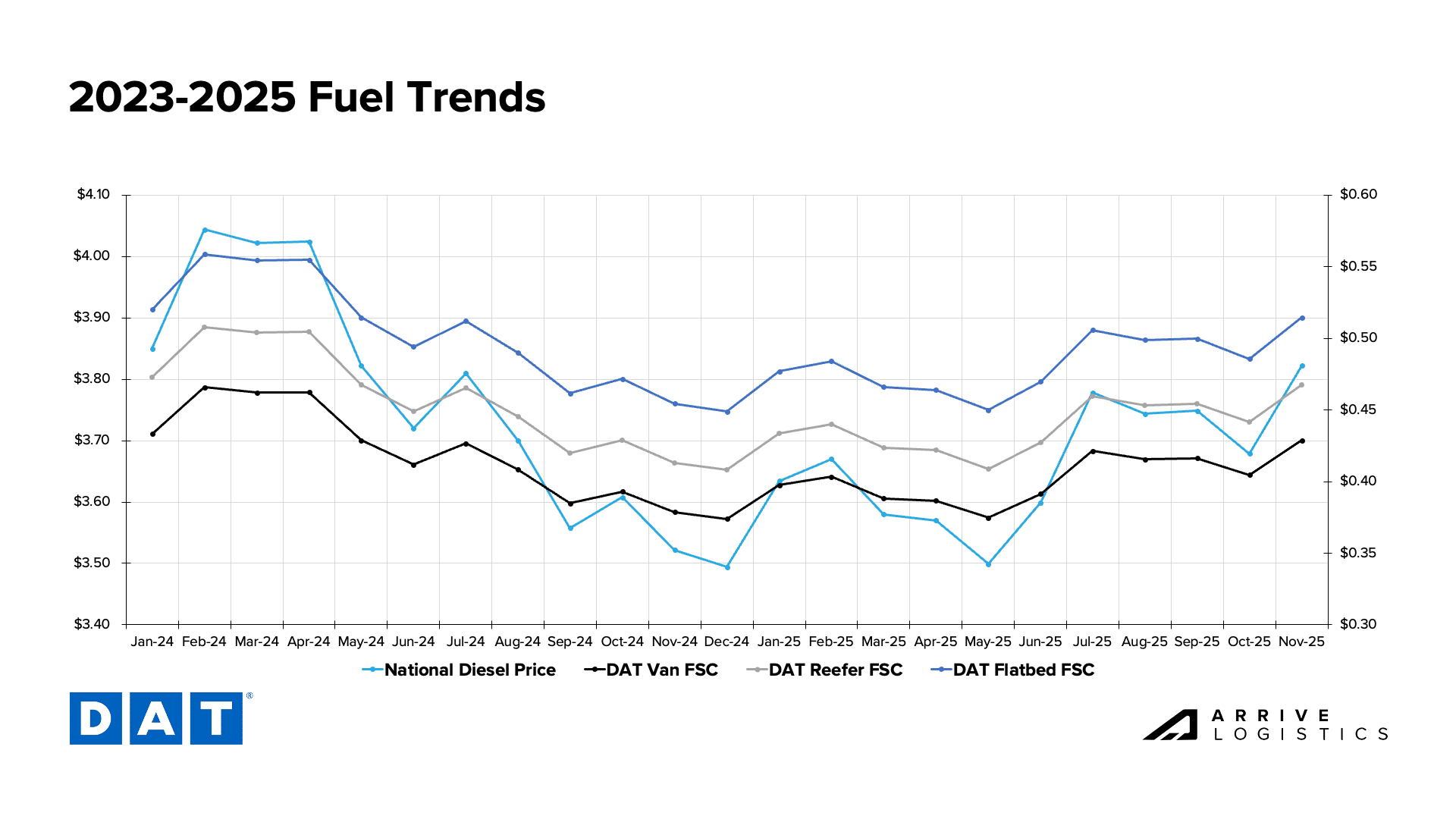
DAT Fuel Trends

Chart Notes
  • Diesel prices stable: Prices have remained in a tight range over the past few months, keeping fuel costs steady. The U.S. Energy Information Administration’s latest forecast calls for modest increases but overall stability.

DAT Dry Van National Average RPM Spot vs. Contract

Chart Notes
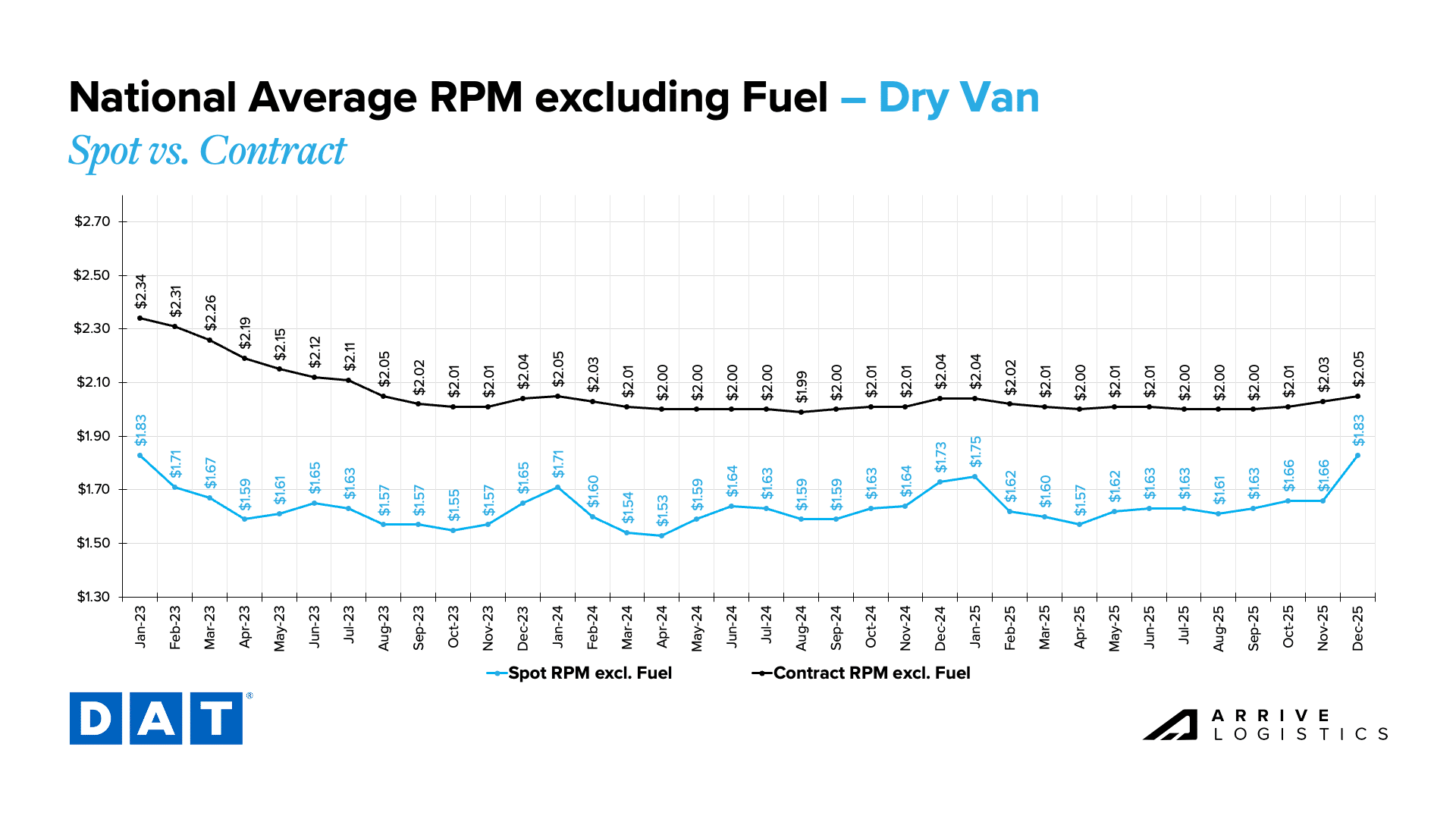
  • Spot-contract gap closes rapidly: The dry van spot-contract gap has narrowed to just $0.22 after hovering between $0.35 and $0.43 per mile over the past nine months. A narrower gap signals greater market sensitivity to disruption, but the gap is expected to widen as seasonal tightness fades and spot rates return to a February floor consistent with prior-year trends.

DAT Temp Controlled National Average RPM Spot vs. Contract

Chart Notes
  • Reefer spot-contract gap closing rapidly: The reefer spot-contract gap hovered between $0.33 and $0.36 per mile from May to September but has since narrowed to $0.18 in December amid a spike in spot rates. While a smaller gap typically signals greater market sensitivity to disruption, seasonal fading of spot rates should reduce market vulnerability in Q1.

DAT Flatbed National Average RPM Spot vs. Contract

Chart Notes

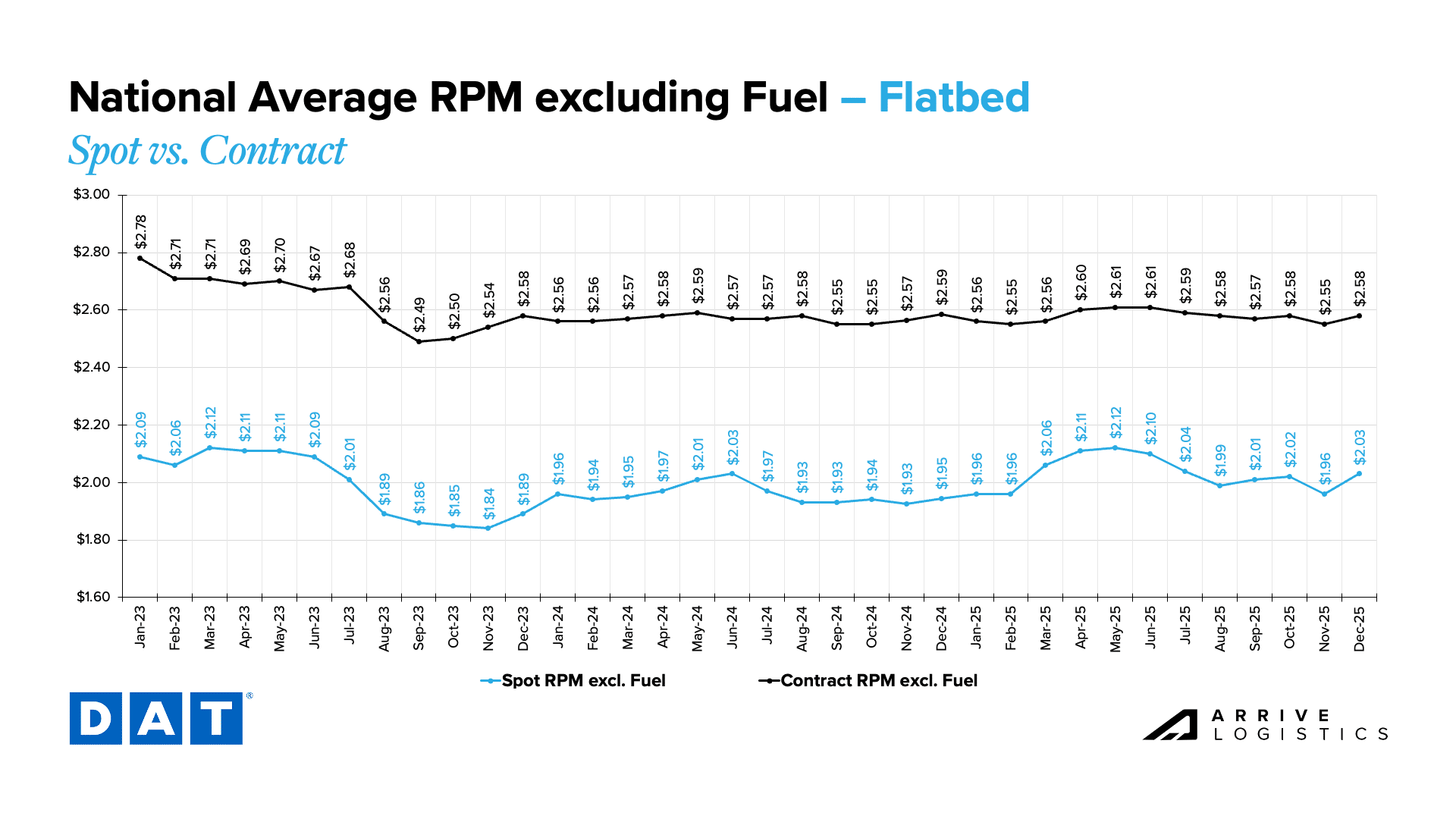
  • Flatbed linehaul rates show stable year-over-year growth: After strong early-season gains, flatbed spot linehaul rates leveled off in the summer months. Rates rose between 3.4% and 4.1% from June through October and are currently up just 4.4% year-over-year in December.

Economic Conditions

Looking Back

Manufacturing remained under pressure through November, with new orders and overall PMI weakening and a large share of manufacturing GDP in strong contraction. Warehouse utilization also declined for the first time in the Logistics Managers Index history as front-loaded inventories were reduced rather than replenished.

Looking Ahead

A manufacturing recovery will depend on how business investment responds to trade developments. Inventory replenishment could drive demand in Q1, but tariff-related cost pressure at the shipper level risks pushing inflation higher and weighing on consumer demand. Tariffs, inflation and the upcoming midterm elections all remain risks heading into 2026.

Bank of America Total Card Spending, Bank of America Consumer Checkpoints

Chart Notes
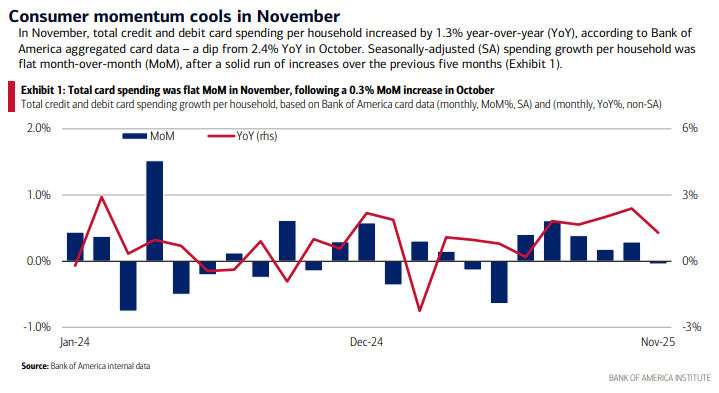
  • Consumer spending increases in November: Bank of America (BoA) reported household spending rose 1.3% year-over-year in November, with virtually no change month-over-month, breaking five consecutive months of growth. BoA also reported spending on “holiday items” was up 4.9% year-over-year as of early December, supporting the NRF outlook for a record retail spending season.

Navigate the freight market
with confidence.

Get this free report delivered straight to your inbox every month.

Start shipping with Arrive

"*" indicates required fields

This field is hidden when viewing the form

Matt Pyatt, Chief Executive Officer

Matt Pyatt is the Chief Executive Officer of Arrive Logistics. He co-founded Arrive with President Eric Dunigan in 2014 after building his career at Command Transportation. As CEO, he is responsible for overseeing the company’s financial health, strategic vision and culture, as well as building a scalable leadership team to support Arrive’s growth.

Subscribe to receive freight market updates​​

"*" indicates required fields


Subscribe to receive freight market updates

Quick Apply

"*" indicates required fields

Max. file size: 50 MB.

Arrive Carrier Requirements

Please have the following info ready to complete registration

  • MC, MX, DOT, or state reg #
  • Tax ID & W9 info
  • Cert of Insurance: $100k cargo, $1M Auto, & $1M commercial general liability coverage
  • Active Common or Contract Authority (365+ days)
  • Safety Rating of at least Satisfactory (or None)

Fraud Prevention

Freight fraud continues to impact our industry. We encourage shippers and carriers to reach out to Arrive immediately if there is ever a shipment in question that may be subject to fraud (including fictitious actors and websites). Arrive will not ask you to pay upfront for any dedicated lane or committed capacity program. If the offer you are receiving sounds too good to be true or unrealistic, it may be fraud. Arrive Logistics recommends verifying all communications come from our registered email domain is @arrivelogistics.com. Our 24/7 phone number is 888-861-0650 and our leadership team can also be reached at feedback@arrivelogistics.com.

Use of Cookies

We use cookies to enhance your browsing experience, serve personalized ads or content, and analyze site traffic. By continuing to use this website, you acknowledge and consent to our use of cookies as detailed in our privacy policy.

Get Access to the Shipper Portal

Current Customers

Already shipping with Arrive?

Connect with your representative to get access to your ARRIVEnow Shipper Portal. Can’t connect with your rep? Use this form to reach out.

New Customers

Not shipping with Arrive yet?

If you’re not an Arrive customer, please join our network to access the portal.

Carrier Scorecard Feedback

Contact Us

"*" indicates required fields

Scott Sandager,
Chief Administrative Officer 

Scott Sandager is the Chief Administrative Officer at Arrive Logistics. He joined Arrive in 2018, bringing over 14 years of logistics and brokerage experience, with expertise in project and change management, organizational design, talent development and customer satisfaction. Scott previously held many diverse roles of increasing responsibility with AFN, a Chicago-based freight brokerage.

Eric Dunigan,
President & Co-Founder

Eric Dunigan is the President of Arrive Logistics. He began his career at Command Transportation before co-founding Arrive with Matt Pyatt in 2014. As president, he is responsible for driving revenue and growth, as well as leading the Strategic Partnerships team — a veteran group of supply chain experts who work with Arrive’s customers to reimagine their shipping strategy.

Start shipping with Arrive

"*" indicates required fields

This field is hidden when viewing the form
Arrive Logistics VP of Market Intelligence David Spencer Headshot

David Spencer,
VP of Market Intelligence

David Spencer is the Vice President of Market Intelligence at Arrive Logistics. David joined Arrive in 2017 after spending six years at AFN focused on business intelligence. His department provides critical market data and expert analysis to internal teams and publishes monthly market updates for shippers and carriers under the Arrive Insights banner.

Andrew Clarke, Board Chair,
Arrive Logistics and Global Critical Logistics

Andrew Clarke is Board Chairman for Global Critical and DCLI, Inc., and a board member for Arrive Logistics and Element Fleet Management Corp. His 20 years of global transportation and logistics experience include time as CFO of C.H. Robinson, CEO of Panther Expedited Services, Inc. and SVP and CFO roles at Forward Air Corporation.

Dean Croke,
Principal Analyst
at DAT Freight and Analytics

Dean Croke is a Market Analyst at DAT Solutions, where he focuses on freight market intelligence and data analytics. His 35 years of experience with data analytics, transportation, supply chain management, mining and insurance risk management include time as co-founder of FleetRisk Advisors and in a number of other high-level roles with FreightWaves, Spireon, Lancer Insurance, Omnitracs Analytics (formerly Qualcomm) and more.

Asanka Jayasuriya,
CTO and Partner at 8VC

Asanka Jayasuriya is the CTO at 8VC. He is an accomplished engineering and product leader with 20+ years of experience in the cloud. He has a strong background in enterprise SaaS, PLG products, infrastructure, and security. Notably, he served as CTO and SVP of Engineering at SailPoint, leading their successful transition to the cloud and successful exit event. He also held senior leadership roles at InVision, Atlassian, and Amazon, driving growth, operational excellence, and innovation. At 8VC, Asanka works with the entrepreneurs and leaders in our portfolio as a virtual CTO supporting their growth.

Chad Eichelberger,
President at Reliance Partners

Chad Eichelberger is the President of Reliance Partners. Since 2015, he’s leveraged his extensive experience in risk management, compliance, best practices and contracts to lead the company’s logistics and truck insurance strategy and operations. Chad was previously the President of Access America Transport, where he led the company from $8M to over $600M in revenue.

Barry Conlon,
CEO & Founder at Overhaul

Barry Conlon is the CEO and founder of Overhaul, the global leader in active supply chain risk management and intelligence. With a remarkable career spanning over 30 years in supply chain security, he is widely regarded as a trailblazer in modern-day supply chain security standards and best practices.

Tim Denoyer,
VP and Senior Analyst at ACT Research

As VP and Senior Analyst at ACT Research, Tim analyzes commercial vehicle demand and alternative powertrain development (i.e. electrification), and authors the ACT Freight Forecast, U.S. Rate and Volume Outlook. He previously spent fifteen years in equity research focused primarily on the transportation, machinery, and automotive industries, and co-founded leading equity research firm Wolfe Research.

Request Arrive's SOC 2 Report

Download December 2025 Freight Market Update

Download this Report

"*" indicates required fields

Add me to the monthly distribution

function custom_enqueue_script() { ?>